
Loading, please wait...
LOT 0307
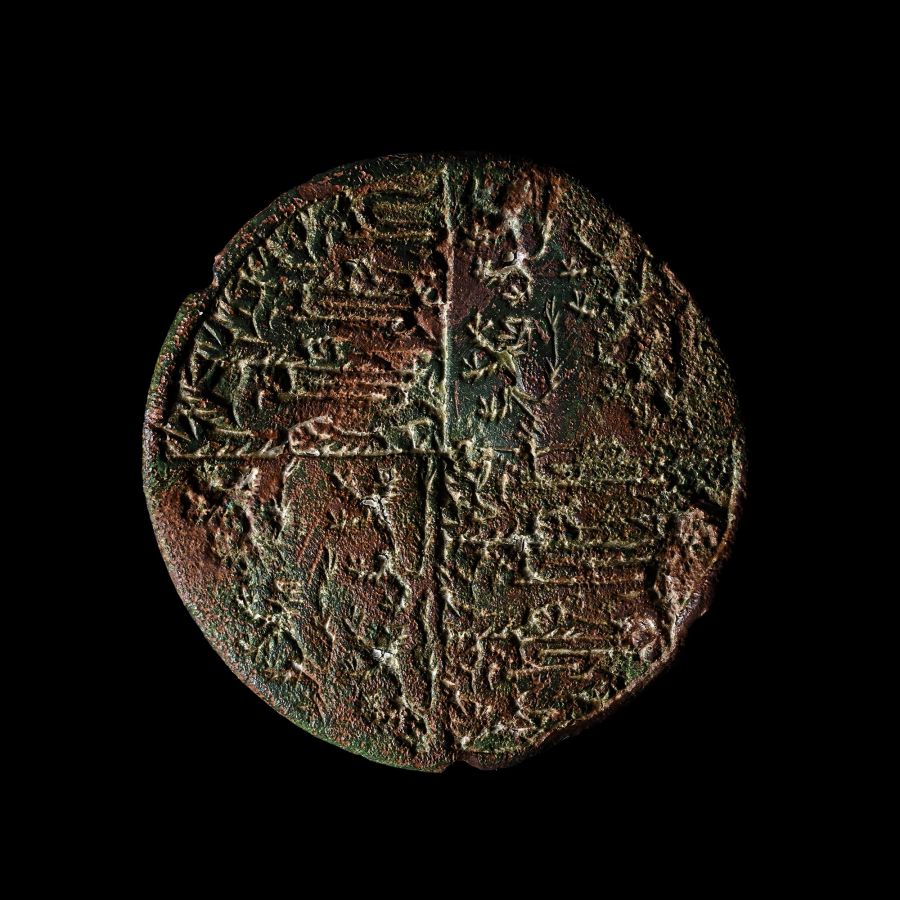
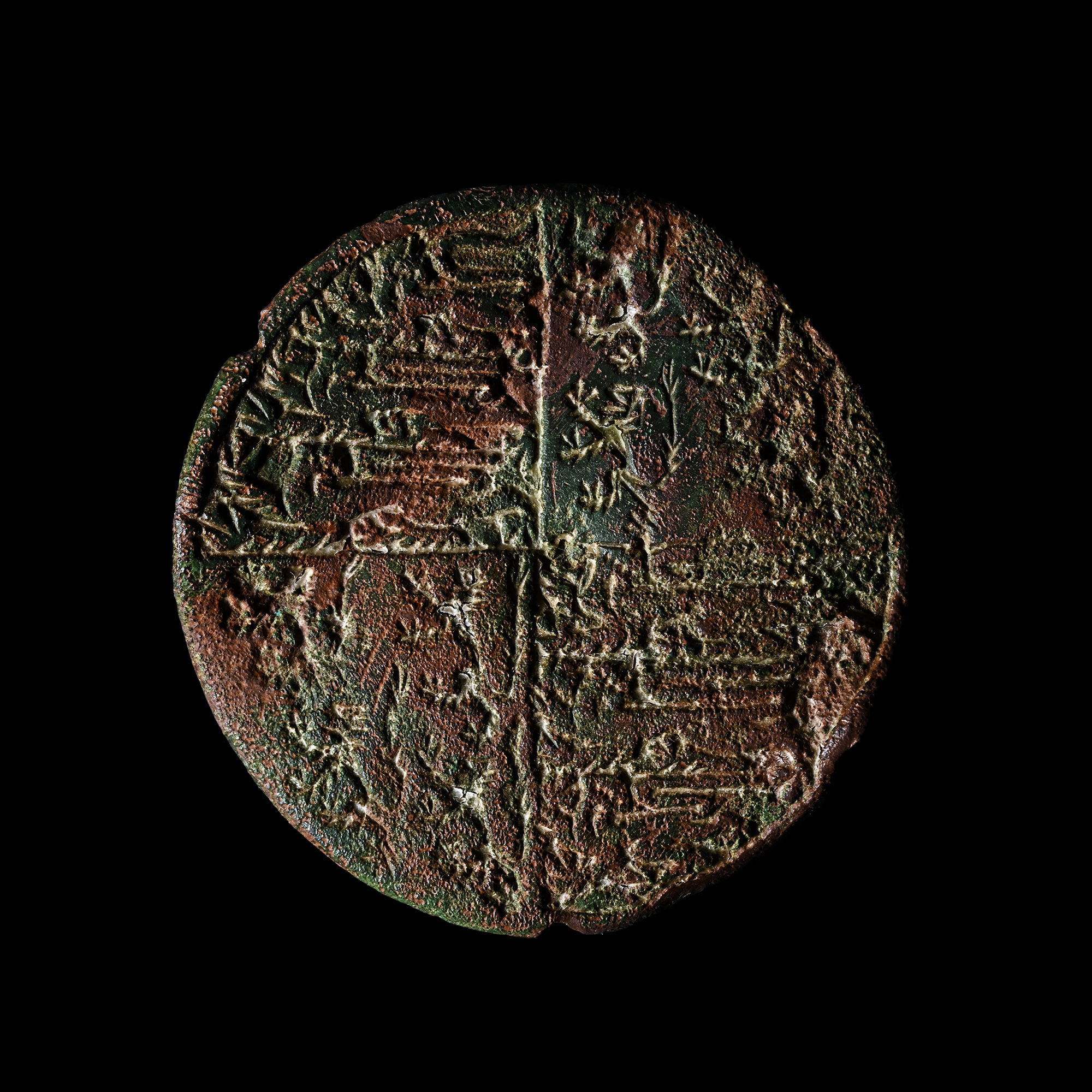
Royal Medieval Bronze Carriage Plate of Edward III and his Wife Queen Philippa of Hainault
ENGLAND, 1327-1377 A.D.
2 3/8 in. (37.2 grams, 59 mm).
Discoid appliqué, flat in section and slightly distorted; incuse heraldic detailing to obverse blazoned 'Quarterly 1st and 4th Gules three lions passant guardant [Or] 2nd and 3rd [Or] four lions rampant [in a quadrangle] the 1st and 4th Sable the 2nd and 3rd [Gules]'.
ProvenanceFound Lowick, East Northamptonshire, UK.
Accompanied by a copy of the British Museum's Portable Antiquities Scheme (PAS) report no.BH-7A9E2F.
Cf. Ashley, S., Medieval Armorial Horse Furniture in Norfolk, East Anglian Archaeology 101, Dereham, 2002, fig.20.
FootnotesThe Royal College of Arms has identified these arms as belonging to King Edward III and his wife, Philippa of Hainault (r. 1327 - 1369). The terminus post quem for this piece is therefore 1327, the date of the marriage, and the likely terminus ante quem is Edward's death in 1377. A circular mount with the same fixing method, which bore the arms of the Bishopric of Ely, was found in Norfolk and is illustrated and described by Steven Ashley (2002: Fig. 20, p. 45, no. 196). The presence of the royal arms on this piece is likely to be a public display of allegiance to the throne rather than an indication of ownership on the part of the crown.
CONDITIONTimeLine Auctions follows a vetting process to ensure the authenticity and legality of all items, reinforcing our commitment to integrity and responsible trading. Each antiquity, antique, and coin lot undergoes thorough examination by a vetting committee of at least ten external specialists, professional trade association members, scientists, and archaeologists: Our Vetting Process
AUCTIONS:
TimeLine is a leading auction house specialising in antiquities, ancient art, collectables, natural history, coins, medals, and books. Our auctions offer museums, collectors, historians, and enthusiasts the opportunity to acquire unique and historically significant pieces.
LOT 0307
Royal Medieval Bronze Carriage Plate of Edward III and his Wife Queen Philippa of Hainault
Sold for (Inc. bp): £546
-
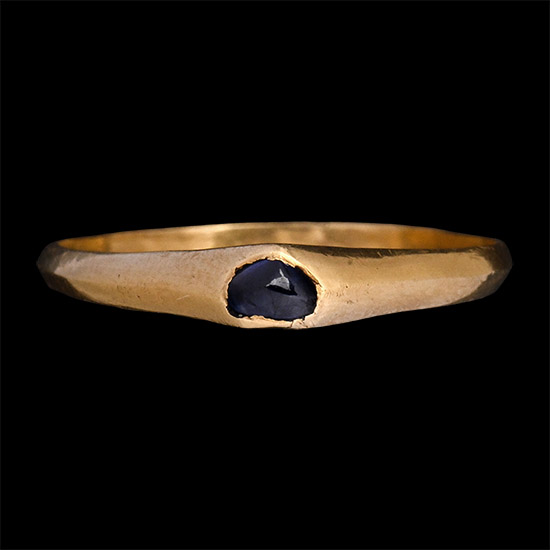
Medieval Gold Stirrup Ring with Sapphire
13th-14th century A.D.Estimate: £2,000 - 3,000 (+bp*)
Opening Bid: £1,000
Slender keeled hoop and a high bezel set with a polished sapphire cabochon. 2.24 grams, 23.70 mm overall, 18.14 x 19.03 mm internal diameter (approximate size British Q, USA 8, Europe 17.49, Japan 16)
Acquired on the European art market. This lot has been checked against the Interpol Database of stolen works of art and is accompanied by search certificate number no.13389-258004.
The style of the ring is known as a stirrup ring due to the resemblance the form has to stirrups on a horse. During the Middle Ages, gemstones were often associated with magical and protective properties that they were believed to possess. Gemstones could protect against evil or poisons, as well as heightening the individual’s characteristics and strengths. Sapphires were frequently worn by Bishops and other clergy due to their ability to promote their bearer’s chastity and piety. Sapphires were believed to be able to change colour if the wearer acted sinfully or lacked faith; it was because of this belief that jewels set with sapphires were worn as symbols of honesty and devout faith. -
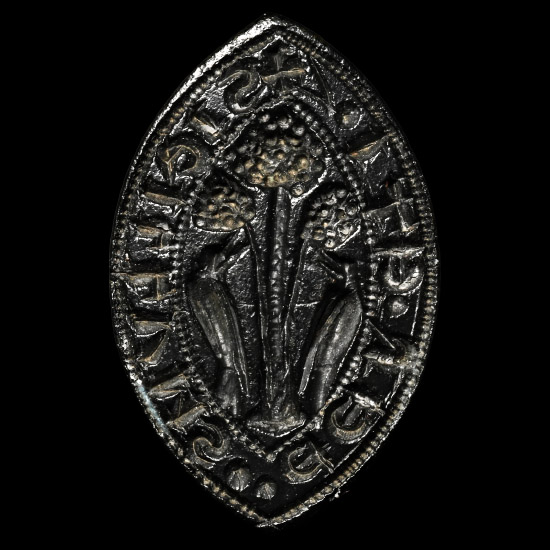
Medieval Bronze Seal Matrix with Pair of Birds
14th century A.D.Sold for (Inc. bp): £260
Vesica-shaped with a loop on the reverse, two birds flanking a tree at the centre, and the inscription likely reading ‘SIGILLVMS : EERETI’ for 'SIGILLVM SECRETI' (private seal)'. 7.66 grams, 30 mm
Acquired on the European art market. -
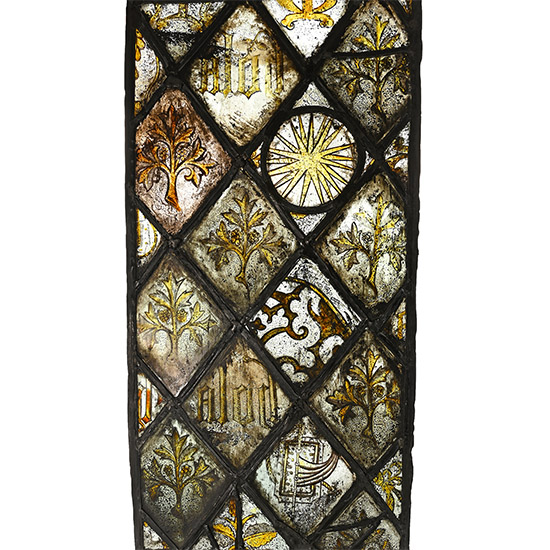
Medieval Stained Glass Panel
England or France, 15th-16th century A.D.Sold for (Inc. bp): £4,160
Rectangular panel composed of lozenge-shaped tiles with trees, scrolled motifs, a sun, and three with partial inscription. 1.9 kg, 56.6 x 29 cm
Private collection, London, UK.
