
Loading, please wait...
LOT 0130
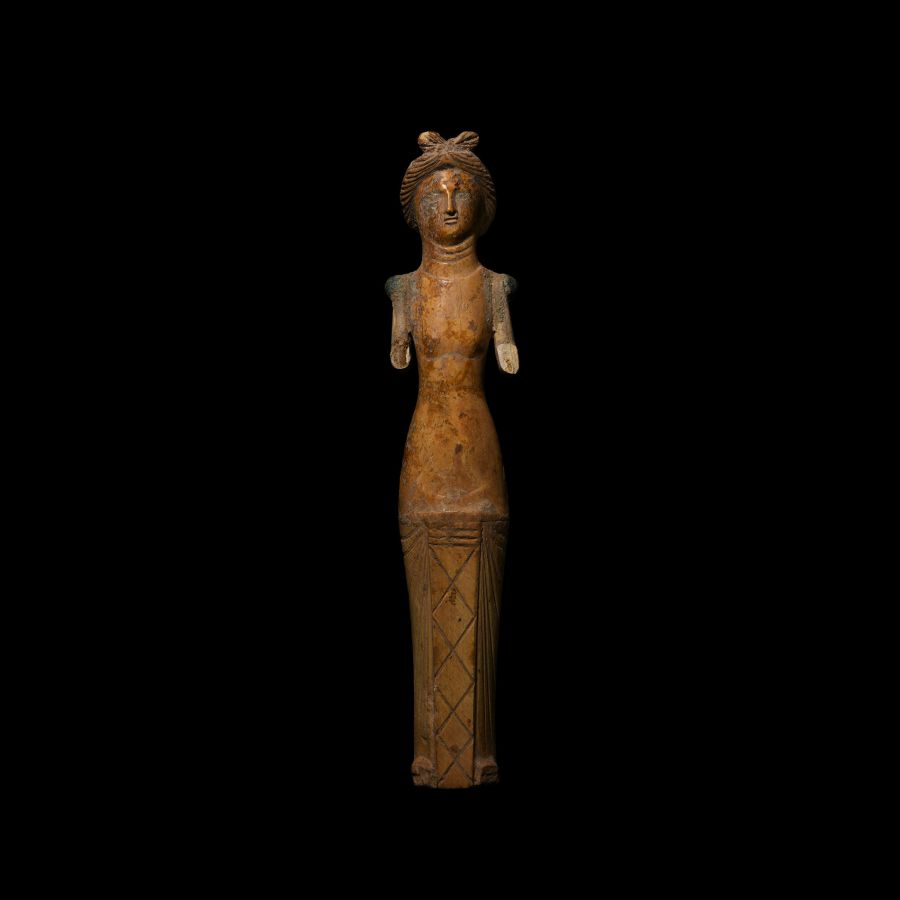
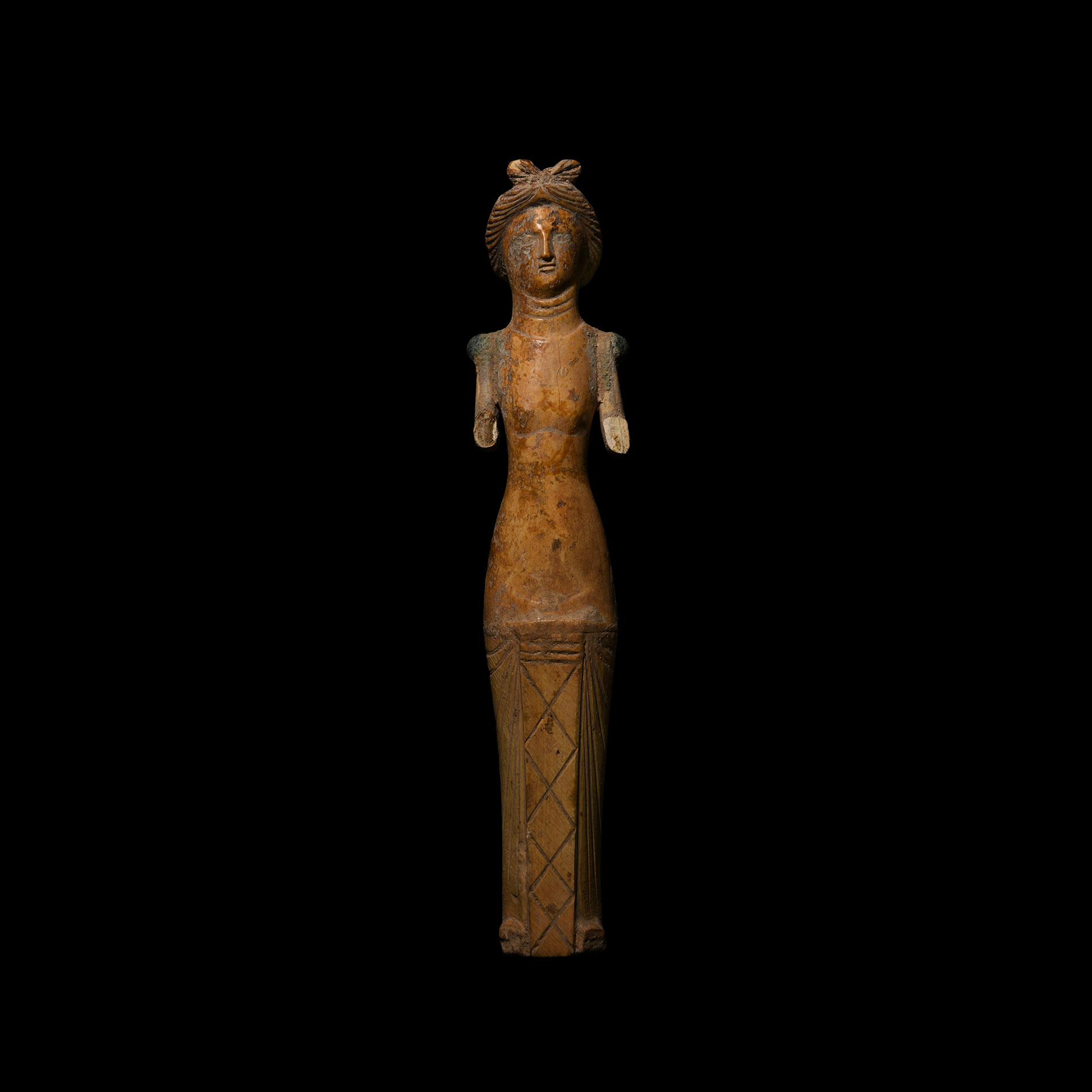
Romano-Parthian Female Bone Idol
3RD CENTURY B.C.-2ND CENTURY A.D.
7 1/2 in. (77 grams, 19 cm high).
A bone doll depicting a female figure with elaborately tied hairstyle, semi-naturalistic facial and anatomical detailing and geometric detailing to the garment wrapped around her lower body; stub arms; copper-alloy rivets to the shoulders.
Provenancewith a London, UK gallery 1971-early 2000s.
LiteratureSee The British Museum, museum number 1853,1219.60, for a comparable (partial) figure.
CONDITIONTimeLine Auctions follows a vetting process to ensure the authenticity and legality of all items, reinforcing our commitment to integrity and responsible trading. Each antiquity, antique, and coin lot undergoes thorough examination by a vetting committee of at least ten external specialists, professional trade association members, scientists, and archaeologists: Our Vetting Process
AUCTIONS:
TimeLine is a leading auction house specialising in antiquities, ancient art, collectables, natural history, coins, medals, and books. Our auctions offer museums, collectors, historians, and enthusiasts the opportunity to acquire unique and historically significant pieces.
LOT 0130
Romano-Parthian Female Bone Idol
Estimate £1,200 - 1,700€1,390 - 1,970 (for guidance only)$1,620 - 2,300 (for guidance only)
-
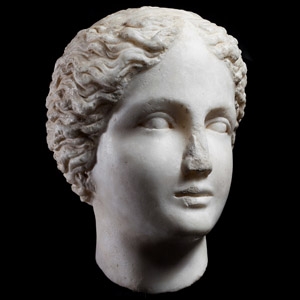
Roman Marble Head of a Young Woman
2nd century A.D.Sold for (Inc. bp): £16,900
A skilfully carved life-size marble head of a female (possibly Artemis, a Muse or an Amazon) with centrally parted hair composed of wavy strands and tied in a ponytail at the back; serene facial expression, almond-shaped eyes and small mouth with slightly parted lips; some restoration; mounted on a custom-made display stand. 14 kg total, 38 cm high including stand
Ex private collection, Monaco, 1960s-1970s. Acquired from the Monaco Fine Arts on 4th November 1992. Private collection of Mr & Mrs Daniel, Monaco. Acquired by the present owner from David Aaron Gallery in 2019. Accompanied by an academic report by Dr Raffaele D’Amato. This lot has been checked against the Interpol Database of stolen works of art and is accompanied by searcher certificate number no.11569-197722.
The youthful head seems to be based on the Greek Attic Artemis Colonna type of the 4th century B.C. The composition of the head is powerful with a serene countenance, its physiognomy replete with the idealised quality characteristic of Greek classical sculpture. This classic influence is best seen in the perfect almond- shaped eyes with their sharply carved lids as well as the smooth contour of the face. The rich handling of the coiffure and the smooth quality of the face can suggest a date sometime during the Hadrianic (117 to 138 A.D.) or early Antonine periods. -
.jpg)
Roman Terracotta Bust of a Boy
1st-century B.C.-1st century A.D.Sold for (Inc. bp): £351
A terracotta bust of a boy mounted on an integral channeled plinth base, modelled with semi-naturalistic facial features and a cropped hairstyle, wearing a bulla and a sash over the left shoulder. 341 grams, 17 cm high
Ex private German collection, 1960; thence by descent. with Auktionshaus Owl, Bielefeld, Germany, 5 September 2015, Lot 40605.
In ancient Rome, the bulla was an amulet given to every boy nine days after his birth. The meaning, origins and use of the bulla are in some ways enigmatic and still a subject of research for scholars. The bulla was worn around the neck during childhood and adolescence. Depending on the social status and wealth of the family who commissioned it, different materials were used; on rare occasions it was made fully in gold, if the child belonged to a family of the high Roman aristocracy, or more commonly made in lead covered with a gold foil. The bulla was also made for the poorer classes in lesser materials, such as fabric or leather. -
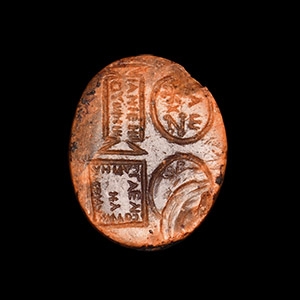
Roman Epigraphic Gemstone with Symbols
4th-5th century A.D.Sold for (Inc. bp): £910
An epigraphic gem of oval shape, with a smooth surface on one side and inscriptions of a magical-Christian nature engraved in tondos and tabulae ansatae on the other side, one bearing the Greek letters Α and ω (Alpha and Omega) above the letters I and X. 0.84 grams, 17 mm
Acquired before 1988. Ex family collection, by descent, Geneva.
The letter Alfa and Omega (A W) are a clear link with a Christian cult, especially in this case in which the two letters are incised over the other two letter Iota and Chi IX, initials of the Greek Iesus Xριστός 'Christ'. The letters Alpha and Omega are symbols of eternity of the Divine Figure (I am the Alpha and the Omega, the First and the Last, the Beginning and the End, Revelation, 22.13).
