
Loading, please wait...

LOT 0409
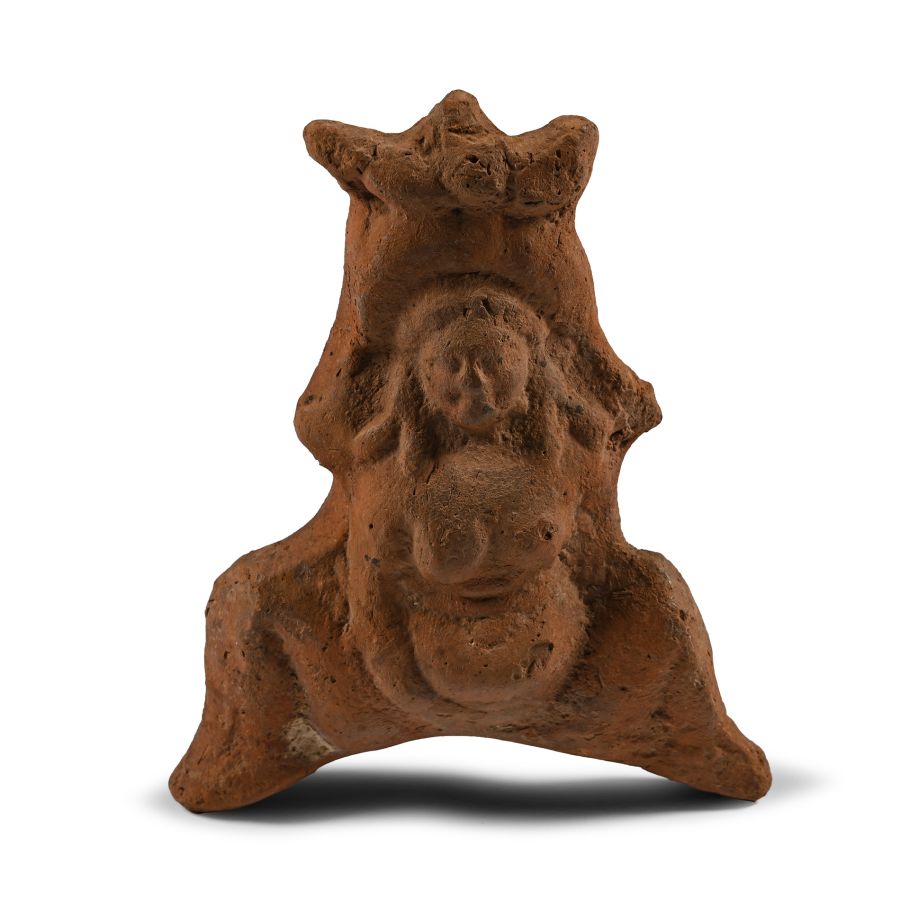
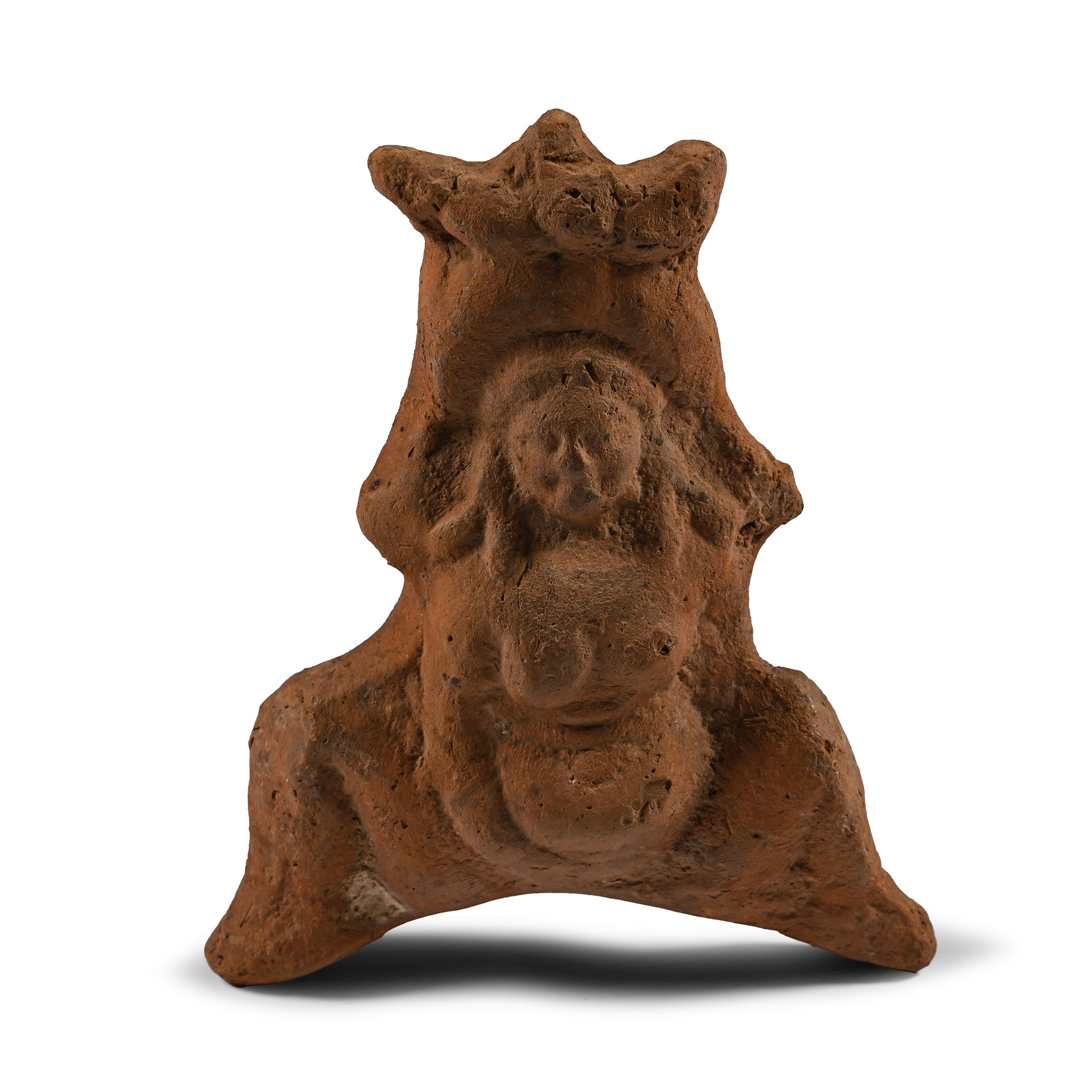
Romano-Egyptian Terracotta Figurine of Baubo
PTOLEMAIC PERIOD, 2ND-1ST CENTURY B.C.
5 1/8 in. (213 grams, 13 cm).
Modelled as a seated plump fertility figure; the right hand touching the pubic area beneath the rounded abdomen, a garland upon her propoloma and thick braids falling on her shoulders, smooth back with a vent hole. [No Reserve]
ProvenanceThe Erotica Collection Christian von Faber-Castell, Küsnacgt ZH, Switzerland, since the late 1970s.
This lot is accompanied by an illustrated lot declaration signed by the Head of the Antiquities Department, Dr Raffaele D’Amato.
Cf. Nagwa Abdelnaby, A.I., ‘Two unpublished Figurines of Women Purifying themselves in the Greco-Roman Museum of Alexandria’ in Bulletin of the Center Payrological, 38 (1), November 2021, pp.645-664, figs.3, lett. A and D.
FootnotesBaubo was a minor divinity of the Greek mythology, linked to the cult of Demeter and Persephone. The statuette belongs to the second type of Baubo figurines, widespread in the last Ptolemaic and Roman period in Egypt. The Egyptian Baubo are split into two groups, and this one belongs to the first group depicting a woman seating frontally whilst holding a musical instrument. In some of these figurines her right hand is touching her genitalia. Many of them were used as amulets or as ex-voto.
Christian von Faber-Castell (born 1950) is a renowned German entrepreneur and art collector, best known as a member of the prominent Faber-Castell family, famed for their iconic writing instruments. A passionate advocate for art and culture, Christian von Faber-Castell curated an extensive and diverse private collection of erotica, spanning centuries and cultures. His collection reflects a deep appreciation for the interplay of beauty, sensuality, and artistic expression, bringing together rare and unique works that explore themes of intimacy and human connection. Pieces from this collection have been featured in notable exhibitions and are celebrated for their artistic and historical significance. This offering represents a rare opportunity to acquire works from one of the most fascinating and eclectic private collections of its kind.
TimeLine Auctions follows a vetting process to ensure the authenticity and legality of all items, reinforcing our commitment to integrity and responsible trading. Each antiquity, antique, and coin lot undergoes thorough examination by a vetting committee of at least ten external specialists, professional trade association members, scientists, and archaeologists: Our Vetting Process
AUCTIONS:
TimeLine is a leading auction house specialising in antiquities, ancient art, collectables, natural history, coins, medals, and books. Our auctions offer museums, collectors, historians, and enthusiasts the opportunity to acquire unique and historically significant pieces.
-
Large Egyptian Bronze Statue of Khonsu
Late Period, 26th Dynasty, 664-525 B.C.Sold for (Inc. bp): £23,400
Standing in advancing pose on a rectangular base; the god modelled with a disc representing the full-moon surmounting a crescent new moon atop his head and fronted by a uraeus, the falcon-head sports a finely striated tripartite wig and with beaded silver wire frames to the (once inlaid) eyes; wearing a broad wesekh collar; the left arm bent and fist drilled to grip a staff, right arm straight to the side with similar drilled fist; pleated shendyt kilt and belt to the hips; mounted on a tiered socle base. 896 grams total, 27 cm including stand
Very fine condition.
Smith family collection, Cambridge, UK since 1949. Private UK collection since 1978. Accompanied by a scholarly note by Egyptologist Paul Whelan. This lot has been checked against the Interpol Database of stolen works of art and is accompanied by search certificate number no.11033-183985. This lot has been cleared against the Art Loss Register database, and is accompanied by an illustrated lot declaration signed by the Head of the Antiquities Department, Dr Raffaele D’Amato.
The moon god Khonsu (whose name means 'wanderer', referring to the passage of the moon across the sky) is known as a blood-thirsty sky-deity in the Pyramid Texts. In New Kingdom Thebes, however, he was regarded as a far more benevolent deity, being the child of Amun and Mut, and provided with his own temple at Karnak. There, he was considered to control destiny. Khonsu can appear in human form with a side-lock of youth, wearing an enveloping garment, and holding royal regalia, and also as a falcon-headed man with the full moon and crescent new moon headdress, as with this fine example. In his falcon-headed form he frequently holds an ankh symbol and a was-sceptre, for which the hands of this piece were drilled to accept the god's well-known attributes. -
Romano-Egyptian Terracotta Figure of Baubo
Ptolemaic Period, 2nd-1st century B.C.Estimate: £700 - 900 (+bp*)
Opening Bid: £350
The squatting figure depicted nude, a garland upon her propoloma and thick braids falling on her shoulders, her legs bent and spread wide, her right hand touching her genitals and the left hand raised holding a lotus flower. 375 grams, 15.8 cm
with Superior Galleries, Los Angeles, USA. Ex Dr W. Benson Harer, Los Angeles, USA, March 1985. This lot is accompanied by an illustrated lot declaration signed by the Head of the Antiquities Department, Dr Raffaele D’Amato.
Baubo was a minor divinity of the Greek mythology, linked to the cult of Demeter and Persephone. The statuette belongs to the second type of Baubo figurines, widespread in the last Ptolemaic and Roman period in Egypt. The Egyptian Baubo figures are split into two groups, and this one belongs to the first group depicting a woman seating frontally whilst holding a musical instrument. In some of these figurines her right hand is touching her genitalia. Many of them were used as amulets or as ex-voto. -
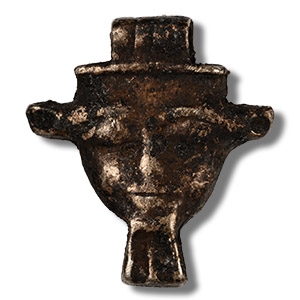
Egyptian Silver Hathor Amulet
Late-Ptolemaic Period, 664-30 B.C.Sold for (Inc. bp): £98
D-shaped mask representing the human-headed Hathor with cow ears and a short beard, with a ribbed suspension loop above. 0.66 grams, 10 mm
From an early 20th century collection. This lot is accompanied by an illustrated lot declaration signed by the Head of the Antiquities Department, Dr Raffaele D’Amato.
