
Loading, please wait...


LOT 2018
Romano-Egyptian Style Fayum Portrait of a Woman
20TH CENTURY A.D.
18 1/2 x 13 1/4 in. (1.73 kg total, 47 x 33.8 cm including frame).
Portrait of a young woman, her head turned slightly to the right, with an oval face, thin almond-shaped eyes, and a large mouth with full lips; her curly hair arranged above her forehead in a series of rich curls; her clothing consisting of a pink tunic visible at the neck and shoulders; encaustic on wood. [No Reserve]
ProvenancePrivate collection of Dr Fred Olsen (1891-1986) and Mrs Florence Ellen Olsen (née Quittenton, d.1996), Guilford, Connecticut, by at least 1961.
Exhibited at 'Coptic Art', The Minneapolis Institute of Art, Minneapolis, Minnesota, 5 December 1961-7 January 1962, no.L-380-2, loan number L61.711.
Coptic Art, Des Moines Art Center, Des Moines, Iowa, 16 February-1 April 1962, no.L-380-2.
LiteratureCf. Parlasca, K., Frenz, H.G., Ritratti di Mummie, Repertorio d’arte dell’Egitto Greco-Romano, Roma, 2003, no.698, for similar.
FootnotesFayum portraits, painted on wood or linen, applied to the mummies of the Graeco-Roman period, are one of the most wonderful legacies that the koiné of the Graeco-Roman world has left us. Due to the favourable climate enhancing the state of preservation, these encaustic paintings have left us an almost photographic testimony of the faces of the inhabitants of Roman Egypt.
CONDITIONTimeLine Auctions follows a vetting process to ensure the authenticity and legality of all items, reinforcing our commitment to integrity and responsible trading. Each antiquity, antique, and coin lot undergoes thorough examination by a vetting committee of at least ten external specialists, professional trade association members, scientists, and archaeologists: Our Vetting Process
AUCTIONS:
TimeLine is a leading auction house specialising in antiquities, ancient art, collectables, natural history, coins, medals, and books. Our auctions offer museums, collectors, historians, and enthusiasts the opportunity to acquire unique and historically significant pieces.
-
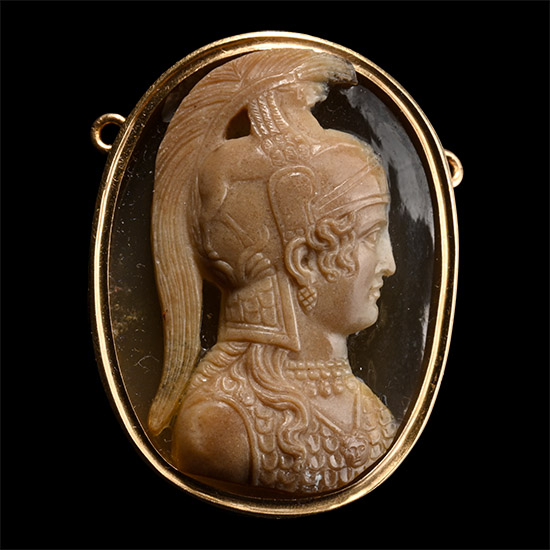
Sardonyx Cameo of the Greek Goddess Athena in Gold Mount
Europe, 18th century A.D.Sold for (Inc. bp): £1,690
Finely carved, high-relief cameo depicting profile bust of the goddess, wearing a plumed helmet with the crest supported by a winged Pegasus, her hair modelled in soft curls framing the face and falling over the shoulder above articulated lorica (battle armour); small grape-shaped earrings and multiple necklaces carefully rendered, creating an appealing contrast between martial attributes and feminine ornament; set in an unmarked, high-carat gold frame, probably struck and finished in England after the gem’s return from the Grand Tour, two lateral suspension loops. 14.98 grams, 36 mm
Acquired on the European art market.
The relief shows confident toolwork: crisp contours to the facial profile, detailed treatment of the helmet and feathers, and subtle gradations of planes between the figure and the background. -
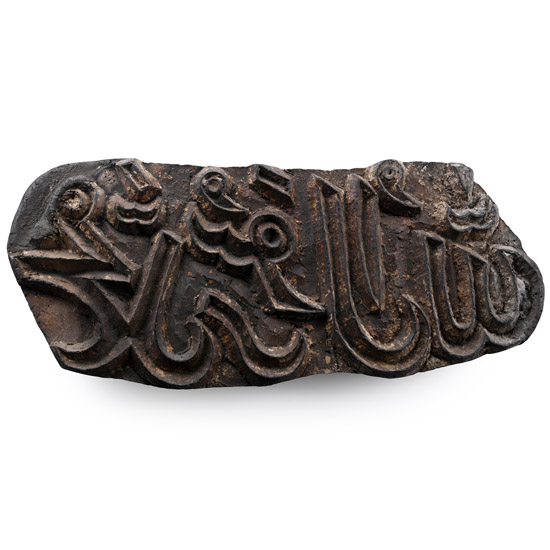
Wooden Bread Stamp with 'Mohammed Prophet of God' Inscription
Early 19th century A.D.Estimate: £400 - 600 (+bp*)
Opening Bid: £222
Subrectangular in plan with rounded ends, applied handle to reverse with modern hanger; high-relief calligraphic text. 865 grams, 32 cm
London, UK, collection. -
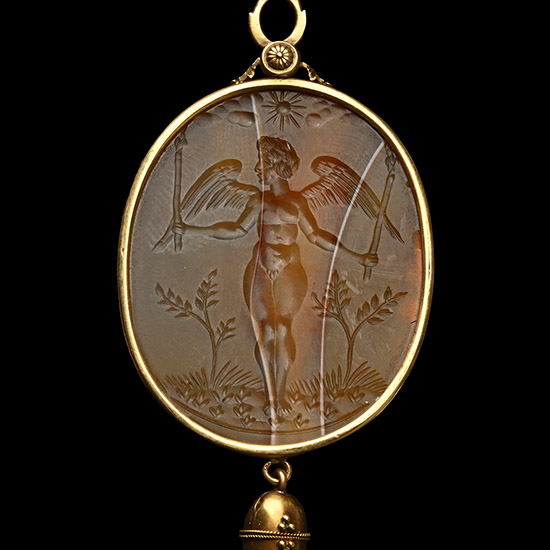
Renaissance Gold Pendant with Agate Gemstone of Cupid
Italy, late 16th-early 17th century A.D.Sold for (Inc. bp): £3,640
Cupid shown standing amid the vegetation, his wings and arms spread and holding two short staffs in his hands, clouds and the sun above; set in a gold frame with a conical pendant drop below; supplied with a museum-quality impression. 13.53 grams, 75 mm
Acquired on the European art market. This lot has been checked against the Interpol Database of stolen works of art and is accompanied by search certificate number no.13341-257981.
The cameo shows a Cupid in the same style as the one in the British Museum Sloane collection. Cupid was a very popular motif in 17th-century Italian artistic production. The presence of Cupid on the cameo implies amorous attachment, or sometimes, amorous conflict. The cameo shows a sophisticated atmosphere, relayed in the brown and grey colours.
