
Loading, please wait...
LOT 0481
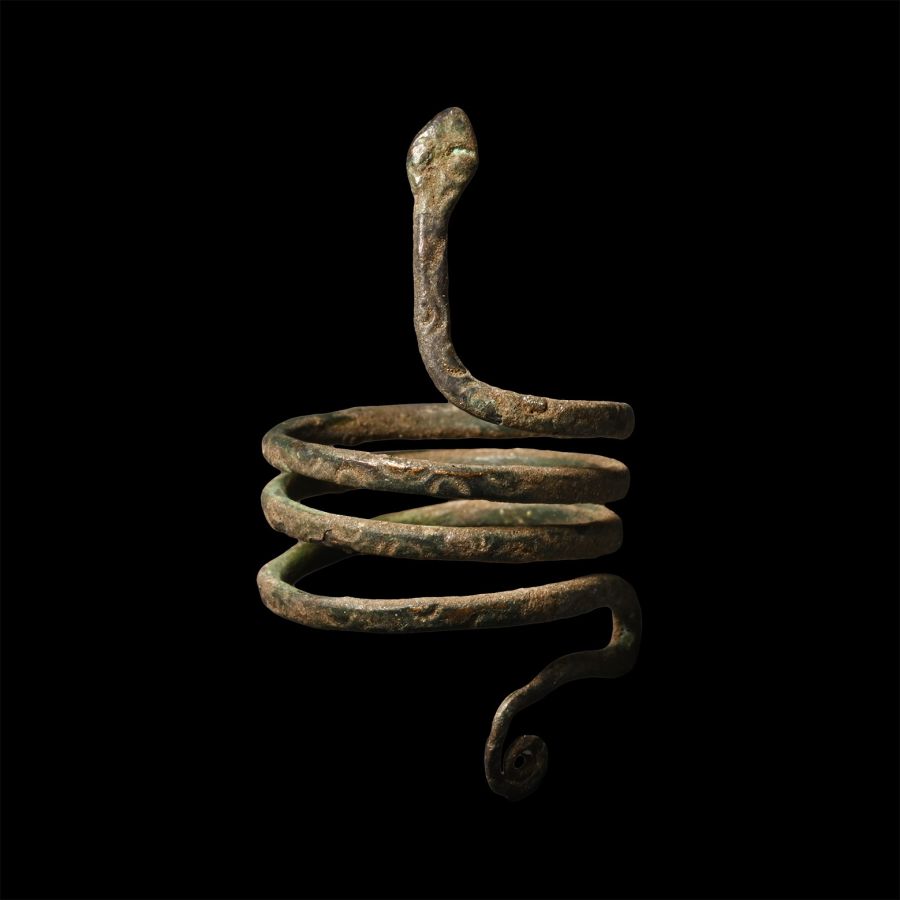
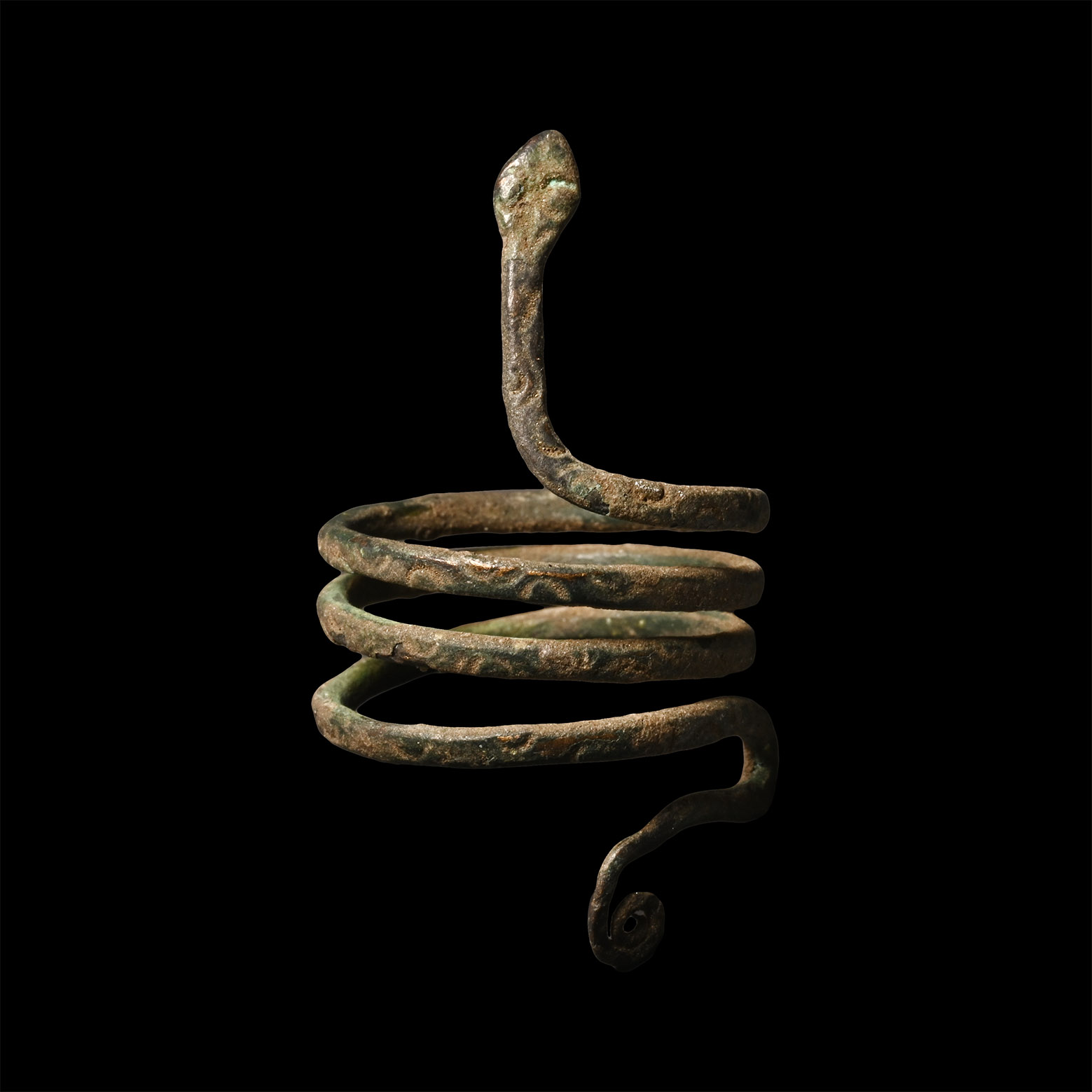
Romano-Egyptian Bronze Snake Ring
CIRCA 1ST CENTURY B.C.
1 1/2 in. (4.61 grams, 40.41 mm overall, 17.80 mm internal diameter (approximate size British L, USA 5 3/4, Europe 11.24, Japan 10)).
With D-section narrow coiled band with stylised scale detailing, raised head and tightly coiled tip of the tail. [No Reserve]
ProvenanceAcquired on the UK art market before 2000.
Property of a Surrey, UK, collector.
See Chadour, A.B., Rings. The Alice and Louis Koch Collection, volume I, Leeds, 1994, item 117, for type.
CONDITIONTimeLine Auctions follows a vetting process to ensure the authenticity and legality of all items, reinforcing our commitment to integrity and responsible trading. Each antiquity, antique, and coin lot undergoes thorough examination by a vetting committee of at least ten external specialists, professional trade association members, scientists, and archaeologists: Our Vetting Process
AUCTIONS:
TimeLine is a leading auction house specialising in antiquities, ancient art, collectables, natural history, coins, medals, and books. Our auctions offer museums, collectors, historians, and enthusiasts the opportunity to acquire unique and historically significant pieces.
-

Large Egyptian Wooden Shabti with Hieroglyphs
New Kingdom, circa 1300 B.C.Sold for (Inc. bp): £1,170
Finely modelled with gesso surface and painted detailing; wearing lappet wig and broad collar, crossed hands holding agricultural implements; frontal column of hieroglyphic text dedicating the shabti to 'The illuminated, the Osiris, Renpt-nefer, true of voice'. 107 grams, 22 cm high
Part of an old collection dating back to the 19th century. Ex property of a gentleman, acquired before the 1980s. Private collection of Mr T.H., Norfolk, UK. -

Egyptian Wooden Model Boat with Oarsmen
Middle Kingdom, late 11th-early 12th Dynasty, 2010-1961 B.C.Estimate: £15,000 - 20,000 (+bp*)
Opening Bid: £8,000
Comprising a cream-coloured crescent-shaped boat manned by a crew of seven oarsmen, each with a short black wig, their bodies painted in reddish-brown and wearing cream-coloured kilts; all with pivoting arms and with hands drilled to accept oars (now missing); an outline around the boat's deck and a net pattern at the prow and stern in red; a portion of an inward slanting stern post remains, with traces of another at the prow; the oarsmen re-affixed. 1.3 kg total, 41.5 cm wide
Acquired in the 1960s. From the collection of the late Egyptologist Surgeon Commander P.H.K. Gray RN. From a Surrey, UK, collection. Accompanied by an academic report by Egyptologist Paul Whelan. This lot has been checked against the Interpol Database of stolen works of art and is accompanied by search certificate no.11943-209563.
Models of various boat types were sometimes provided for the same burial. For the different types see Winlock, H.E., Models of Daily Life in Ancient Egypt from the Tomb of Meket-Re' at Thebes, Cambridge MA, 1955, pp.92-103. -
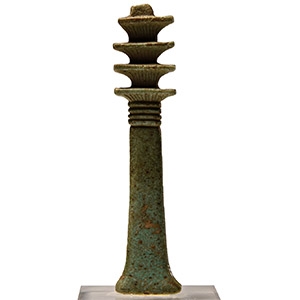
Large Egyptian Faience Djed Pillar Amulet
Late Period, 664-332 B.C.Sold for (Inc. bp): £845
Olive-green glazed composition amulet with ribbed panel, flared base; mounted on a custom-made stand. 78 grams total, 12.5 cm high including stand
Ex Phillipps collection, with old labels to verso. Private collection of Mr T.H., Norfolk, UK.
The djed pillar signifies the concepts of 'permanence' and 'stability' and was a common funerary amulet from the Old Kingdom onwards. It was first associated with the gods Ptah and Sokar, but later became a symbol of Osiris, representing the god's backbone. In this context, the djed pillar appears in Chapter 155 of the Book of the Dead, concerned with the resurrection of the deceased.
