
Loading, please wait...
LOT 0418
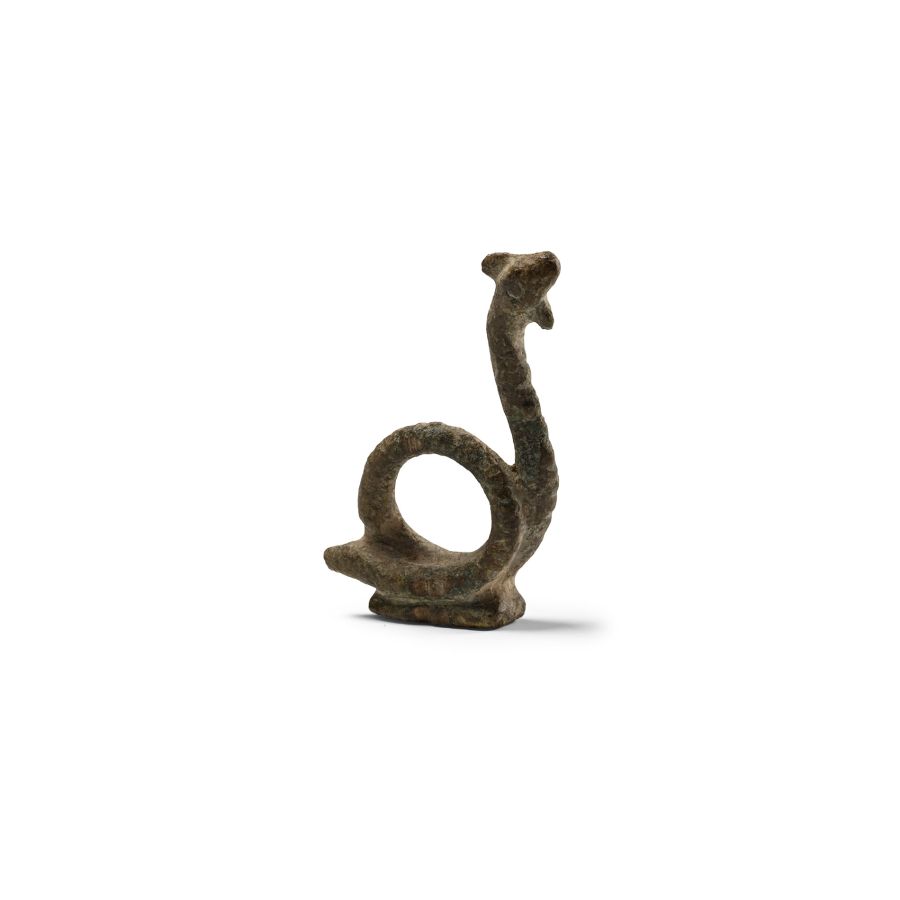
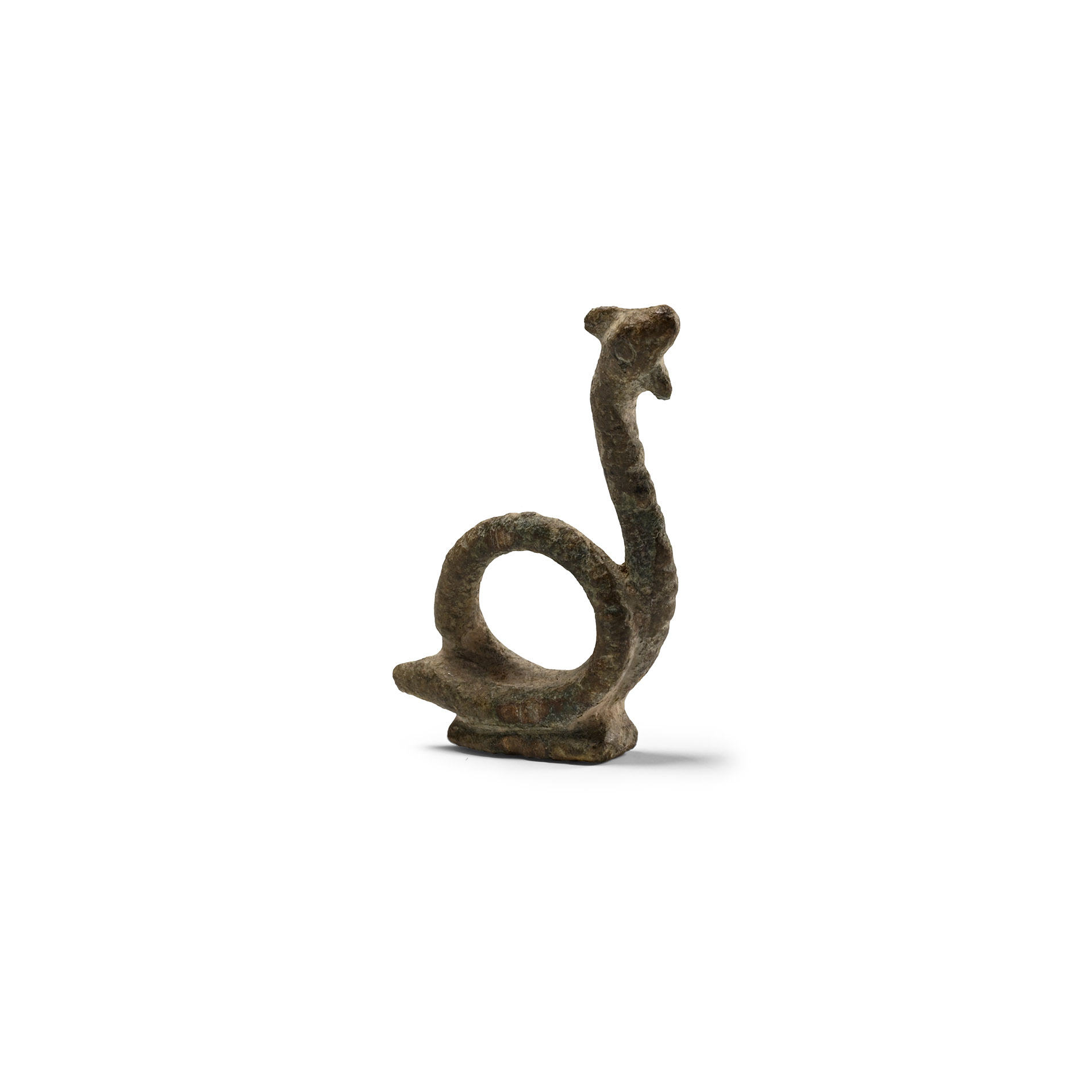
Romano-Egyptian Bronze Rearing Serpent
ROMAN PERIOD, 30 B.C.-323 A.D.
1 1/2 in. (12.5 grams, 39 mm).
Modelled in the round with naturalistic detailing, coiled with head facing upwards, on a rectangular base.
Provenance‘The Ancient Menagerie Collection’ formerly the property of a Cambridgeshire lady, collected since the 1990s and acquired from auctions and dealers throughout Europe and the USA, now ex London collection.
CONDITIONTimeLine Auctions follows a vetting process to ensure the authenticity and legality of all items, reinforcing our commitment to integrity and responsible trading. Each antiquity, antique, and coin lot undergoes thorough examination by a vetting committee of at least ten external specialists, professional trade association members, scientists, and archaeologists: Our Vetting Process
AUCTIONS:
TimeLine is a leading auction house specialising in antiquities, ancient art, collectables, natural history, coins, medals, and books. Our auctions offer museums, collectors, historians, and enthusiasts the opportunity to acquire unique and historically significant pieces.
-
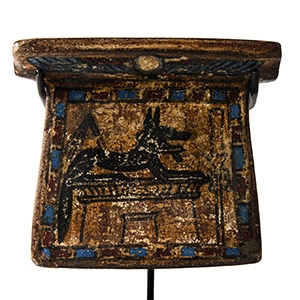
Egyptian Bifacial Faience Pectoral with Anubis
Late New Kingdom, 1290-1070 B.C.Sold for (Inc. bp): £1,690
The obverse with a scene of Anubis recumbent on a pylon-shaped shrine with a standing sceptre in front; the reverse painted with a djed pillar flanked by two knots of Isis, remains of polychrome painted pigment; three piercings to both sides of the top; accompanied by a custom-made display stand. 71 grams, 85 mm wide (223 grams total, 10.5 cm including stand)
Fine condition.
From an early 20th century collection. This lot has been checked against the Interpol Database of stolen works of art and is accompanied by search certificate number no.11104-182800.
Pectorals worn by the living were made from metal, usually gold; for the dead, glazed composition was an acceptable substitute, indicating the funerary nature of such objects. Circular piercings have been made through the cavetto cornice, enabling the piece to be stitched to the bandages covering a mummy's chest. The shape of the pectoral imitates that of a pylon, the rectangular tower which flanked the gateway into an Egyptian temple. The cavetto cornice is decorated with a winged and gilded sun-disk. All four sides are adorned with a block pattern. A jackal reclining on a pylon-shaped shrine represents Anubis, god of embalming. He has a magical tie or scarf around his neck and is shown with a flagellum. Such imagery is found in New Kingdom tombs at Thebes. In front of the shrine is the sekhem sceptre of power. The reverse depicts a djed pillar, believed to represent the backbone with ribs of Osiris, god of the dead, flanked by the Girdle of Isis or 'tit' amulet. Both were standard funerary amulets. -
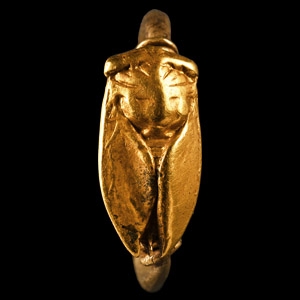
Egyptian Gold Ring with Fly
Late Period, 664-332 B.C.Sold for (Inc. bp): £3,120
The round-section hoop tapering towards the bezel where the arms overlap and form coil sleeves around the opposite shoulder, gold fly attached to the bezel with two mounting loops, with simple detailing to the upper body, possibly incorporating a human face; possibly a marriage. 5.28 grams, 27.27 mm overall, 19.10 mm internal diameter (approximate size British S 1/2, USA 9 1/4, Europe 20.63, Japan 19)
Acquired in the late 1980s-early 1990s. This lot has been checked against the Interpol Database of stolen works of art and is accompanied by search certificate number no.11847-204562.
The gold fly was an emblem of valour. -
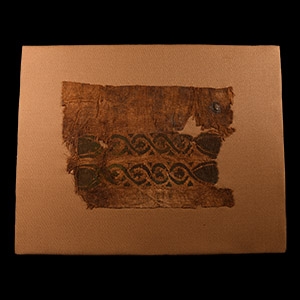
Egyptian Mounted Coptic Textile
Circa 6th-7th century A.D.Sold for (Inc. bp): £39
Comprising a pair of simple segmenta on a woven background, formed of a spiral line surrounding floral images, closed at both ends by a pair of petals. 121 grams, 38 x 30 cm
Acquired 1970s-1996. Property of a North American collector. London collection, 2016.
The textile shows a pair of segmenta, probably from a sleeve of a linen tunic. The wool here seems to be Z-spun, a spin direction not very common in Roman Egypt and suggesting that the spun yarn may have been traded from another province of the empire. Frequently, like in our case, the wool is purple in hue.
