Loading, please wait...

Romano-Egyptian Alabaster Alabastron Romano-Egyptian Alabaster Alabastron Romano-Egyptian Alabaster Alabastron
Use mousewheel to zoom in and out, click to enlarge
Details

LOT 0030

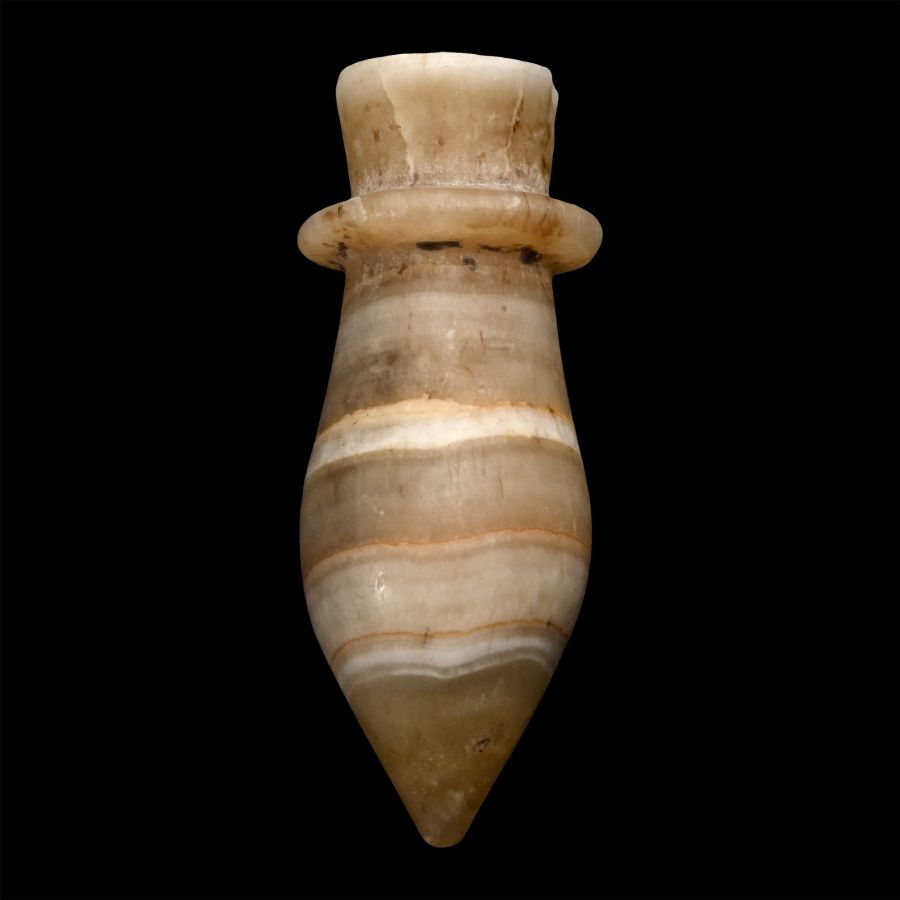
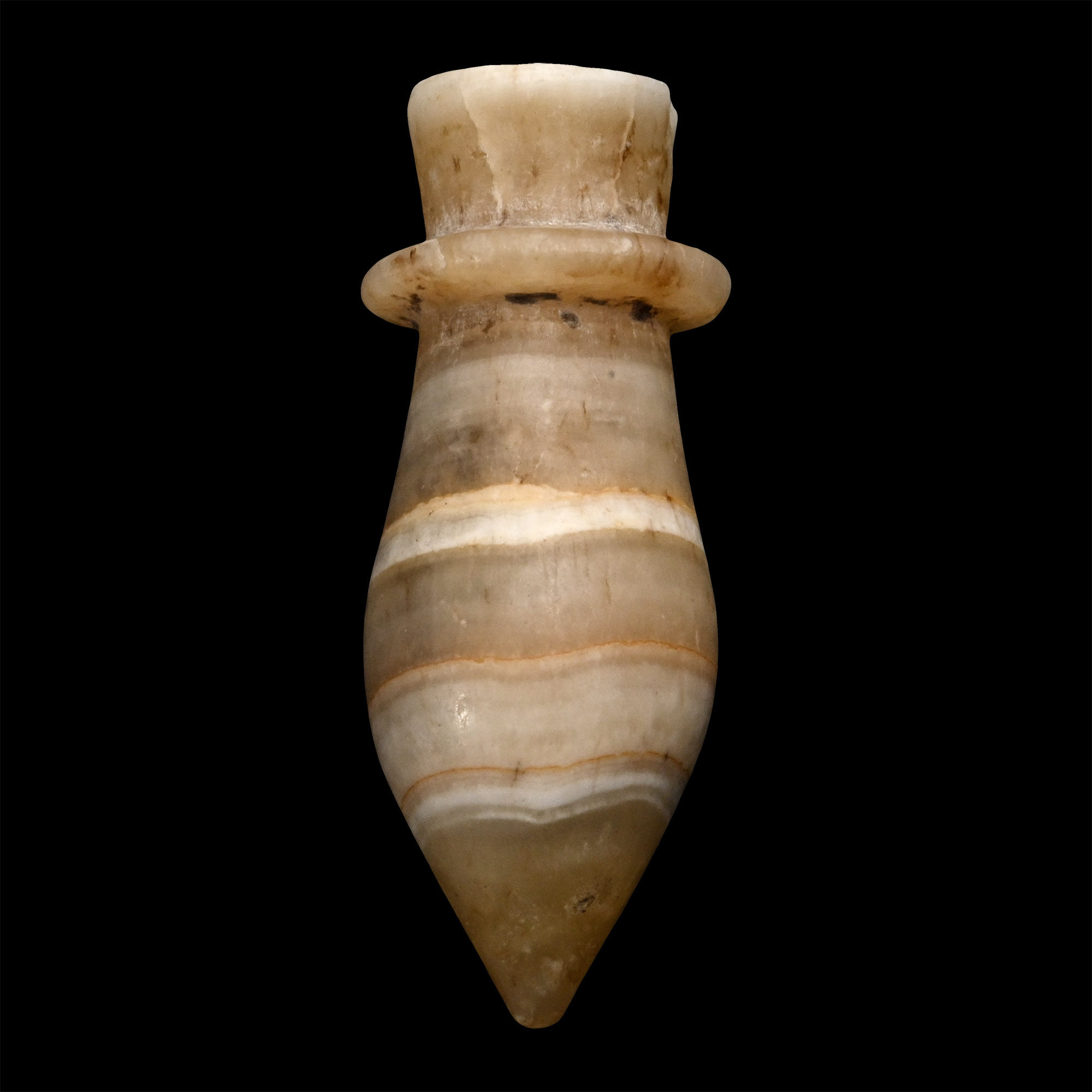
Romano-Egyptian Alabaster Alabastron

1ST CENTURY B.C.-1ST CENTURY A.D.

1 3/4 in. (7.71 grams, 44 mm).

Small alabastron in banded Egyptian calcite-alabaster, pointed ovoid body and tall neck divided by a broad annular collar and finished with a plain straight rim.

Provenance

Acquired on the European art market in 1990s.
English private collection.

Literature

Cf. The British Museum, London, inv. nos. 1867,0508.712; 1856,1226.1753; 1881,0824.146; 1850,0805.5.

Footnotes

A well-attested type produced from the Twenty-Seventh Dynasty through the Ptolemaic period and continuing into the early Julio-Claudian era.

CONDITION
VETTING:

TimeLine Auctions follows a vetting process to ensure the authenticity and legality of all items, reinforcing our commitment to integrity and responsible trading. Each antiquity, antique, and coin lot undergoes thorough examination by a vetting committee of at least ten external specialists, professional trade association members, scientists, and archaeologists: Our Vetting Process


AUCTIONS:

TimeLine is a leading auction house specialising in antiquities, ancient art, collectables, natural history, coins, medals, and books. Our auctions offer museums, collectors, historians, and enthusiasts the opportunity to acquire unique and historically significant pieces.

LOT 0030

Romano-Egyptian Alabaster Alabastron

Estimate £300 - 400€350 - 460 (for guidance only)$410 - 540 (for guidance only)

Opening Bid
£150 (EUR 174; USD 203) +BP*

Sign in to Bid

Please enter a e-mail
Please enter a password
Or Create Account here.
Please confirm to accept TC and Privacy policy

Bids: 0
RELATED LOTS
  • Large Egyptian Faience Heart Amulet
    Large Egyptian Faience Heart Amulet
    Late Period, 664-332 B.C.

    Estimate: £100 - 140 (+bp*)

    Opening Bid: £5

    Modelled in the round with a piriform body and two lateral projections with striations. 7.66 grams, 30 mm


    Ex N. Thomas private collection, UK, 1980s-1990s. Accompanied by a previous dealer's sales ticket.

    Lot Details

  • Monumental Egyptian Granite Statue Base with Hieroglyphics
    For Prince Parahirwenemef, the third son of Ramesses II
    Monumental Egyptian Granite Statue Base with Hieroglyphics
    New Kingdom, 19th Dynasty, circa 1250 B.C.

    Estimate: £40,000 - 60,000 (‡+bp*)

    Opening Bid: £20,000

    The reddish granite base and lower part of a kneeling statue of Prince Parahirwenemef, preserving the feet and lower legs with finely detailed sandals and well-modelled toes; part of the kilt survives, with a line of sunken hieroglyphs on either side; a broad front pillar and narrower back pillar rise from the base, both inscribed, while hieroglyphic inscriptions continue around all four sides of the plinth; the mirrored base inscriptions comprise offering formulae invoking Amun-Ra on behalf of the prince together with a series of his royal and military titles, including "royal scribe", "overseer of horses", "troop commander", "group marshaler", and the previously unattested title tpy n mšꜥ ("chief of troops"); a separate inscription on the rear of the plinth names the noblewoman Wadjet-khayty as sn.t=f mr=f ("his sister/wife, his beloved"), providing the first substantial evidence for her relationship with the prince and strongly suggesting that she was his wife 140 kg, 58.5 cm


    Private collection of Mr A., acquired circa 1983-1984. Thence by descent, private collection since the late 1990s. This lot has been checked against the Interpol Database of stolen works of art and is accompanied by a search certificate number no.12887-241732. An article on this significant piece is currently being prepared by Egyptologist Paul Whelan.

    Prince Parahirwenemef, the third son of Ramesses II and Queen Nefertari, is depicted in several relief scenes and two colossal statues associated with Ramesses II's temples, as well as in two smaller statues, both surviving only in fragmentary form. The inscriptions on this previously unrecorded statue base preserve the previously unattested military title tpy n mšꜥ ("chief of troops"), expanding the known titulary of Parahirwenemef and reinforcing his close association with the Ramesside chariot corps. The monument also provides the first substantial evidence concerning the noblewoman Wadjet-khayty, previously known only from a brief reference to a lost Karnak monument, strongly supporting her identification as the prince's wife. Together, the inscriptions make an important contribution to the study of Ramesside royal genealogy, military administration, and princely sculpture.

    Lot Details

  • Egyptian Miniature Alabaster Jar
    Egyptian Miniature Alabaster Jar
    New Kingdom, 1550-1295 B.C.

    Estimate: £30 - 40 (+bp*)

    Opening Bid: £5

    Miniature alabsatron with ovoid body and flared rim to the mouth; collector's inked number '1' inside mouth; rim chipped. 22 grams, 41 mm


    From the collection of David Donlan (1947–2025), a dedicated and lifelong collector with a passion for the ancient world and the natural sciences, forming his collection from 1960s onwards, using many reputable dealers across the United Kingdom, including the well-regarded Coincraft and The Parthenon Gallery.

    Lot Details