
Loading, please wait...


LOT 1848
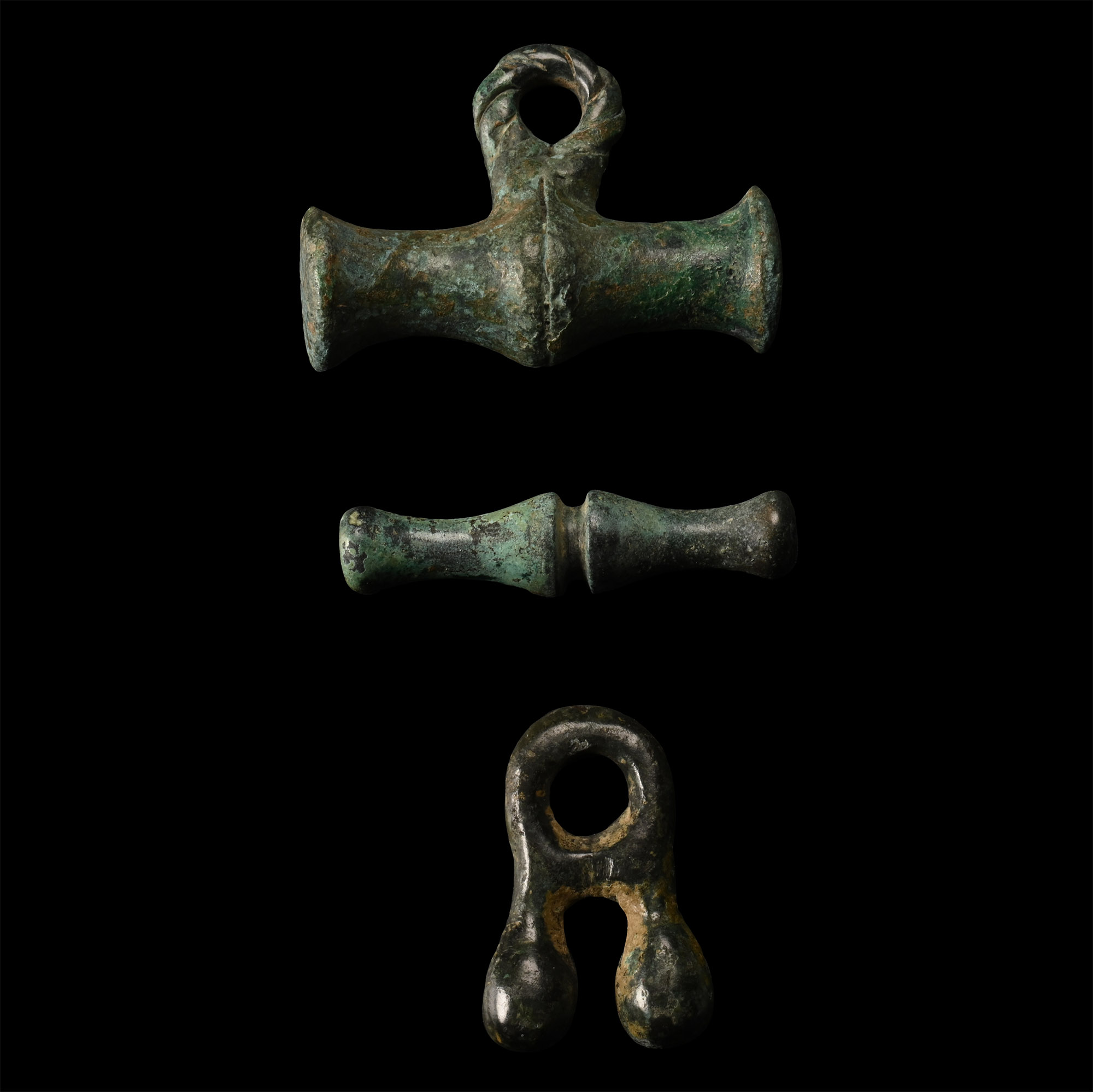
Romano-Celtic Bronze Toggle Group
2ND CENTURY B.C.-1ST CENTURY A.D.
1 - 1 3/8 in. (39.4 grams total, 26-35 mm).
Group of fasteners including barrel-shaped type with loop and disc finials, central bar with gusset and other types. [No Reserve]
Provenancewith H.A.C. A.G., Basel, prior 1999.
This lot is accompanied by an illustrated lot declaration signed by the Head of the Antiquities Department, Dr Raffaele D’Amato.
Cf. Bailey, G., Buttons & Fasteners 500 BC-AD1840, Witham, 2004, p.87, items 10.5, 10.7, and others.
CONDITIONTimeLine Auctions follows a vetting process to ensure the authenticity and legality of all items, reinforcing our commitment to integrity and responsible trading. Each antiquity, antique, and coin lot undergoes thorough examination by a vetting committee of at least ten external specialists, professional trade association members, scientists, and archaeologists: Our Vetting Process
AUCTIONS:
TimeLine is a leading auction house specialising in antiquities, ancient art, collectables, natural history, coins, medals, and books. Our auctions offer museums, collectors, historians, and enthusiasts the opportunity to acquire unique and historically significant pieces.
-
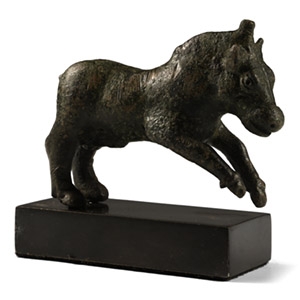
Romano-Celtic Bronze Leaping Boar Statuette
1st century B.C.-1st century A.D.Estimate: £4,000 - 6,000 (+bp*)
Opening Bid: £1,784
Modelled in the round in a dynamic pose with fierce facial features and partially open mouth; ridge of bristles to the spine; mounted on a custom-made stand. 165 grams total, 74 mm wide
Found Hampshire, UK, in the 1980s. From the collection of David Miller and a Cambridge, UK, collection, 2000s. This lot has been checked against the Interpol Database of stolen works of art and is accompanied by search certificate number no.12512-231450. This lot has been cleared against the Art Loss Register database, and is accompanied by an illustrated lot declaration signed by the Head of the Antiquities Department, Dr Raffaele D’Amato.
The small statuettes of boars found in Roman Britain and Gaul were likely used as votive figurines for cult places. They were widespread in the Roman provinces of Celtic origin. However, one cannot exclude the fact that many boars found in Britain belong to the pre-conquest era. One of the few types of bronze figurines that are known to precede the arrival of the Romans is, in fact, that of the boars. -
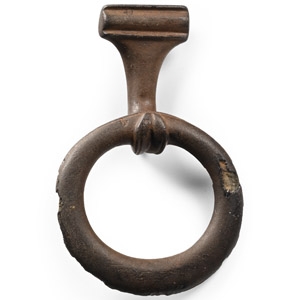
Iron Age Celtic Bronze Belt Toggle
1st century B.C.-1st century A.D.Sold for (Inc. bp): £20
With annular attachment mount and supporting arm with loop to reverse. 16.3 grams, 54 mm
Previously in a Lincolnshire, UK, collection. Property of a private collector, West London, UK. This lot is accompanied by an illustrated lot declaration signed by the Head of the Antiquities Department, Dr Raffaele D’Amato. -

Iron Age Celtic Bronze Ribbed Bracelet or Proto-Money
La Tène B, 3rd century B.C.Sold for (Inc. bp): £78
D-shaped in section, segmented on the outer face into a series of convex knobs, each separated by a groove. 116 grams, 57 mm
with H.A.C.A.G., Basel, prior 1999. Accompanied by a copy of an Art Loss Register certificate no.S00103135. This lot is accompanied by an illustrated lot declaration signed by the Head of the Antiquities Department, Dr Raffaele D’Amato.
After the end of the Bronze Age, bronze was still extensively used for weapons and ornaments, which have usually survived far better than the rust-prone remains of early iron tools. From Celtic Europe, we have a great amount of small bracelets and bronze rings worn by people of modest means in the centuries leading up to the emergence of the classical period.
