
Loading, please wait...


LOT 0706
Romano-Celtic Bronze Statuette of the God Apollo
2ND-4TH CENTURY A.D.
2 5/8 in. (29.7 grams, 66 mm).
Depicted nude and wearing a quiver on his back, the strap for the quiver indicated by stamped roundels, detailing on the abdomen. [No Reserve]
ProvenanceFrom the private collection of a European gentleman (1942-2024), formed since the 1970s.
LiteratureCf. a similar statuette from Augst in Durham, E., Metal Figurines in Roman Britain, volume 2, Cambridge, 2010, plate 8.
CONDITIONTimeLine Auctions follows a vetting process to ensure the authenticity and legality of all items, reinforcing our commitment to integrity and responsible trading. Each antiquity, antique, and coin lot undergoes thorough examination by a vetting committee of at least ten external specialists, professional trade association members, scientists, and archaeologists: Our Vetting Process
AUCTIONS:
TimeLine is a leading auction house specialising in antiquities, ancient art, collectables, natural history, coins, medals, and books. Our auctions offer museums, collectors, historians, and enthusiasts the opportunity to acquire unique and historically significant pieces.
-

Roman Sapphire Gemstone with Crescent Moon and Star
Third quarter of 1st century B.C.Sold for (Inc. bp): £5,980
Cushion-shaped greenish-blue intaglio engraved with a large crescent moon and star. 1.05 grams, 10 mm
Formerly in a private collection of an European lady, 1970s-1980s. Private collection, UK. This lot has been checked against the Interpol Database of stolen works of art and is accompanied by search certificate number no.13305-257800.
Basaltic sapphires used by the Romans came from surface deposits in northern Ethiopia, which were already known and productive in ancient times. This hypothesis is supported by comments by Pliny the Elder (23–79 A.D.) and Solinus (early 3rd century A.D.), both of whom referred to gems from Ethiopia named ‘hyacintos’, which is generally accepted in archaeology to be the ancient name of sapphire. The moon and stars have been, since the 4th century BC, symbols of the city of Byzantium and were also linked with Spartan military culture. -
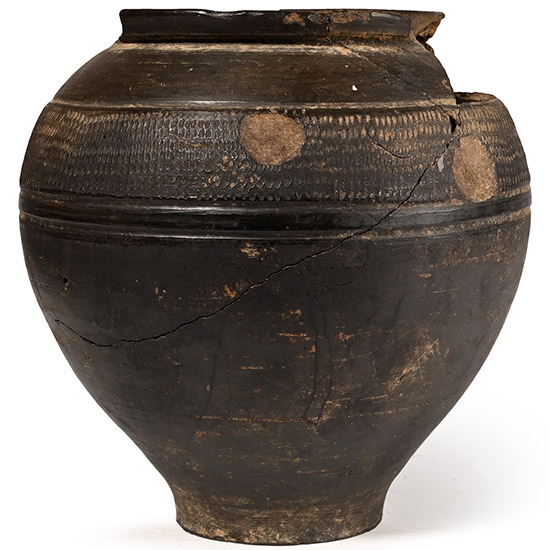
Romano-British 'Colchester' Decorated Terracotta Vase
2nd-3rd century A.D.Sold for (Inc. bp): £286
Black burnished ware jar with narrow foot, bulbous body with broad shoulder and flared rim to the mouth; circumferential band of rouetting to the shoulder; Type BB2; repaired. 530 grams, 15.5 cm
Discovered during renovations of Williams and Griffin, Colchester, Essex, UK, circa 1980s. -
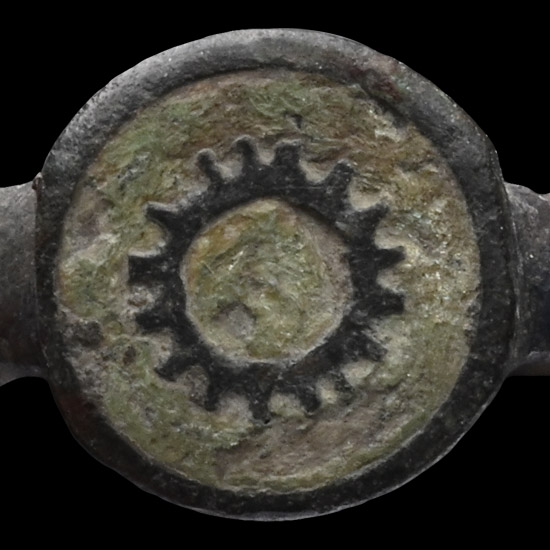
Roman Enamelled Bronze Ring
2nd-3rd century A.D.Sold for (Inc. bp): £78
Comprising a slender round-section hoop, raised collars on the shoulders, discoid bezel with enamel. 1.45 grams, 18.43 mm overall, 15.54 mm internal diameter (approximate size British I, USA 4 1/4, Europe 7.44, Japan 7)
Ex German art market, 2000s. Acquired from an EU collector living in London. From the collection of a Surrey, UK, gentleman.
