
Loading, please wait...
_900x900.jpg "Romano-Celtic Bronze Pincer Brooch")
_200x200.jpg "Romano-Celtic Bronze Pincer Brooch")
.jpg "Romano-Celtic Bronze Pincer Brooch")
LOT 1692
Romano-Celtic Bronze Pincer Brooch
1ST CENTURY B.C.-1ST CENTURY A.D.
2 1/2 in. (7.09 grams, 64 mm).
Comprising a deep ribbed bow with a returned foot, short catchplate below; round-section pin with a flat-section extension forming the other side of the 'pincer' head. [No Reserve]
ProvenanceEx German art market, 2000s.
Acquired from an EU collector living in London.
From the collection of Surrey, UK, gentleman.
TimeLine Auctions follows a vetting process to ensure the authenticity and legality of all items, reinforcing our commitment to integrity and responsible trading. Each antiquity, antique, and coin lot undergoes thorough examination by a vetting committee of at least ten external specialists, professional trade association members, scientists, and archaeologists: Our Vetting Process
AUCTIONS:
TimeLine is a leading auction house specialising in antiquities, ancient art, collectables, natural history, coins, medals, and books. Our auctions offer museums, collectors, historians, and enthusiasts the opportunity to acquire unique and historically significant pieces.
-
.jpg)
Iron Age British Celtic Bronze Decorated Ring-Headed Pin
Late 1st millennium B.C.Sold for (Inc. bp): £195
With tapering shank and integral ring with bulb finial; shank pierced below the junction with the bulb. 16 grams, 87 mm
Found Norfolk, Southern England. Acquired on the UK art market in the 1980s. From an East Anglian private collection. Accompanied by an old Norfolk Castle Museum record slip.
Recorded and assessed by the Secretary of State’s Expert Adviser as an object of cultural interest. The RCEWA reviewed an export application and determined that it meets the third Waverley criterion, making it currently non-exportable. -
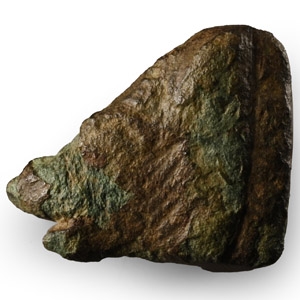
Iron Age Celtic Bronze Boar's Head Mount
1st century B.C.-1st century A.D.Sold for (Inc. bp): £65
Triangular in profile with boar-head detailing, mounting pins to reverse. 4.62 grams, 21 mm
Ex Peter Hewett, Coins & Artefacts, UK. Acquired on the European art market since the early 2000s. From the private Northern Ireland collection of R.M. Accompanied by copies of line drawings of the object. -
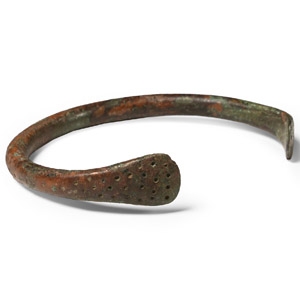
Iron Age Celtic Bronze Bracelet
1st century B.C.-1st century A.D.Sold for (Inc. bp): £117
Comprising a penannular round-section body with hammered terminals, punched pellet decoration to each of the finials. 27.3 grams, 67 mm
Ex German art market, 2000s. Acquired from an EU collector living in London. From the collection of Surrey, UK, gentleman.
