
Loading, please wait...


LOT 0922
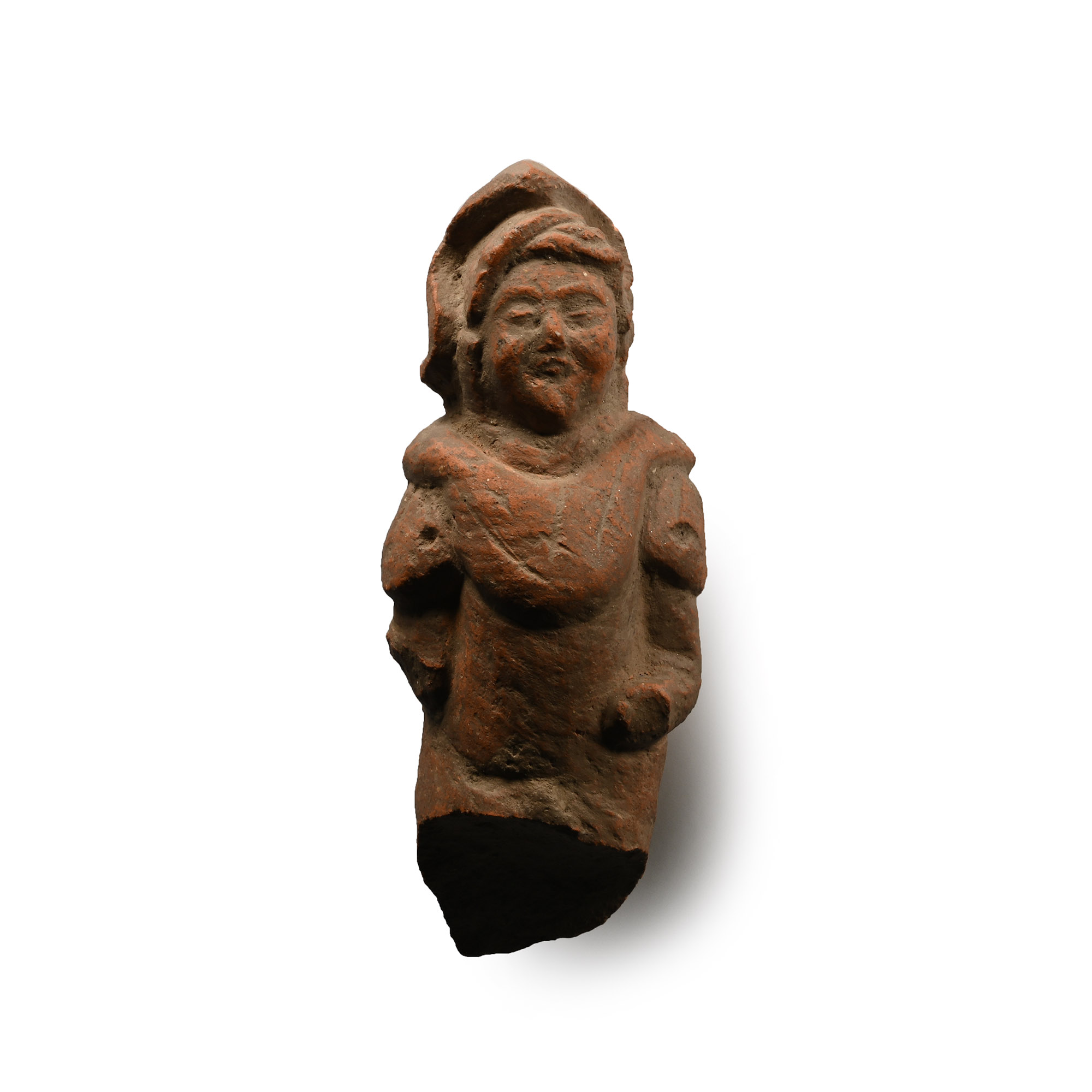
Romano-British Terracotta Figural Patera Handle of Dadophoros
3RD-4TH CENTURY A.D.
3 3/4 in. (97 grams, 97 mm).
Columnar in form with anthropomorphic detailing modelled in the round; figure with a loose Persian-style hood over his thick hair, wearing a military cloak, left arm bent at his side. [No Reserve]
ProvenanceFound fieldwalking in North Norfolk, UK, circa 2008.
Ian Wilkinson collection, Nottinghamshire, UK, formed since 1985.
This lot is accompanied by an illustrated lot declaration signed by the Head of the Antiquities Department, Dr Raffaele D’Amato.
Cf. Claus, M., The Roman Cult of Mithras, tr. Richard Gordon, Edinburgh, 2000, p.95.
FootnotesThe dadophoroi were torch-bearers who accompanied Mithras in his ceremonial travels. They are named as 'Cautes' who holds a burning torch point-upwards, whereas 'Cautopates' holds one pointing down.
CONDITIONTimeLine Auctions follows a vetting process to ensure the authenticity and legality of all items, reinforcing our commitment to integrity and responsible trading. Each antiquity, antique, and coin lot undergoes thorough examination by a vetting committee of at least ten external specialists, professional trade association members, scientists, and archaeologists: Our Vetting Process
AUCTIONS:
TimeLine is a leading auction house specialising in antiquities, ancient art, collectables, natural history, coins, medals, and books. Our auctions offer museums, collectors, historians, and enthusiasts the opportunity to acquire unique and historically significant pieces.
LOT 0922
Romano-British Terracotta Figural Patera Handle of Dadophoros
Sold for (Inc. bp): £98
-
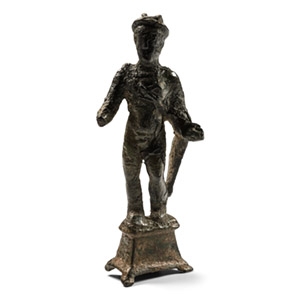
Roman Bronze Statuette of the God of Mercury
1st-2nd century A.D.Sold for (Inc. bp): £468
Modelled standing nude in contrapposto stance, wearing a mantle draped to the left shoulder and secured at the right, wearing winged petasos cap, standing on a rectangular base. 89.8 grams, 95 mm
UK private collection before 2000. Acquired on the UK art market. Property of a London gentleman. This lot is accompanied by an illustrated lot declaration signed by the Head of the Antiquities Department, Dr Raffaele D’Amato. -
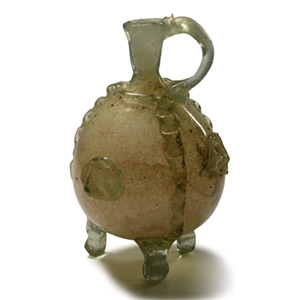
Late Roman Glass Vessel with Trail
4th-5th century A.D.Sold for (Inc. bp): £715
Globular body with narrow funicular neck and squared rim, applied trail strap handle; three applied discs to the equator, two with an impressed cross; applied trail collar to the shoulder and three vertical corrugated trails extending to stub feet, rim restored. 78.1 grams, 10.7 cm
with a London, UK gallery 1971-early 2000s. This lot is accompanied by an illustrated lot declaration signed by the Head of the Antiquities Department, Dr Raffaele D’Amato. -
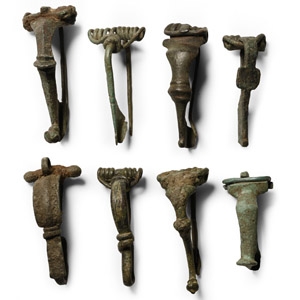
Roman Bronze Bow Brooch Collection
1st-3rd century A.D.Sold for (Inc. bp): £650
Including La Tène II, knee-brooch, dolphin type and others. 54 grams total, 32-46 mm
From an English collection formed before 2000. This lot is accompanied by an illustrated lot declaration signed by the Head of the Antiquities Department, Dr Raffaele D’Amato.
