
Loading, please wait...
LOT 0925
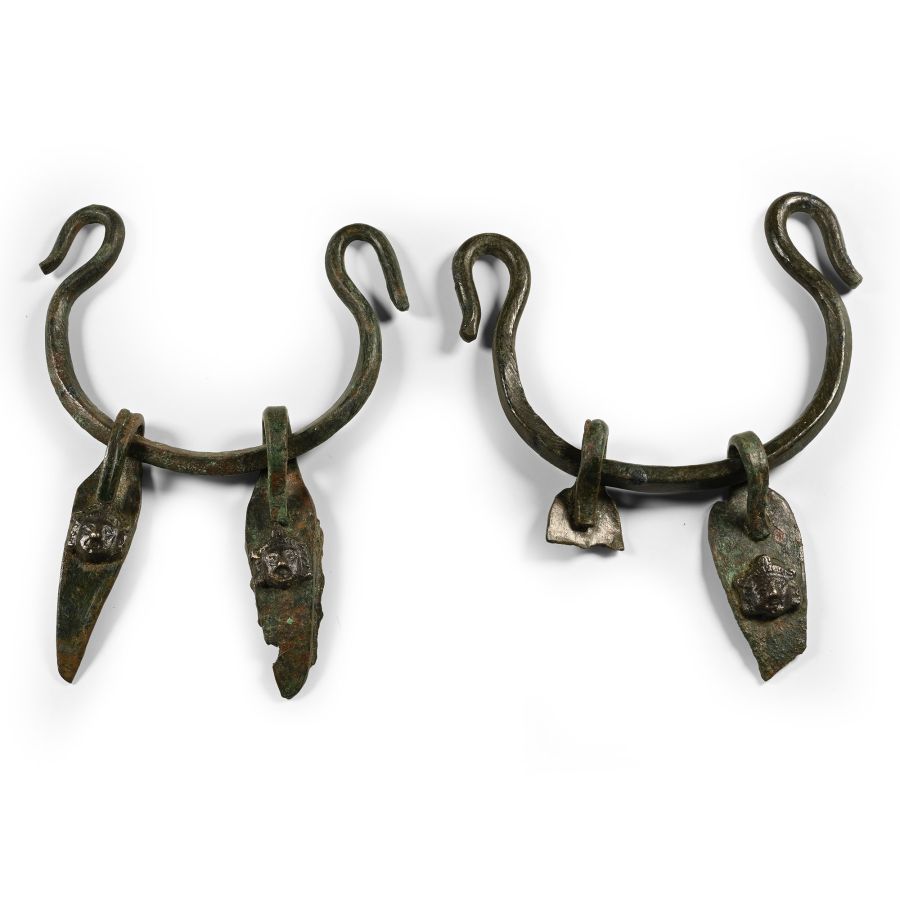
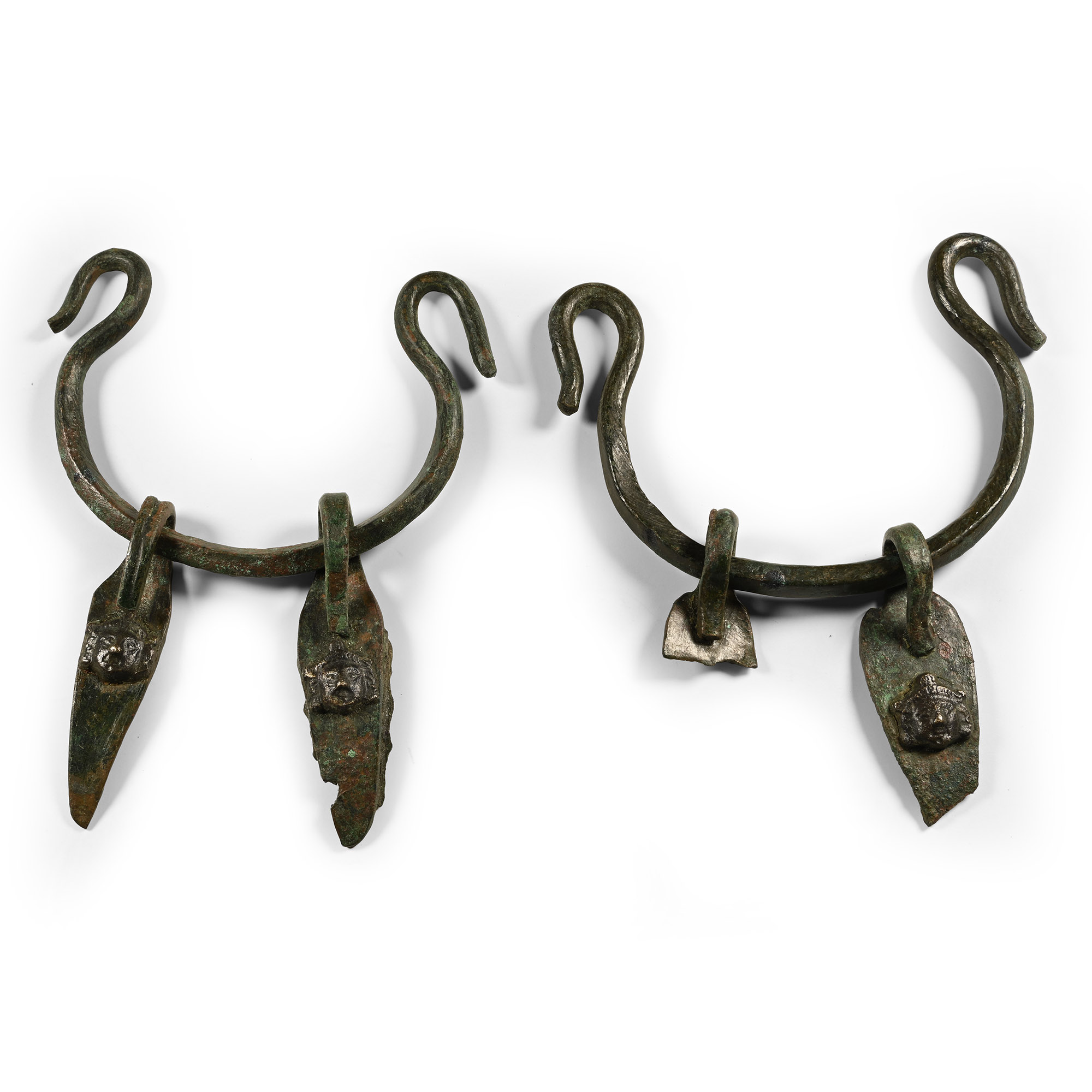
Romano-British 'Silchester' Bronze Figural Vessel Handle Pair
1ST-2ND CENTURY A.D.
3 3/4 - 4 in. (180 grams total, 9.5-10.3 cm wide).
Matched pair of drop-handles for a situla or other large vessel, each an arched rod with curved and returned ends attached to a looped bar and leaf-shaped panel with an applied mask or gorgoneion below (one absent). [2, No Reserve]
ProvenanceFound North Hampshire near the Roman town of Calleva (Silchester), the Iron Age Celtic capital of the Attrabates tribe.
Recorded with Reading Museum, in the 1970s.
From an old Hampshire, UK, collection.
Ex Ancient & Gothic, UK.
Accompanied by copies of two typed and hand illustrated previous information sheets including provenance.
This lot is accompanied by an illustrated lot declaration signed by the Head of the Antiquities Department, Dr Raffaele D’Amato.
TimeLine Auctions follows a vetting process to ensure the authenticity and legality of all items, reinforcing our commitment to integrity and responsible trading. Each antiquity, antique, and coin lot undergoes thorough examination by a vetting committee of at least ten external specialists, professional trade association members, scientists, and archaeologists: Our Vetting Process
AUCTIONS:
TimeLine is a leading auction house specialising in antiquities, ancient art, collectables, natural history, coins, medals, and books. Our auctions offer museums, collectors, historians, and enthusiasts the opportunity to acquire unique and historically significant pieces.
LOT 0925
Romano-British 'Silchester' Bronze Figural Vessel Handle Pair
Sold for (Inc. bp): £130
-
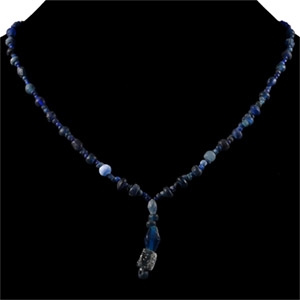
Roman Blue Glass Bead Necklace String
1st-4th century A.D. and laterSold for (Inc. bp): £156
Composed of small annular beads interspersed with larger oblate and other beads; restrung to a Y-shape with facetted feature beads. 14.5 grams, 32.5 cm
Acquired 1980-2015. Ex Abelita family collection. This lot is accompanied by an illustrated lot declaration signed by the Head of the Antiquities Department, Dr Raffaele D’Amato. -
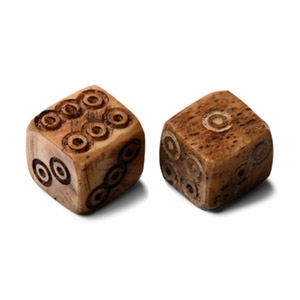
Roman Bone Dice Pair
1st-4th century A.D.Sold for (Inc. bp): £312
Each a bone cube with ring-and-dot markings disposed: 1:6, 2:4, 3:5. 1.78 grams total, 7-8 mm
From an English collection formed before 2000. -
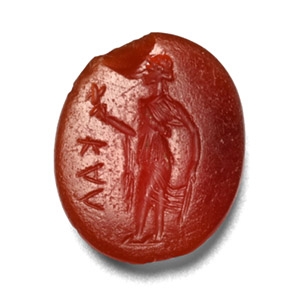
Roman Carnelian Intaglio with Spes
2nd-3rd century A.D.Sold for (Inc. bp): £208
Standing and facing left with her right hand raised an holding a budding flower; inscription in Greek 'KAΛ(OΣ)' (= beautiful) on the left. 0.74 grams, 13 mm
Ex R. Sebastia Coch (1908-1969) collection, Barcelona; thence by descent. English art market, 2018. Accompanied by a copy of an Art Loss Register certificate no.S00143341. This lot is accompanied by an illustrated lot declaration signed by the Head of the Antiquities Department, Dr Raffaele D’Amato.
