
Loading, please wait...

LOT 0877
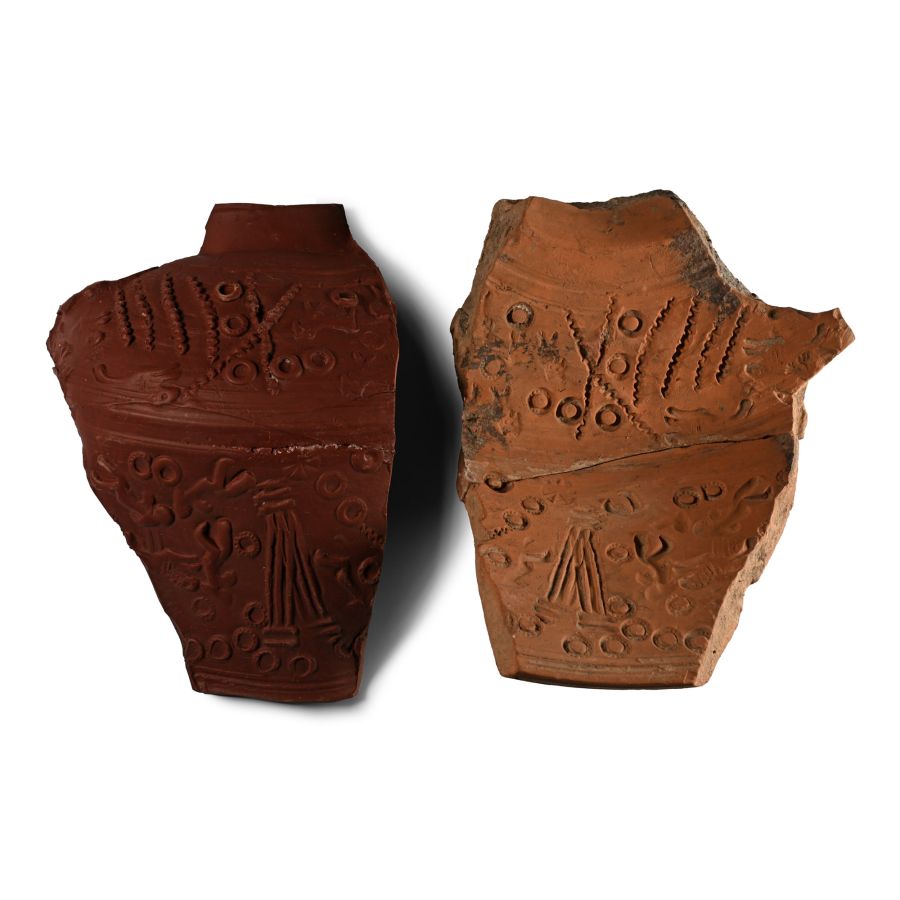
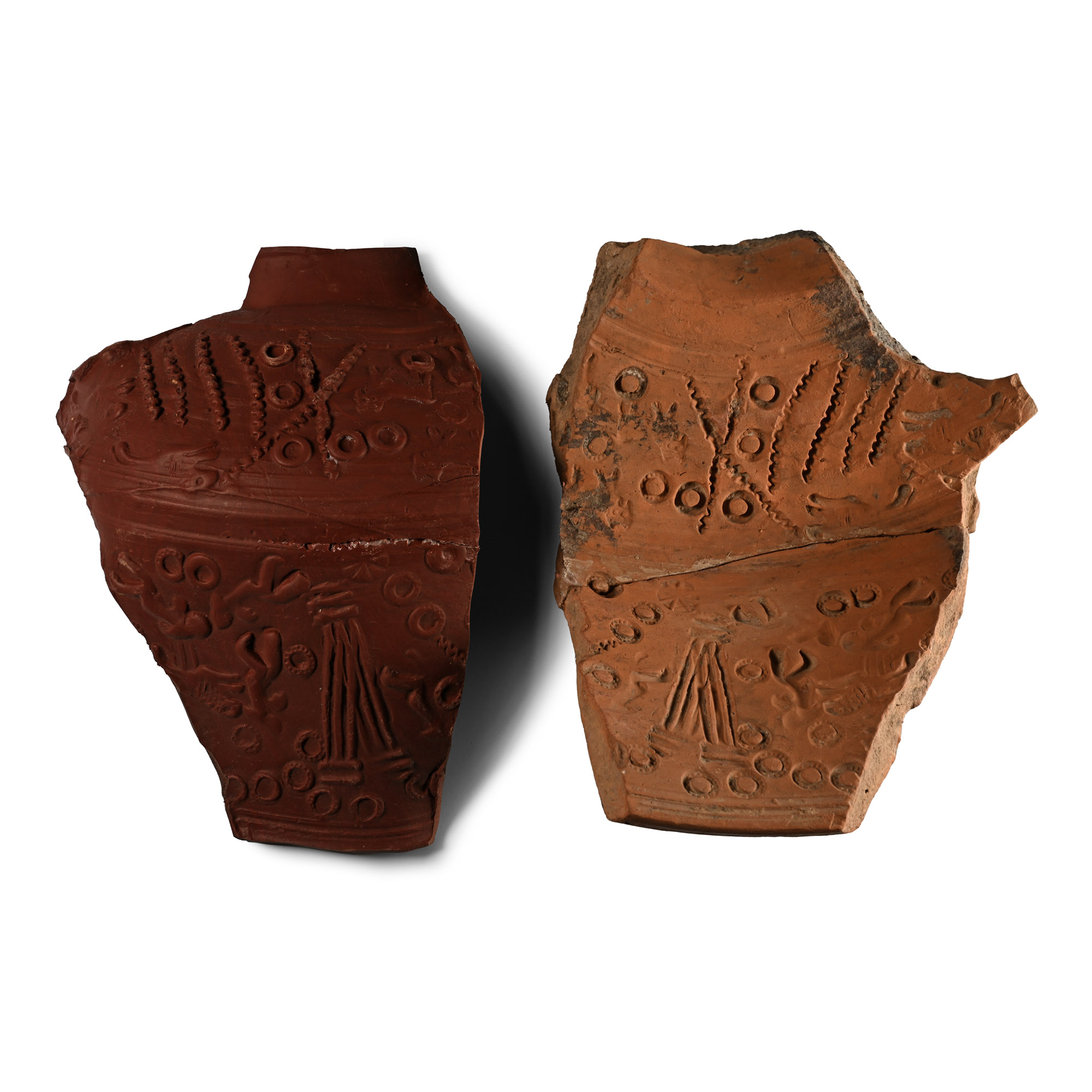
Romano-British Potter's Bowl Mould Fragment with Massacre by Lions
3RD-4TH CENTURY A.D.
7 1/8 in. (695 grams total, 18 cm each).
Fragment of terracotta mould for a bowl, sidewall and rim with impressed decoration: horizontal bands to rim and equator delimiting two registers; upper: two ribbed columns angled to suggest toppling, with pelletted rings in the field, three running human figures and a leaping lion; lower: three sheep advancing towards bands of wavy lines and rings (to suggest vegetation?) with two leaping lions advancing towards them and a preying eagle above; supplied with a modern impression. [2, No Reserve]
ProvenanceFound Suffolk, UK.
From an old English collection.
Ian Wilkinson collection, Nottinghamshire, UK, formed since 1985.
This lot is accompanied by an illustrated lot declaration signed by the Head of the Antiquities Department, Dr Raffaele D’Amato.
The terracotta fragment represents a scene rarely seen in Roman art, the condemnation ad bestias, of criminals; the dating of the terracotta, between the 3rd and 4th century, could refer the scene to the last great persecution against Christians unleashed by Diocletian and Maximian in 303 AD.
CONDITIONTimeLine Auctions follows a vetting process to ensure the authenticity and legality of all items, reinforcing our commitment to integrity and responsible trading. Each antiquity, antique, and coin lot undergoes thorough examination by a vetting committee of at least ten external specialists, professional trade association members, scientists, and archaeologists: Our Vetting Process
AUCTIONS:
TimeLine is a leading auction house specialising in antiquities, ancient art, collectables, natural history, coins, medals, and books. Our auctions offer museums, collectors, historians, and enthusiasts the opportunity to acquire unique and historically significant pieces.
LOT 0877
Romano-British Potter's Bowl Mould Fragment with Massacre by Lions
Sold for (Inc. bp): £104
-
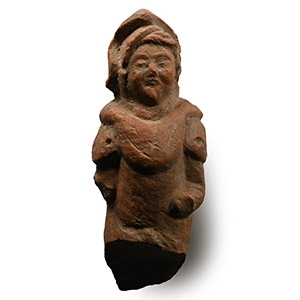
Romano-British Terracotta Figural Patera Handle of Dadophoros
3rd-4th century A.D.Sold for (Inc. bp): £98
Columnar in form with anthropomorphic detailing modelled in the round; figure with a loose Persian-style hood over his thick hair, wearing a military cloak, left arm bent at his side. 97 grams, 97 mm
Found fieldwalking in North Norfolk, UK, circa 2008. Ian Wilkinson collection, Nottinghamshire, UK, formed since 1985. This lot is accompanied by an illustrated lot declaration signed by the Head of the Antiquities Department, Dr Raffaele D’Amato.
The dadophoroi were torch-bearers who accompanied Mithras in his ceremonial travels. They are named as 'Cautes' who holds a burning torch point-upwards, whereas 'Cautopates' holds one pointing down. -
.jpg)
Larger Than Life-Size Roman Bronze Sandaled Toes
1st-3rd century A.D.Sold for (Inc. bp): £2,600
Hollow-formed front left sandaled foot with draped hem of a vestis talaris across the rear edge and tiered sole to the footwear, traces of gilding; supplied with a custom-made wooden stand. 847 grams total, 14 cm
Acquired in Germany in 2001. Acquired by the present owner from the above. Accompanied by an academic report by Dr Raffaele D’Amato. This lot has been checked against the Interpol Database of stolen works of art and is accompanied by search certificate number no.12192-222323. This lot has been cleared against the Art Loss Register database, and is accompanied by an illustrated lot declaration signed by the Head of the Antiquities Department, Dr Raffaele D’Amato.
The detailed bronze foot exhibits an incredible rendering of the smallest details; its dimensions suggest that the statue to which it belonged was nearly a human size sculpture, probably a goddess. -
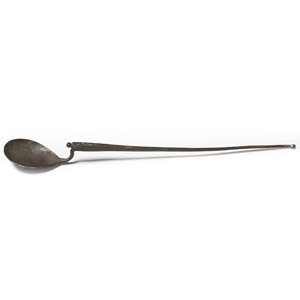
Roman Silver Swan-Necked Ligula Spoon
1st-2nd century A.D.Sold for (Inc. bp): £442
With shallow bowl, knop finial at each end of the square-section shank. 10.5 grams, 14.2 cm
Ex German art market, 2000s. Acquired from an EU collector living in London. From the collection of Surrey, UK, gentleman. This lot is accompanied by an illustrated lot declaration signed by the Head of the Antiquities Department, Dr Raffaele D’Amato.
