
Loading, please wait...


LOT 0605
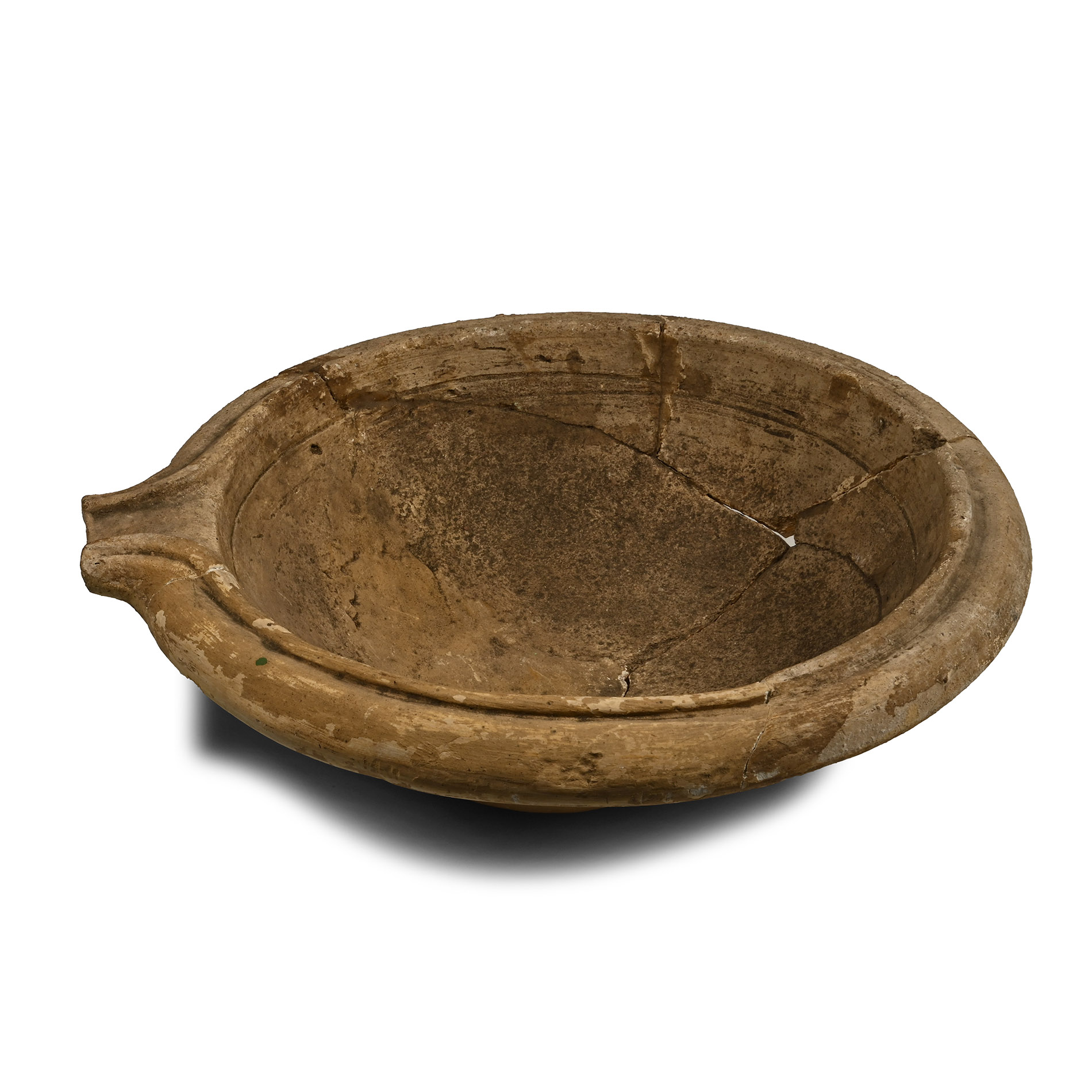
Romano-British Buffware Mortaria from Nene Valley
2ND-3RD CENTURY A.D.
13 5/8 in. (2.41 kg, 34.5 cm wide).
With broad squat body, lip inside the curved rim, ribbed pouring lip; repaired. [No Reserve]
ProvenanceFound Nene Valley, Peterborough, UK.
From an old English collection.
Acquired from Helios Gallery in 2011.
Ian Wilkinson collection, Nottinghamshire, UK, formed since 1985.
This lot is accompanied by an illustrated lot declaration signed by the Head of the Antiquities Department, Dr Raffaele D’Amato.
See Darling, M.J., Roman Pottery from the Upper Defences, Lincoln Archaeological Trust. Monograph, 16/2, Council for British Archaeology for the Lincoln Archaeological Trust, London, (1984), pp.69-73, for similar.
CONDITIONTimeLine Auctions follows a vetting process to ensure the authenticity and legality of all items, reinforcing our commitment to integrity and responsible trading. Each antiquity, antique, and coin lot undergoes thorough examination by a vetting committee of at least ten external specialists, professional trade association members, scientists, and archaeologists: Our Vetting Process
AUCTIONS:
TimeLine is a leading auction house specialising in antiquities, ancient art, collectables, natural history, coins, medals, and books. Our auctions offer museums, collectors, historians, and enthusiasts the opportunity to acquire unique and historically significant pieces.
-
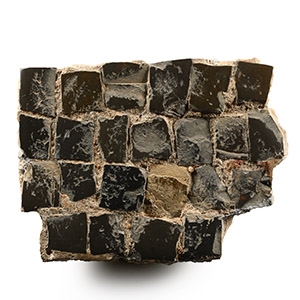
Roman Floor Mosaic Section
2nd-4th century A.D.Sold for (Inc. bp): £286
With oblong tesserae in matrix, mainly blue-grey in colour on the exposed faces but pale grey to the underside. 289 grams, 91 mm
Found Thuburbo Majus, Tunisia, North Africa. Imported to the UK before 1945. From a private old collection formed in the mid 20th century. Ian Wilkinson collection, Nottinghamshire, UK, formed since 1985. This lot is accompanied by an illustrated lot declaration signed by the Head of the Antiquities Department, Dr Raffaele D’Amato. -
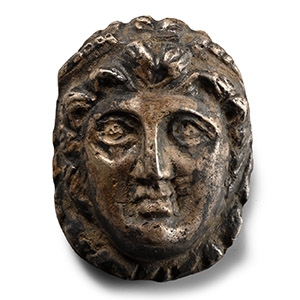
Roman Silver Applique Mask
2nd-4th century A.D.Sold for (Inc. bp): £247
Appliqué with repoussé detailing, mask of Alexander the Great or Dionysus with diadem to his brow. 3.77 grams, 22 mm
Acquired on the London art market in the late 1980s-1990s. From the family collection of an East London, UK, gentleman. This lot is accompanied by an illustrated lot declaration signed by the Head of the Antiquities Department, Dr Raffaele D’Amato.
Similar applications in bronze or silver (sometimes even in gold) decorated the triclinia of rich aristocrats, or the precious furnishings in fine wood of the furniture of the Villas. -
.jpg)
Roman Bronze Chariot Fitting of a Celtic Prisoner
2nd-3rd century A.D.Sold for (Inc. bp): £3,900
Bust and torso of an indigenous nobleman modelled in the round; with rounded facial features, the shoulder-length hair dressed in hanks and cut into tiers, centre-parted and framing the face; the eyes exaggerated, probably originally emphasised with sheet-silver detailing; the broad chest smooth with ring-and-dot nipples; a thick collar or torc sitting high on the collar-bone, with braided detailing and finished with a D-shaped pendant; each upper-arm supported by a barley-twist column with cup finial and stylised flames above; the centre supported by a rectangular block with incised herringbone linear pattern interspersed with pointillé pellets; the base broad and gently curved away from the figure, with a lattice of bilinear panels bearing groups of three ring-and-dot motifs, D-shaped loop to the forward edge flanked by smaller lobes; the reverse plain, the head hollow with remains of a thick loop at the lower edge of the hair; significant iron deposits to surface from its deposition environment; of provincial Roman workmanship. 461 grams, 13 cm
From a collection acquired on the UK art market from various auction houses and collections mostly before 2000. From an important Cambridgeshire estate; thence by descent. This lot is accompanied by an illustrated lot declaration signed by the Head of the Antiquities Department, Dr Raffaele D’Amato.
Its construction with a central block flanked by two short pillars (i.e. leaving two slots) suggests that the piece may have been intended as a rein-guide for a chariot, whereby the leather or fabric straps would pass through the two apertures and, by their separation, be prevented from tangling. Bronze figural busts are known from Gallo-Roman contexts: they are usually female and interpreted as tutelae or protective tribal spirits (Boucher & Tassinari, 1976, items 62-4). The present example is evidently designed to impress the viewer with its portrayal of the 'noble barbarian' as a suitable conveyor of martial splendour (Boucher & Tassinari, 1976, item 321). The impressive figure recalls the famed statue 'The Dying Gaul' in the Capitoline Museum, Rome, showing a 'barbarian' warrior with a neck torc, thick hair and moustache, discarded weapons and shield carved on the ground and a carnyx trumpet between his legs. The statue is a copy of a Hellenistic original celebrating a Greek victory over the Galatians.
