Loading, please wait...
Details
LOT 0163
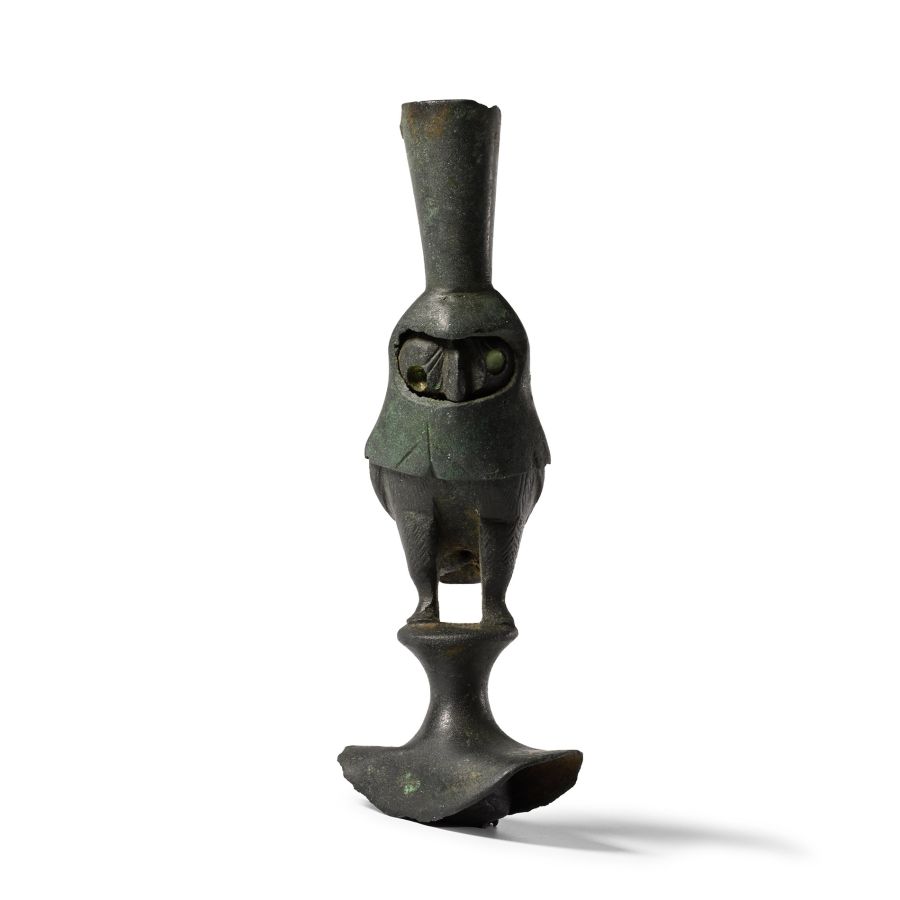
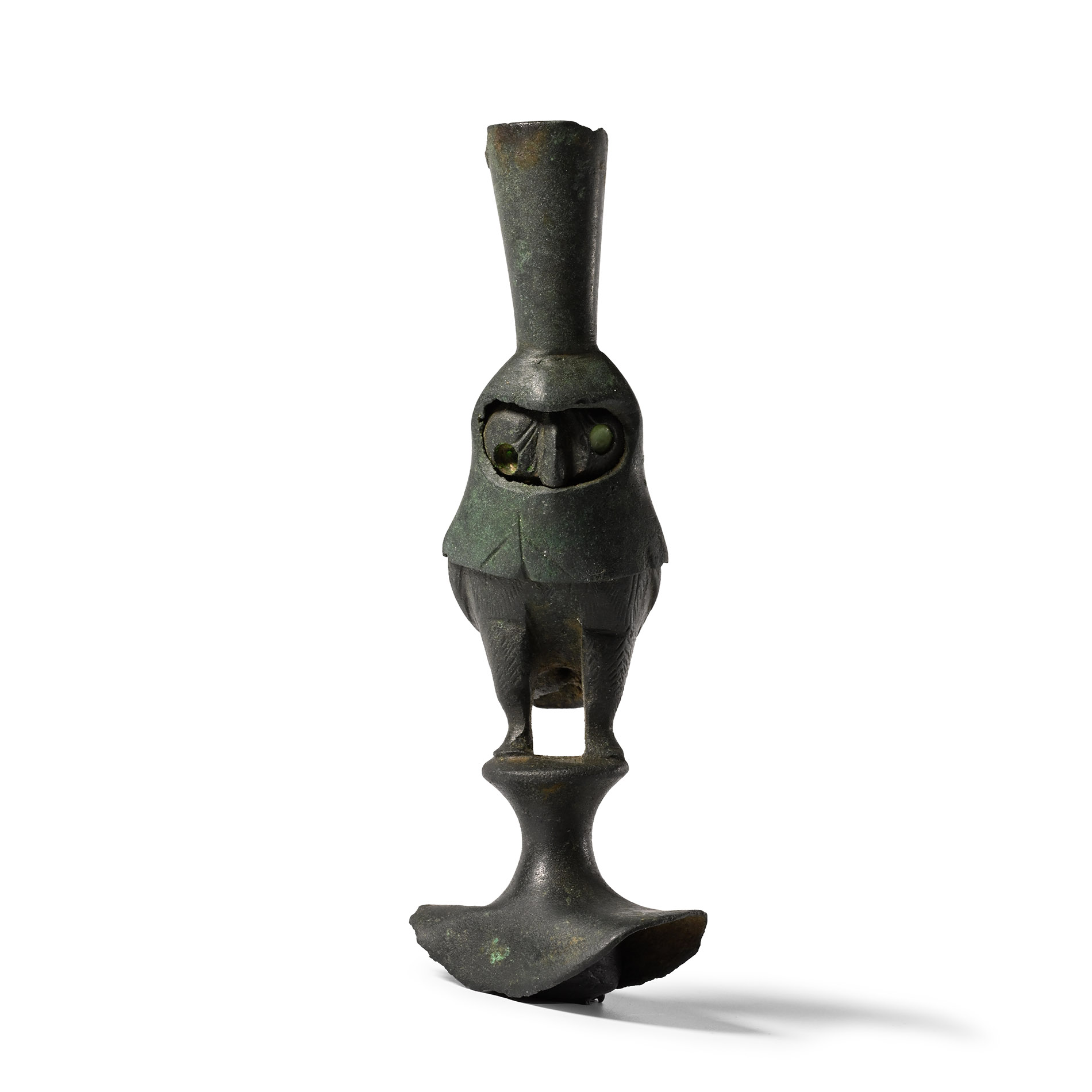
Romano-British Bronze Owl Candlestick
1ST-2ND CENTURY A.D.
4 1/8 in. (70 grams, 10.5 cm).
Comprising a stylised owl figurine standing on a flared base, with incised feather detailing to the wings, legs and body, recessed eyes to accept glass inserts (one absent); fitted with a separately modelled cowl or hood with incised detail to the breast, topped with a conical finial to accept a candle.
Provenance
Acquired in the 1980s.
From the Belgian collection of Mr D.S. of Flemu.
Property of a North London, UK, gentleman.
Literature
Cf. similar owl figurine found in the Cotswolds and recorded with the PAS under reference. GLO-452F33, published in Current Archaeology, 1st June 2022; M.J. Green Corpus of Small Cult-Objects from the Military Areas of Roman Britain, BAR British Series, Oxford, 1978.
Footnotes
The owl was the symbol of the Goddess Minerva in Roman tradition. Her name is linked etymologically to the English word 'mind' and she was considered to be the source of human intellect, patron of wisdom, crafts and sciences.
The base of the figurine has been bent laterally as if to mount it on a post or rail.
VETTING:
TimeLine Auctions follows a vetting process to ensure the authenticity and legality of all items, reinforcing our commitment to integrity and responsible trading. Each antiquity, antique, and coin lot undergoes thorough examination by a vetting committee of at least ten external specialists, professional trade association members, scientists, and archaeologists: Our Vetting Process
AUCTIONS:
TimeLine is a leading auction house specialising in antiquities, ancient art, collectables, natural history, coins, medals, and books. Our auctions offer museums, collectors, historians, and enthusiasts the opportunity to acquire unique and historically significant pieces.
RELATED LOTS
-
Roman Bronze Silenus Figurine
1st-2nd century A.D.Estimate: £3,000 - 4,000 (‡+bp*)
Opening Bid: £1,400
Standing nude with vine-leaf wreath on the brow, muscular physique, dressed beard and stern facial expression, holding a bunch of grapes in the left hand; accompanied by a custom-made display stand. 104 grams, 65 mm high (127 grams total, 71 mm high including stand)
Private Swiss collection, acquired 2001. This lot has been checked against the Interpol Database of stolen works of art and is accompanied by search certificate no.11621-199008.
Silenus was closely associated with the Dionysian cult. He was a deity associated with the forest, wine, drunkenness, the treading-dance of the wine press as an orgiastic ritual. While intoxicated, Silenus was believed to possess the power of prophecy. He helped raise the god Dionysus, son of Zeus, after he was entrusted to him by Hermes. Once, while travelling with Dionysus through Phrygia, Silenus was captured by King Midas who treated his captive hospitably. As a reward, Dionysus granted the king his famous 'golden touch'. The sacred animal of Silenus is the donkey, the mode of transport he often used according to Greek mythology. -
Onyx Gemstone with Hercules
Roman, 2nd-3rd century A.D. or laterEstimate: £1,000 - 1,400 (+bp*)
Opening Bid: £500
Intaglio of Hercules stepping over a sleeping dog to receive a hen from an opposed female; supplied with a museum-quality impression. 1.35 grams, 20 mm
From the collection of a Swiss gentleman formed in Europe from 1970-1980s; thence by descent from the family in London. -
Roman Marble Statue of a Seated Female
Circa 2nd-3rd century A.D.Estimate: £15,000 - 20,000 (+bp*)
Opening Bid: £7,500
A Roman copy after a Hellenistic original, probably representing the goddess Demeter or Aphrodite sitting on a rock with her legs slightly parted, left hand resting on her lap and holding a pomegranate(?); the right arm stretched out to her side and holding a water jug that appears to have been reworked at a later time; dressed in a floor-length chiton with vertical folds and fastened under the breasts by a high belt; himation only covering the lower part of the body leaving her pleated dress clearly visible between her legs; her wavy hair with central parting and collected in a soft chignon at the nape of the neck; the face with schematic features with large eyes and raised eyelids, a small fleshy mouth and a prominent chin. 14.9 kg, 39 cm high
Ex Paris collection. French gallery, Paris, 1990-2000s. Accompanied by an academic report by Dr Marina Mattei and Dr Laura Maria Vigna. This lot has been checked against the Interpol Database of stolen works of art and is accompanied by search certificate number no.11932-209624
The statuette seems to refer to the iconography of the goddess Demeter. Water, an element of purification, is a constant in the cult of this goddess, as is the fruit clutched in her left hand, most likely a pomegranate, an allusive attribute of nourishment and her relationship with Hades. The pomegranate links the iconography to the rape of Persephone, appearing among the funerary symbols as nourishment for the afterlife. Precise references and comparisons can be found with the terracotta statuette, found near Vetralla, in the National Etruscan Museum Rocca Albornoz of Viterbo and with the female bust of the sanctuary of Demeter of San Biagio in Agrigento, for the treatment of the hair and the facial features. The Demeter of Cnidus, a marble statue dated to 350 B.C., today in the British Museum, represents the goddess sitting on a throne wearing a long chiton and himation. The hairstyle with hair gathered in a low knot on the back of the head, however, references directly that of the Cnidian Aphrodite of Praxiteles. The statuette in question could be a copy of the Greek deity Demeter/Persephone created in Roman times, a period in which the cult overlaps with that of Ceres. In the early Imperial age there are examples of contamination of the iconography of Demeter/Persephone with Ceres, as attested among others by the statues of the Capitoline Museums inv. 231 and that of the Roman Theatre of Merida (Spain) in the National Museum of Roman Art, dated to the 1st century A.D.