
Loading, please wait...
_900x900.jpg "Romano-British Bronze Chariot Terret Ring")
_200x200.jpg "Romano-British Bronze Chariot Terret Ring")
.jpg "Romano-British Bronze Chariot Terret Ring")
LOT 0710
Romano-British Bronze Chariot Terret Ring
CIRCA 1ST CENTURY A.D.
2 3/4 in. (76.36 grams, 70.36 mm overall, 21.92 mm internal diameter (approximate size British V, USA 10 1/2, Europe 23.77, Japan 22)).
Comprising a substantial ring mounted on a short neck with tiered collars and facetted flared flange below; three radiating carinated knops, loop to the underside.
ProvenanceFound Thetford, Norfolk.
From an East Anglian private collection.
Cf. Megaw, R.& V., Celtic Art. From its Beginnings to the Book of Kells, London, 1989, item 225, for type.
CONDITIONTimeLine Auctions follows a vetting process to ensure the authenticity and legality of all items, reinforcing our commitment to integrity and responsible trading. Each antiquity, antique, and coin lot undergoes thorough examination by a vetting committee of at least ten external specialists, professional trade association members, scientists, and archaeologists: Our Vetting Process
AUCTIONS:
TimeLine is a leading auction house specialising in antiquities, ancient art, collectables, natural history, coins, medals, and books. Our auctions offer museums, collectors, historians, and enthusiasts the opportunity to acquire unique and historically significant pieces.
-
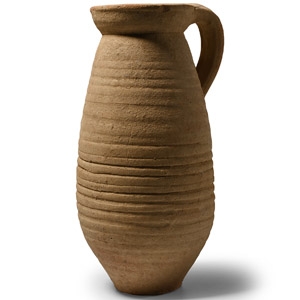
Roman Buff Ware Jug
North African, 2nd-3rd century A.D.Sold for (Inc. bp): £72
A pitcher with short footed base and ribbed sides that taper to the neck; topped by a wide, flared spout and thick strap handle; to the base 'from Tunisia - - (?) 1951'. 347 grams, 16.5 cm
Acquired London art market, 1960s-1980s. Ex property of an Essex, UK, collector. -
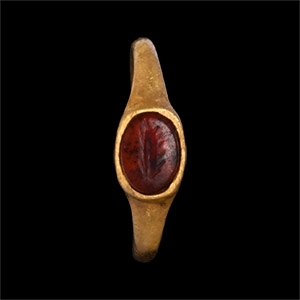
Roman Gold Ring with Ear of Wheat Gemstone
2nd-3rd century A.D.Sold for (Inc. bp): £650
With flat shoulders and ellipsoid plaque, inset carnelian cloison with ear of wheat motif; supplied with a museum-quality impression. 3.98 grams, 23.11 mm overall, 19.74 mm internal diameter (approximate size British O, USA 7, Europe 14.98, Japan 14)
Ex German art market, 2000s. Acquired from an EU collector living in London. From the collection of Surrey, UK, gentleman. -
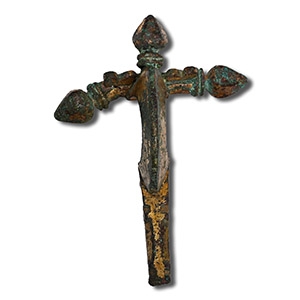
Roman Gilt Bronze Crossbow Brooch
3rd-4th century A.D.Estimate: £300 - 400 (‡+bp*)
Opening Bid: £150
With collared onion-knop finials, keeled deep bow and short chamfered foot; pin in situ. 56 grams, 86 mm
Acquired in Switzerland, 1997. Private collection, Europe.
