
Loading, please wait...
_900x900.jpg "Romanian Orthodox Royal Wooden Doors with Annunciation Scene")
_200x200.jpg "Romanian Orthodox Royal Wooden Doors with Annunciation Scene")
_900x900.jpg "Romanian Orthodox Royal Wooden Doors with Annunciation Scene")
_200x200.jpg "Romanian Orthodox Royal Wooden Doors with Annunciation Scene")
_900x900.jpg "Romanian Orthodox Royal Wooden Doors with Annunciation Scene")
_200x200.jpg "Romanian Orthodox Royal Wooden Doors with Annunciation Scene")
_900x900.jpg "Romanian Orthodox Royal Wooden Doors with Annunciation Scene")
_200x200.jpg "Romanian Orthodox Royal Wooden Doors with Annunciation Scene")
_900x900.jpg "Romanian Orthodox Royal Wooden Doors with Annunciation Scene")
_200x200.jpg "Romanian Orthodox Royal Wooden Doors with Annunciation Scene")
.jpg "Romanian Orthodox Royal Wooden Doors with Annunciation Scene")
.jpg "Romanian Orthodox Royal Wooden Doors with Annunciation Scene")
.jpg "Romanian Orthodox Royal Wooden Doors with Annunciation Scene")
.jpg "Romanian Orthodox Royal Wooden Doors with Annunciation Scene")
.jpg "Romanian Orthodox Royal Wooden Doors with Annunciation Scene")
LOT 2067
Romanian Orthodox Royal Wooden Doors with Annunciation Scene
CIRCA 1750 A.D.
52 x 13 3/8 in (13.8 kg total, 132 x 34 cm each).
Each door a single board with graduated scalloped upper edge, horizontal wooden bars to the reverse, hand-forged iron hinge knuckles and D-section leader to left door; primed with tempera on both faces and painted on the obverse, each with a bottle-green field, blue-grey frontage with vermillion upper storey and gilt roof; Left Door: portion of city wall with tall, narrow building behind, balcony at the upper level with King David standing holding an unfurled scroll, wearing a gilt crown, vermillion tunic and blue mantle; before the wall a winged angel Gabriel holding a frond, wearing a draped mantle over ankle-length chiton and sandals; above, red painted legend 'BOUNA'; to the right edge, a D-section leader painted with red, white and blue diagonal stripes; Right Door: portion of city wall with tall, narrow building behind, balcony at the upper level with King Solomon standing holding a scroll and wearing a gilt crown, similar tunic and mantle to the other; dove descending towards Mary standing before the wall in front of a cushioned throne, with gilt nimbus around her head; red painted legend 'V E S T I R E' above; rare. [2]
ProvenanceProperty of a London, UK, gentleman collector.
Accompanied by a copy of a Romanian export licence.
Accompanied by an academic report by Dr Raffaele D’Amato.
This lot has been checked against the Interpol Database of stolen works of art and is accompanied by search certificate number no.12466-229954.
This lot has been cleared against the Art Loss Register database, and is accompanied by an illustrated lot declaration signed by the Head of the Antiquities Department, Dr Raffaele D'Amato.
Cf. Popescu, G.A., Cristiani d'Oriente, spiritualità, arte e potere nell'Europa Post-Bizantina, Milano, 1999, fig.69, for similar; cf. also Baboș, A., ’Royal Doors of Maramures beyond their appearances’ in Museikon, a journal of Religious Art and Culture, 6/2022, pp.263-294, for similar doors and discussion.
FootnotesThe 'royal doors' (Greek: Ωραία Πύλη) mark the entrance to the iconostasis (wooden screen hiding the altar) in an Eastern Orthodox church.
CONDITIONTimeLine Auctions follows a vetting process to ensure the authenticity and legality of all items, reinforcing our commitment to integrity and responsible trading. Each antiquity, antique, and coin lot undergoes thorough examination by a vetting committee of at least ten external specialists, professional trade association members, scientists, and archaeologists: Our Vetting Process
AUCTIONS:
TimeLine is a leading auction house specialising in antiquities, ancient art, collectables, natural history, coins, medals, and books. Our auctions offer museums, collectors, historians, and enthusiasts the opportunity to acquire unique and historically significant pieces.
LOT 2067
Romanian Orthodox Royal Wooden Doors with Annunciation Scene
Sold for (Inc. bp): £4,680
-
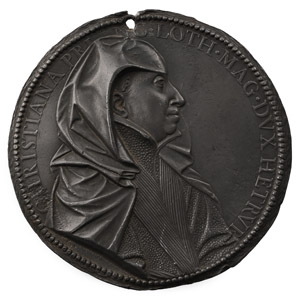
Christine of Lorraine Lead Commemorative Medallion
Circa 1900 A.D.Sold for (Inc. bp): £26
Discoid unifacial medallion pierced close to the beaded rim; profile bust with legend. 119 grams, 96 mm
Acquired on the UK art market in the early 2000s. This lot is accompanied by an illustrated lot declaration signed by the Head of the Antiquities Department, Dr Raffaele D'Amato. -
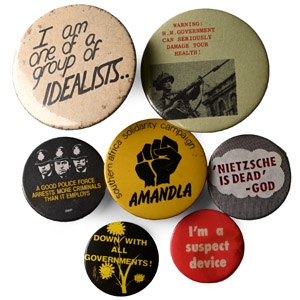
Anti-Society Related Vintage Pin Badge Collection
Circa 1970s A.D. and laterSold for (Inc. bp): £46
Including Southern Africa Solidarity Campaign 'Amandla', 'Down with all governments' and other types. 32.8 grams total, 31-55 mm
From the private collection of a S.W. London gentleman, acquired in the 1970s. This lot is accompanied by an illustrated lot declaration signed by the Head of the Antiquities Department, Dr Raffaele D'Amato. -
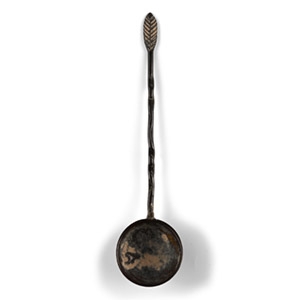
Post Medieval Bronze Medical Spoon
18th century A.D.Sold for (Inc. bp): £33
Deep bowl with flange rim, tendril detailing to the handle, leaf finial. 11 grams, 14cm
Formerly in an old collection formed in the 1970s. Ex property of a Dutch gentleman. Property of a Cheshire, UK, gentleman. This lot is accompanied by an illustrated lot declaration signed by the Head of the Antiquities Department, Dr Raffaele D'Amato.
