
Loading, please wait...


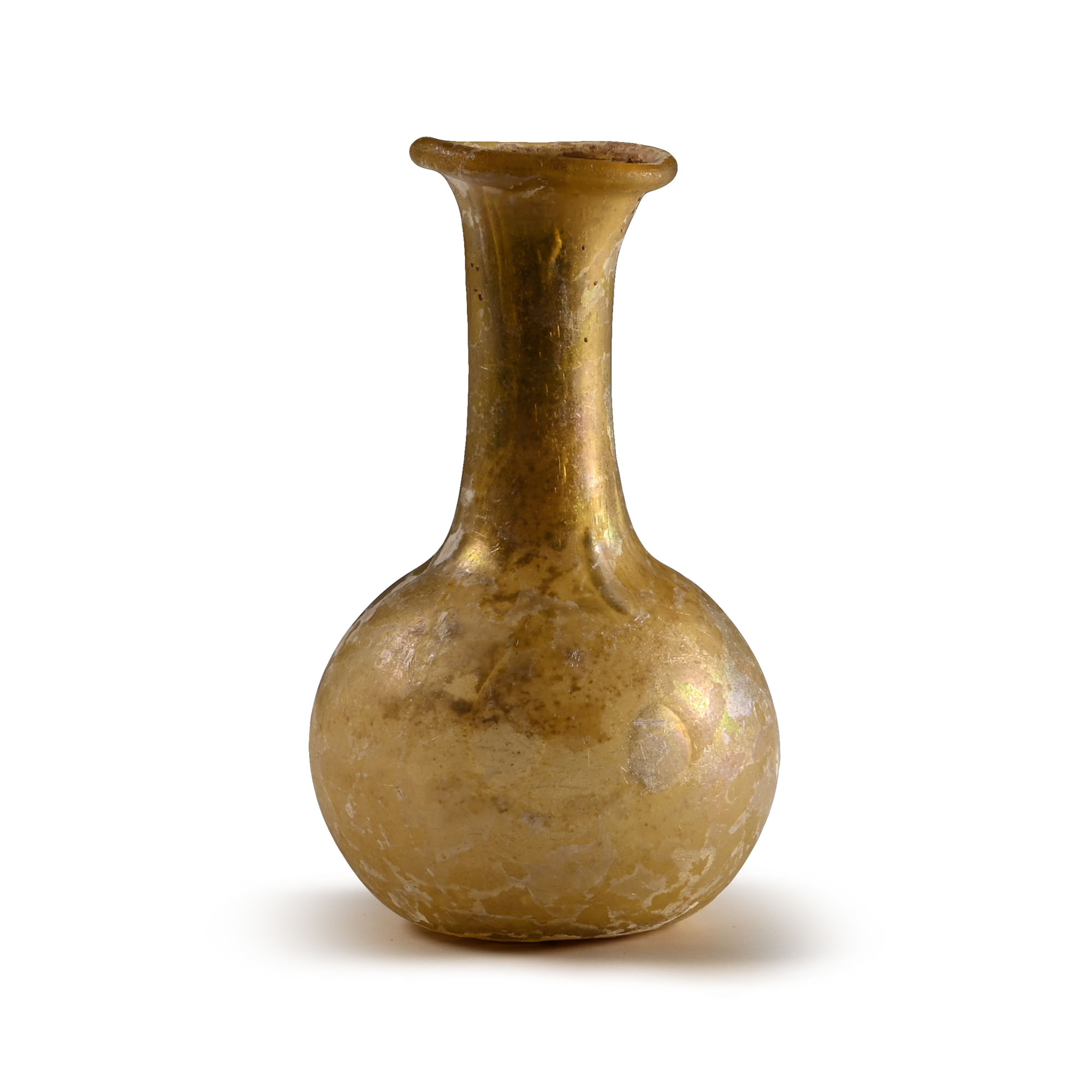
LOT 0733
Roman Yellow Glass Bottle with Iridescence
2ND-3RD CENTURY A.D.
2 1/2 in. (10.1 grams, 65 mm).
Bulbous body with dimpled underside, tubular neck with rolled and folded rim, iridescent surface. [No Reserve]
Provenancewith H.A.C., Basel, prior 1999.
This lot is accompanied by an illustrated lot declaration signed by the Head of the Antiquities Department, Dr Raffaele D’Amato.
Cf. Whitehouse, D., Roman Glass in the Corning Museum of Glass, vol.2, New York, 2001, item 772.
CONDITIONTimeLine Auctions follows a vetting process to ensure the authenticity and legality of all items, reinforcing our commitment to integrity and responsible trading. Each antiquity, antique, and coin lot undergoes thorough examination by a vetting committee of at least ten external specialists, professional trade association members, scientists, and archaeologists: Our Vetting Process
AUCTIONS:
TimeLine is a leading auction house specialising in antiquities, ancient art, collectables, natural history, coins, medals, and books. Our auctions offer museums, collectors, historians, and enthusiasts the opportunity to acquire unique and historically significant pieces.
-
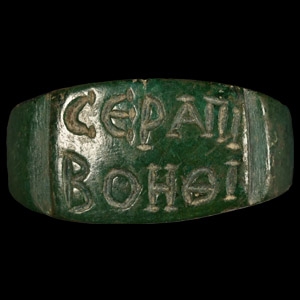
Roman Bronze 'Help Me Serapis' Ring
2nd-3rd century A.D.Sold for (Inc. bp): £1,040
With rectangular plaque, incuse Greek inscription 'CEPAΔωΠI/BOHΘI' (Help me Serapis). 3.74 grams, 20.40 mm overall, 17.71 mm internal diameter (approximate size British K 1/2, USA 5 1/2, Europe 10.58, Japan 10)
Ex German art market, 2000s. Acquired from an EU collector living in London. From the collection of Surrey, UK, gentleman. This lot is accompanied by an illustrated lot declaration signed by the Head of the Antiquities Department, Dr Raffaele D’Amato. -
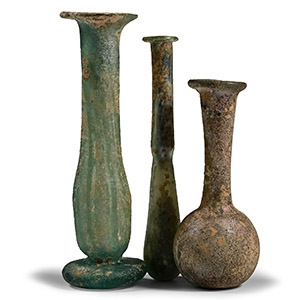
Roman Glass Vessel Group
1st century A.D.Sold for (Inc. bp): £260
Comprising three unguentaria, one with an applied disc foot. 110 grams total, 9.3-12.3 cm
Acquired from Ancient & Oriental, 1980s-1990s. Ian Wilkinson collection, Nottinghamshire, UK, formed since 1985. This lot is accompanied by an illustrated lot declaration signed by the Head of the Antiquities Department, Dr Raffaele D’Amato.
Unguentaria or lacrimatoria (tear-bottles) are among the most common items of Roman blown glass found in the graves. They were cheap and quick to produce, used for perfumes, cosmetics and other gifts offered to the dead. -
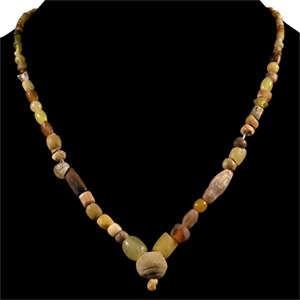
Roman Yellow Glass Bead Necklace String
1st-4th century A.D. and laterSold for (Inc. bp): £65
A designer necklace composed of mainly oblate and barrel-shaped beads, central feature composed of a large spherical bead with a small annular bead below. 35.5 grams, 41.5 cm
Acquired 1980-2015. Ex Abelita family collection. This lot is accompanied by an illustrated lot declaration signed by the Head of the Antiquities Department, Dr Raffaele D’Amato.
