
Loading, please wait...
LOT 0733
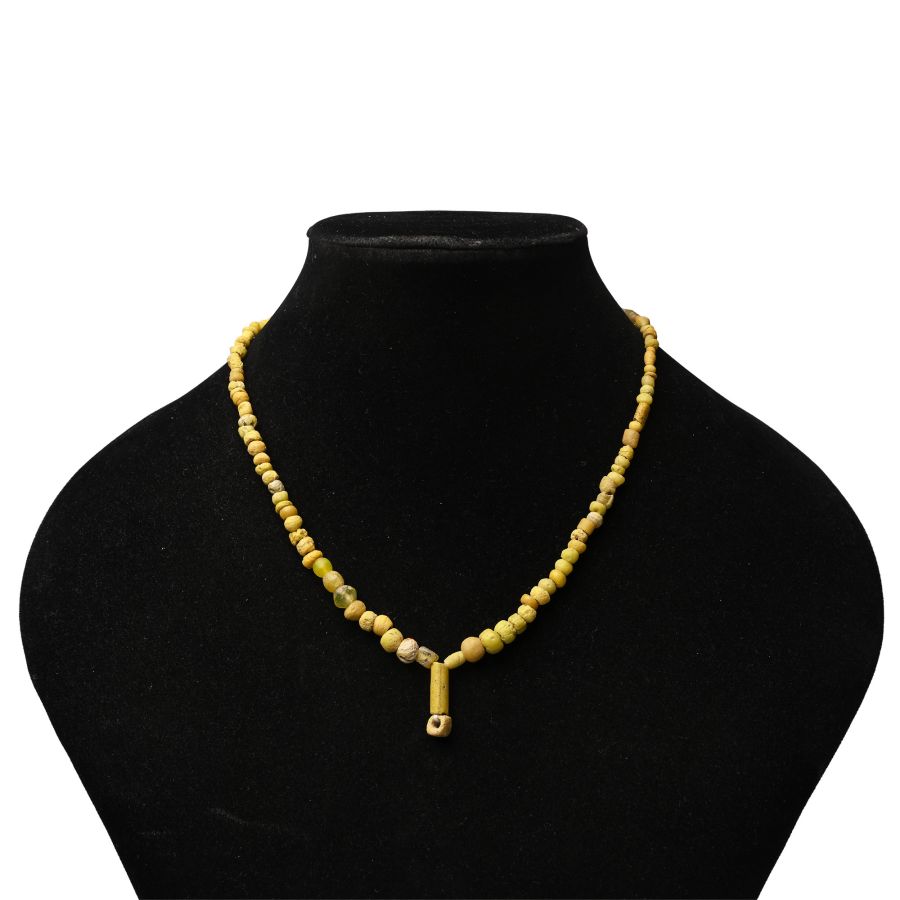
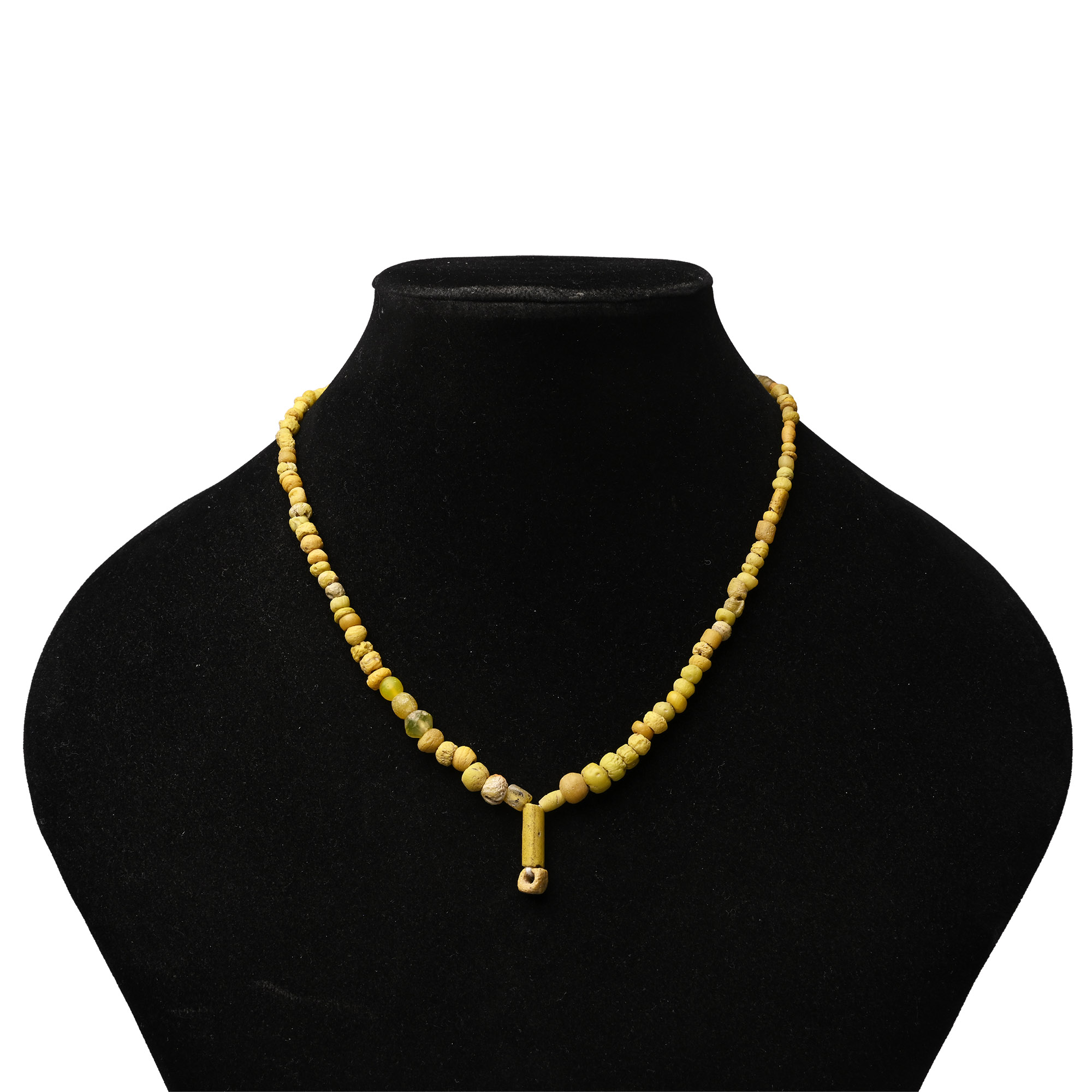
Roman Yellow Glass Bead Necklace String
1ST-4TH CENTURY A.D. AND LATER
15 5/8 in. (16.8 grams, 39.7 cm).
Composed mainly of oblate beads, central feature composed of a tubular bead with a facetted bead suspended below; restrung. [No Reserve]
ProvenanceFrom the London, UK, art market in the 1990s.
This lot is accompanied by an illustrated lot declaration signed by the Head of the Antiquities Department, Dr Raffaele D'Amato.
For example of similar yellow Roman beads see Then-Obluska, J., ‘Beads and pendants from the Hellenistic to early Byzantine Red Sea port of Berenike, Egypt, Seasons 2014 and 2015’ in Polish Archaeology in the Mediterranean, 27/1, 2018, pp.203–234, figs.8, 9b,10a,12b.
FootnotesIn the Roman period there was a strong formal and chromatic diversity of glass beads used for necklaces and bracelets. The most common beads in forms were small biconical (lenticular), barrel-shaped, spherical and annular; the most common colours were dark blue, followed by green and yellow. The succession of glass beads often imitates jewellery made of costly materials (gold, silver, semi-precious and precious stones).
CONDITIONTimeLine Auctions follows a vetting process to ensure the authenticity and legality of all items, reinforcing our commitment to integrity and responsible trading. Each antiquity, antique, and coin lot undergoes thorough examination by a vetting committee of at least ten external specialists, professional trade association members, scientists, and archaeologists: Our Vetting Process
AUCTIONS:
TimeLine is a leading auction house specialising in antiquities, ancient art, collectables, natural history, coins, medals, and books. Our auctions offer museums, collectors, historians, and enthusiasts the opportunity to acquire unique and historically significant pieces.
-
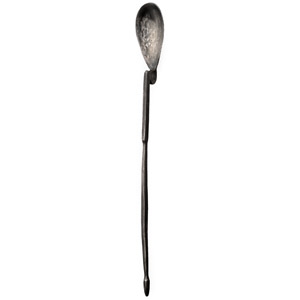
Roman Silver Ligula Spoon
3rd-4th century A.D.Sold for (Inc. bp): £260
With long rectangular-section stem and deep ovoid bowl. 22 grams, 17.7 cm
Ex German art market, 2000s. Acquired from an EU collector living in London. From the collection of a Surrey, UK, gentleman. This lot is accompanied by an illustrated lot declaration signed by the Head of the Antiquities Department, Dr Raffaele D'Amato. -
.jpg)
Late Roman Gnostic Hematite Gemstone with Standing Figure
3rd century A.D.Estimate: £1,500 - 2,000 (‡+bp*)
Opening Bid: £750
Discoid with chamfered edge, standing youth on a baseline with patera in one hand, sword at his hip, enigmatic legend above 'HICAPH[.]K'; supplied with a museum-quality impression. 3 grams, 20 mm
Acquired in 1994. Private collection, thence by descent. Private collection, since the late 1990s. This lot has been checked against the Interpol Database of stolen works of art and is accompanied by a search certificate number no.12867-241734. This lot has been cleared against the Art Loss Register database, and is accompanied by an illustrated lot declaration signed by the Head of the Antiquities Department, Dr Raffaele D'Amato. -
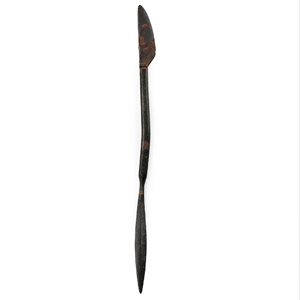
Roman Bronze Medical Scalpel Implement
1st-4th century A.D.Sold for (Inc. bp): £143
Single-edged blade with scooped forward edge attached to an octagonal-section shank with lanceolate probe to the other end. 12 grams, 14 cm
Ex German art market, 2000s. Acquired from an EU collector living in London. From the collection of a Surrey, UK, gentleman. This lot is accompanied by an illustrated lot declaration signed by the Head of the Antiquities Department, Dr Raffaele D'Amato.
