
Loading, please wait...
_900x900.jpg "Roman White Gemstone with Alexander the Great and Philosopher Diogenes of Sinope")
_200x200.jpg "Roman White Gemstone with Alexander the Great and Philosopher Diogenes of Sinope")
.jpg "Roman White Gemstone with Alexander the Great and Philosopher Diogenes of Sinope")
LOT 0006
Roman White Gemstone with Alexander the Great and Philosopher Diogenes of Sinope
2ND-3RD CENTURY A.D.
5/8 in. (1.24 grams, 16.27 mm).
Frieze depicting a seated Alexander the Great holding a ring or collar towards a philosopher emerging from a cauldron; supplied with a museum-quality impression. [No Reserve]
ProvenanceFrom the private collection of a European gentleman (1942-2024), formed since the 1970s.
FootnotesDiogenes of Sinope (c. 412-323 BCE) was an ancient Greek philosopher and one of the founders of Cynicism. He became famous for rejecting wealth, comfort, and social rules, choosing instead to live with very few possessions. He is often said to have lived in a large ceramic jar in Athens, sometimes described as a barrel or tub. Known for his sharp wit and simple way of life, he is also remembered for telling Alexander the Great to step out of his sunlight.
CONDITIONTimeLine Auctions follows a vetting process to ensure the authenticity and legality of all items, reinforcing our commitment to integrity and responsible trading. Each antiquity, antique, and coin lot undergoes thorough examination by a vetting committee of at least ten external specialists, professional trade association members, scientists, and archaeologists: Our Vetting Process
AUCTIONS:
TimeLine is a leading auction house specialising in antiquities, ancient art, collectables, natural history, coins, medals, and books. Our auctions offer museums, collectors, historians, and enthusiasts the opportunity to acquire unique and historically significant pieces.
LOT 0006
Roman White Gemstone with Alexander the Great and Philosopher Diogenes of Sinope
Sold for (Inc. bp): £169
-
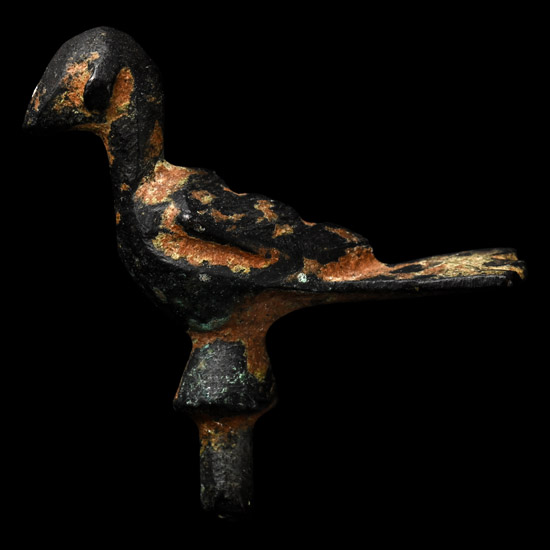
Roman Bronze Bird Finial
2nd-4th century A.D.Sold for (Inc. bp): £65
Modelled in the round with a long tail and small pellet eyes. 9.28 grams, 31 mm high
From the private collection of a European gentleman (1942-2024), formed since the 1970s. -
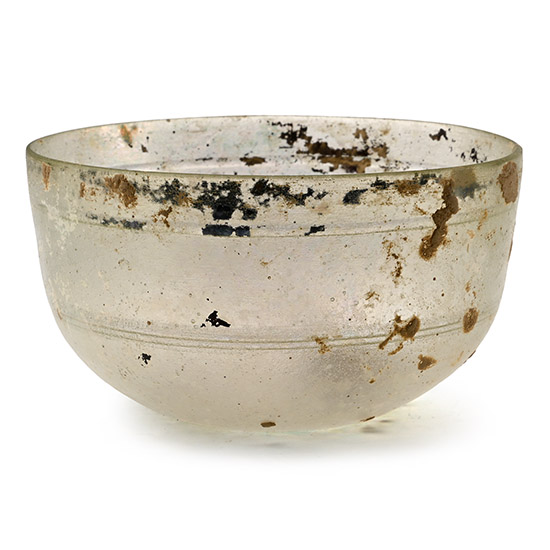
Roman Wheel-Cut Clear Glass Bowl
1st-2nd century A.D.Sold for (Inc. bp): £3,640
Hemispherical in profile with a broad base, bands of wheel-cut horizontal lines to the inner face. 87 grams, 11.4 cm
Private collection, USA and Switzerland, acquired in the late 1980s-early 1990s; thence by descent.
Such bowls are related to the form of Terra Sigillata according to several scholars. The period of their widest use is between 70 and 130 A.D. It was widely used throughout the western parts of the Empire, and especially in Italy. Similar bowls could also be found in the Eastern Mediterranean and were probably produced in Italic workshops, since there are numerous finds in Ticino. -
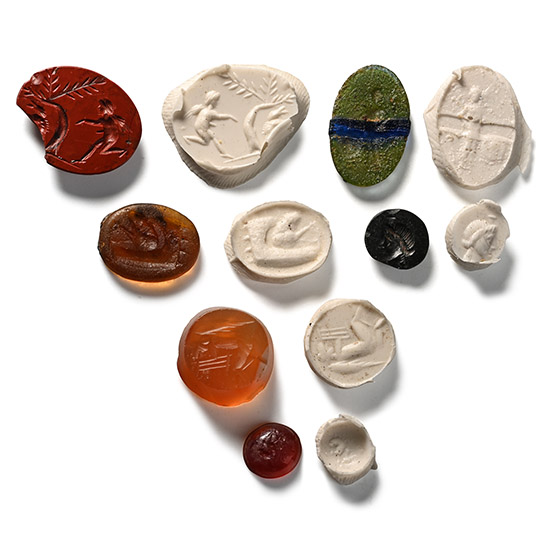
Roman Gemstone and Glass Intaglio Collection
Circa 2nd-3rd century A.D.Sold for (Inc. bp): £195
Comprising: horse in profile; athlete with tree; profile bust; two with crouching figures; standing figure; each supplied with a museum-quality impression. 3.50 grams total, 7.34-16.23 mm
From the private collection of a European gentleman (1942-2024), formed since the 1970s.
