
Loading, please wait...
LOT 0735
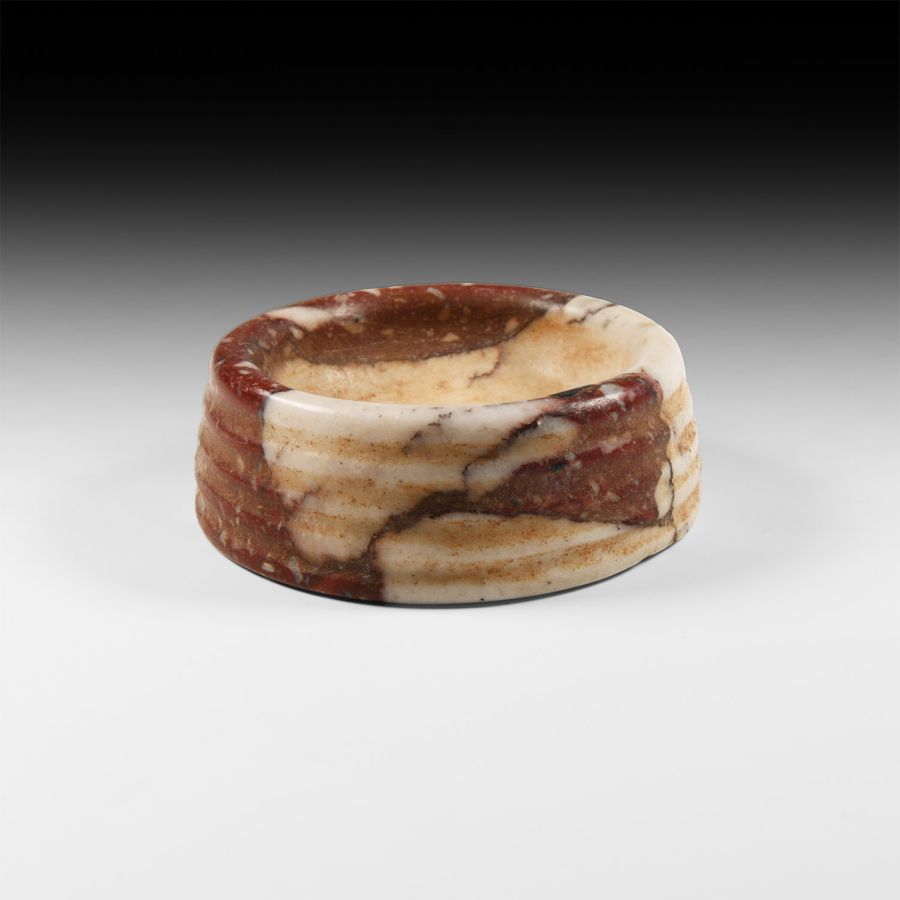
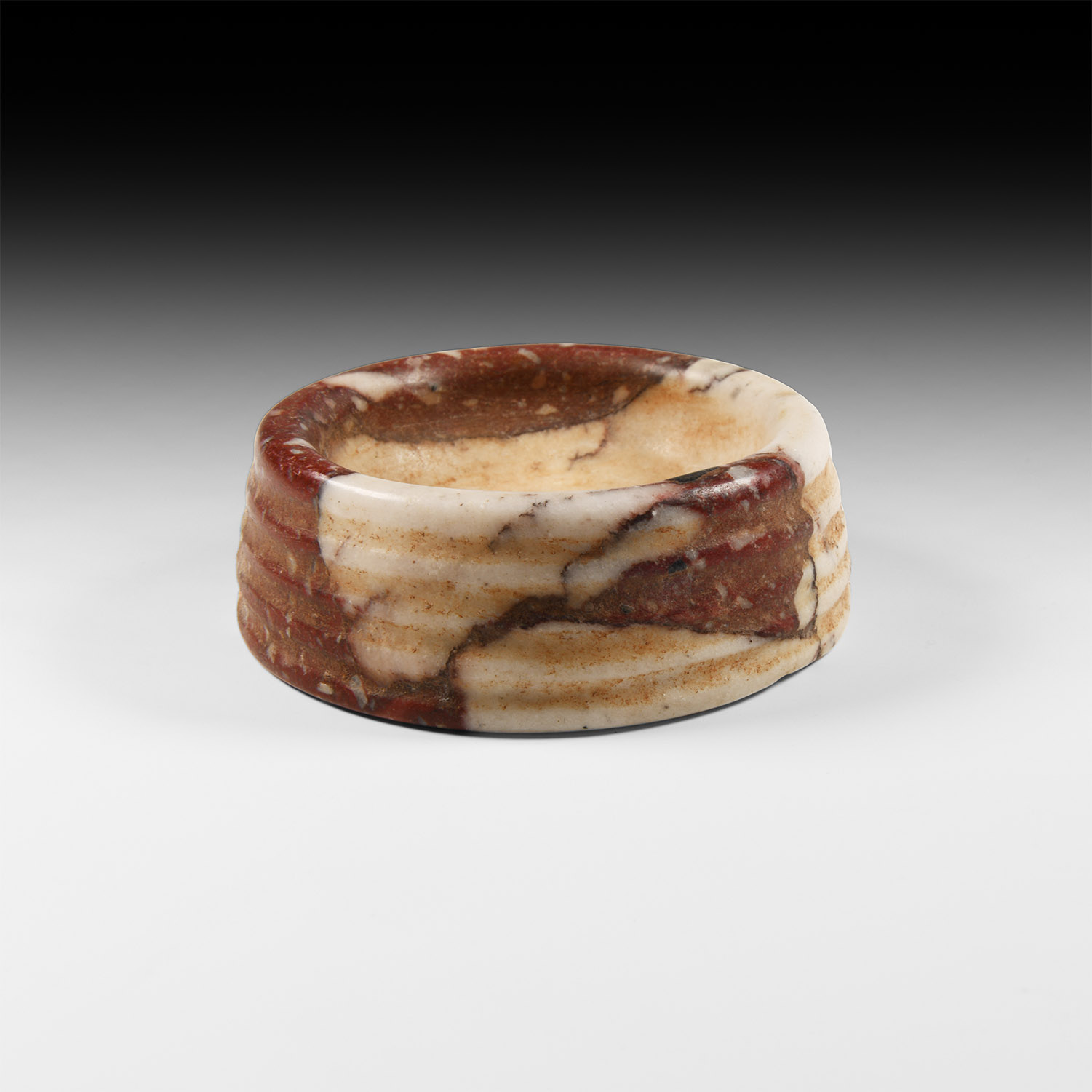
Roman Veined Porphyry Dish
1ST-2ND CENTURY A.D.
2 1/2 in. (134 grams, 65 mm wide).
A shallow mottled 'red' and 'white' marble dish, possibly porphyry marble, with gently sloping gusseted sidewall.
ProvenanceFrench collection, 1960s-early 2000s.
From an important Paris gallery, France.
TimeLine Auctions follows a vetting process to ensure the authenticity and legality of all items, reinforcing our commitment to integrity and responsible trading. Each antiquity, antique, and coin lot undergoes thorough examination by a vetting committee of at least ten external specialists, professional trade association members, scientists, and archaeologists: Our Vetting Process
AUCTIONS:
TimeLine is a leading auction house specialising in antiquities, ancient art, collectables, natural history, coins, medals, and books. Our auctions offer museums, collectors, historians, and enthusiasts the opportunity to acquire unique and historically significant pieces.
-
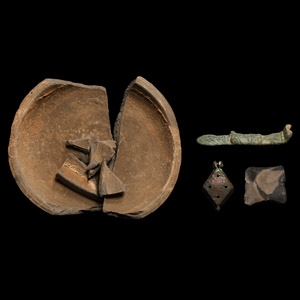
Roman and Other Artefact Group
Circa 1st century A.D. and laterSold for (Inc. bp): £5
A mixed group of artefacts comprising: fragments of a ceramic bowl; a Roman seal-box base; a zoomorphic footplate from an Anglian cruciform brooch; a gun flint. 126 grams total, 24-87 mm
Essex gallery, early 2000s. -
.jpg)
Roman Vine Leaf Mount
1st-2nd century A.D.Sold for (Inc. bp): £39
A bronze mount or harness fitting in the form of a vine leaf displaying simple stylised detailing to the front face, together with a raised perforated lug and scooped plaque above; suspension loop to the reverse. 57 grams, 58 mm
Found Cambridgeshire in the 1990s. -
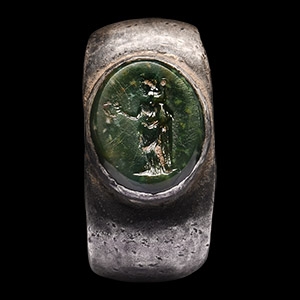
Roman Silver Ring with Goddess Gemstone
2nd-3rd century A.D. or laterSold for (Inc. bp): £390
A silver ring composed of a convex ellipsoid hoop, expanding at the shoulders to a raised oval bezel with collar, set with a green jasper intaglio gemstone engraved with the image of a goddess, carrying a staff and a laurel crown. 8.43 grams, 23.53 mm overall, 19.80 mm internal diameter (approximate size British M 1/2, USA 6 1/4, Europe 13.09, Japan 12)
Acquired in the late 1990s-2000. Property of an East London gentleman.
The ring presents similarities with the type II, variant 1 of the Ruseva-Slokoska classification. Many rings with images of divinities were found by the archaeologists as votive offerings to the divinities engraved on the bezel. It is difficult to interpret which divinity is represented in this ring, but the sceptre and the laurel crown could hint at it being Hera or Juno.
