
Loading, please wait...
LOT 0549
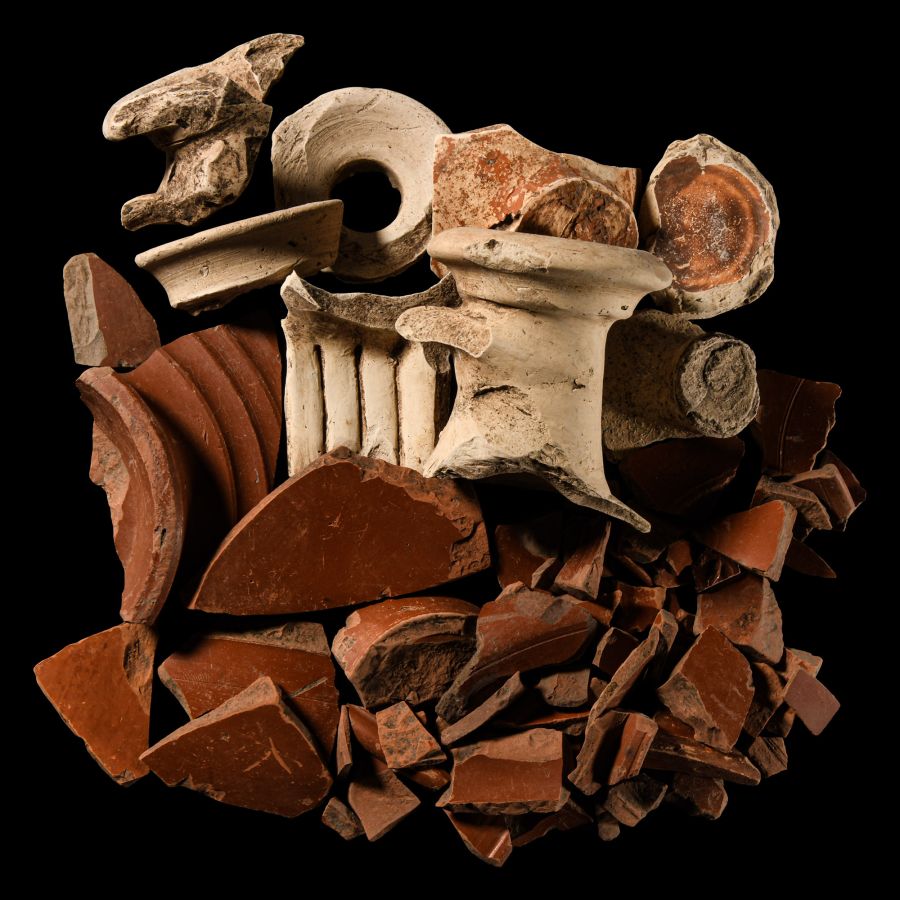
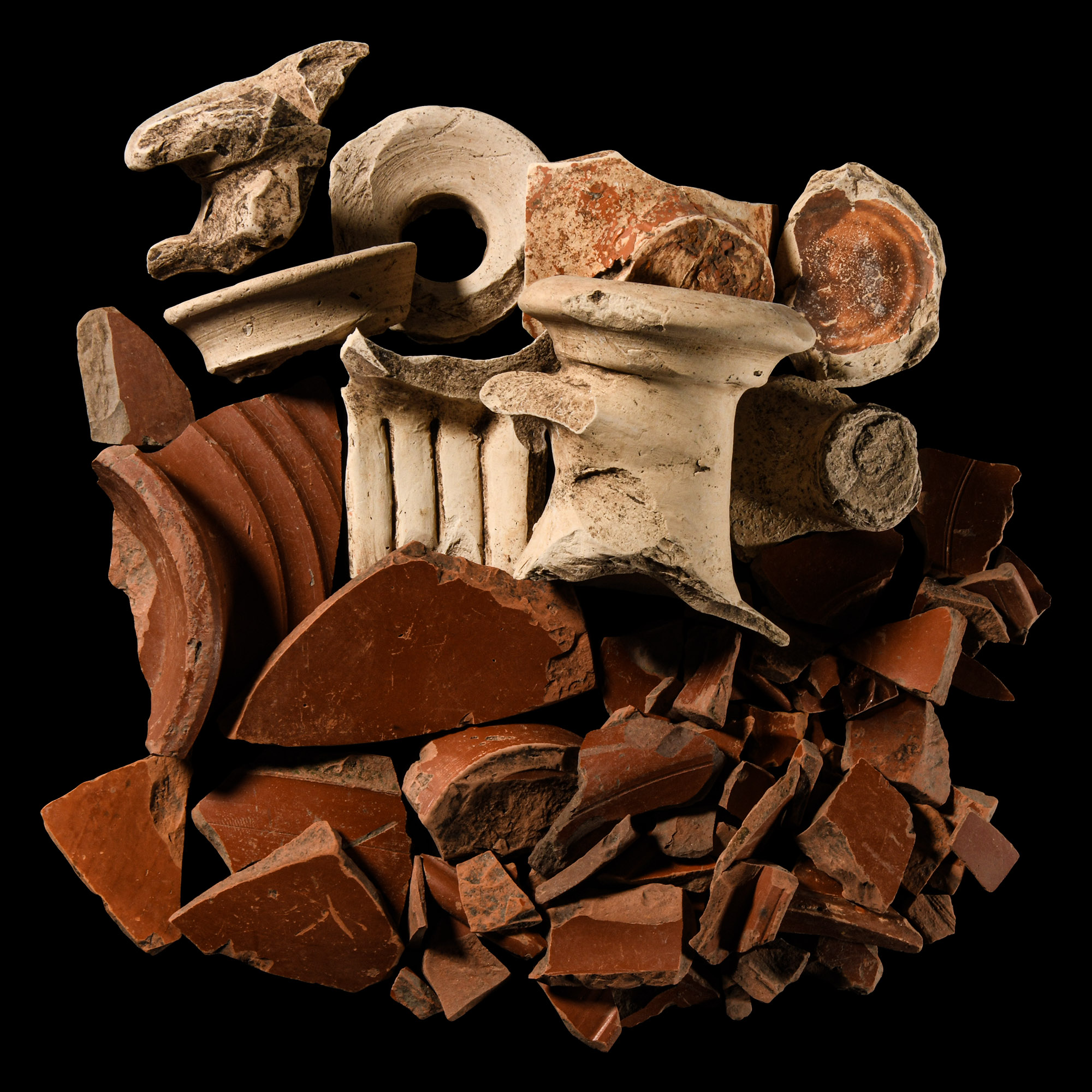
Roman 'Vechten Fort' Terracotta Sherd Collection
1ST-4TH CENTURY A.D.
1/4 - 3 in. (586 grams total, 7-74 mm).
Comprising a large quantity of pottery and red-ware sherds from large and small vessels, including an amphora neck and part of a handle. [78, No Reserve]
ProvenanceFound near Vechten, Netherlands.
Netherlands private collection.
Acquired from a private collector in 2009.
Property of a Nottinghamshire gentleman.
Accompanied by a typed information sheet.
Cf. Van Diepen, L., and Niemeijer, R., ‘Die Terra Sigillata aus Forum Hadriani – Arentsburg, Die Funde der Grabung 2005’ in Müller, M., Terra Sigillata in den germanischen Provinzen, Xantener Berichte, Band 20, Mainz, 2011, pp.163-220, pp. 202ff., for similar terra sigillata.
FootnotesFectio, modern Vechten, was a fort in the limes, the frontier zone of the Roman Empire, situated at the site of the bifurcation of the rovers Rhine and Vecht. Numismatic evidence suggests that it was founded by the Roman general Tiberius (the future emperor) during the 4/5th campaigns. It probably served as a military base during punitive raids. Around the middle of the 2nd century AD, the wood and earth fort was replaced by a stone fortification and occupied by the Ala I Thracum, who had previously been stationed in Britain. At the end of the 2nd/beginning of the 3rd century, the silting up of the Rhine’s arm on which Fectio lays had progressed to such an extent that access from the river was no longer possible. In the more than two and a half centuries of its existence, the camp was destroyed and rebuilt several times until the fort site was finally abandoned - as evidenced by archaeological traces of fire after a final destruction in 270/275 A.D.
CONDITIONTimeLine Auctions follows a vetting process to ensure the authenticity and legality of all items, reinforcing our commitment to integrity and responsible trading. Each antiquity, antique, and coin lot undergoes thorough examination by a vetting committee of at least ten external specialists, professional trade association members, scientists, and archaeologists: Our Vetting Process
AUCTIONS:
TimeLine is a leading auction house specialising in antiquities, ancient art, collectables, natural history, coins, medals, and books. Our auctions offer museums, collectors, historians, and enthusiasts the opportunity to acquire unique and historically significant pieces.
-
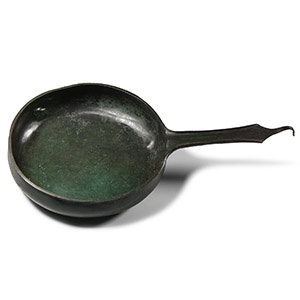
Roman Bronze Pan with Handle
1st century B.C.-1st century A.D.Estimate: £1,200 - 1,700 (+bp*)
Opening Bid: £667
The bowl with a wide flat bottom and convex sides; the inside with incised concentric circles; flat handle with raised edges and hooked finial for suspension. 483 grams, 39.5 cm
German private collection, Mr O., collecting in the 1950s-1960s; thence by descent. with Bonhams, London, 7 July 2016, lot 191. Accompanied by an academic report by Dr Raffaele D’Amato. This lot has been checked against the Interpol Database of stolen works of art and is accompanied by search certificate number no.11735-201189.
This vessel was part of Roman and provincial bronze instrumentum domesticum, i.e. culinary or domestic utility ware. Such cooking vessels are rare: some are found in central and northern Italy, in Pannonia, Germany and in Britain. The Aylesford Pan, today in the British Museum (inventory no.1886.1112.1), is one of the most important finds. This specimen (Eggers type 130), probably pre-Caesarian or Caesarian, was found in a grave together with a Celtic bucket and a jug. -
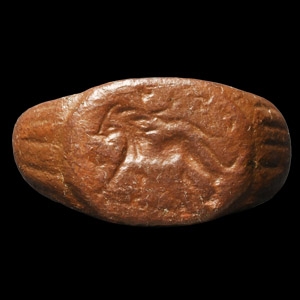
Roman Bronze Ring with Lion
Circa 2nd-4th century A.D.Sold for (Inc. bp): £46
The narrow hoop expanding at the fluted shoulders, oval bezel with intaglio image of an advancing lion with voluminous mane. 5.58 grams, 24.46 mm overall, 19.29 mm internal diameter (approximate size British M 1/2, USA 6 1/4, Europe 13.09, Japan 12)
From the collection of a High Wycombe, Buckinghamshire, UK, gentleman, circa 2000. -
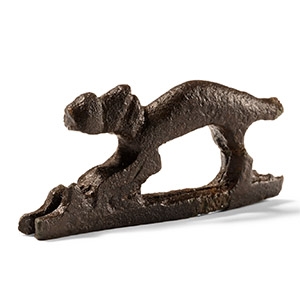
Roman Bronze Knife Handle Section
1st-4th century A.D.Sold for (Inc. bp): £66
From a folding knife handle, having a hound in an active pose chasing a hare, the hare absent. 7.98 grams, 39 mm wide
Found Kettering, Northamptonshire, UK.
