
Loading, please wait...
LOT 0687
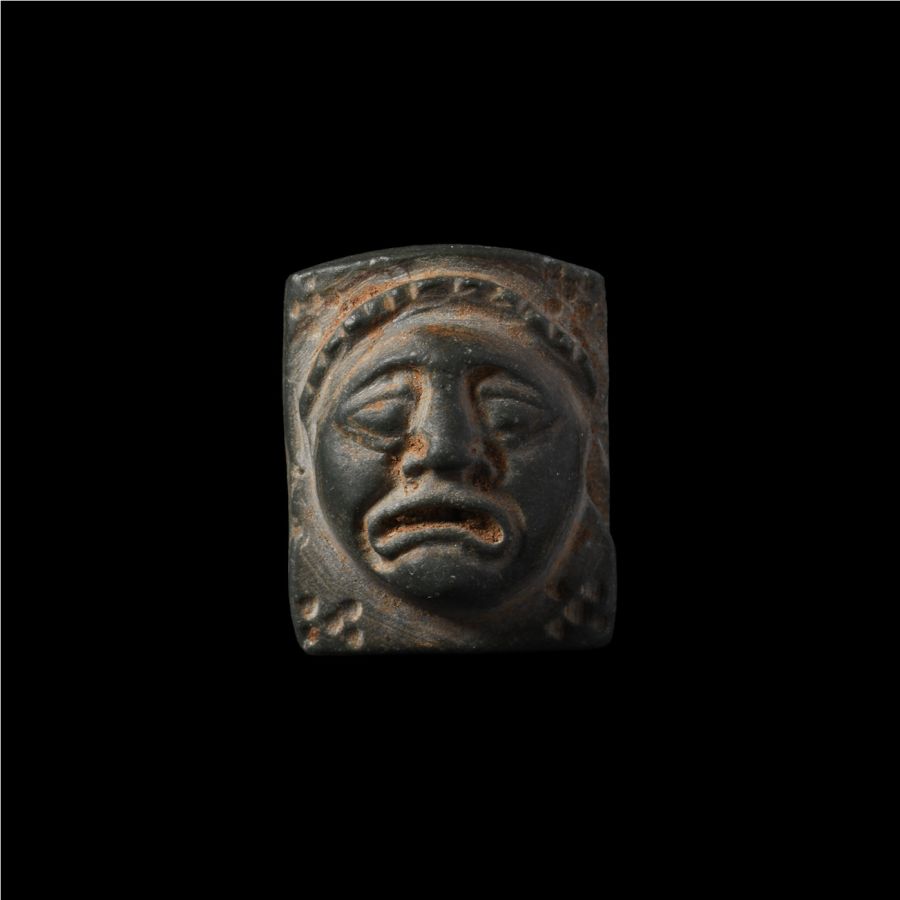
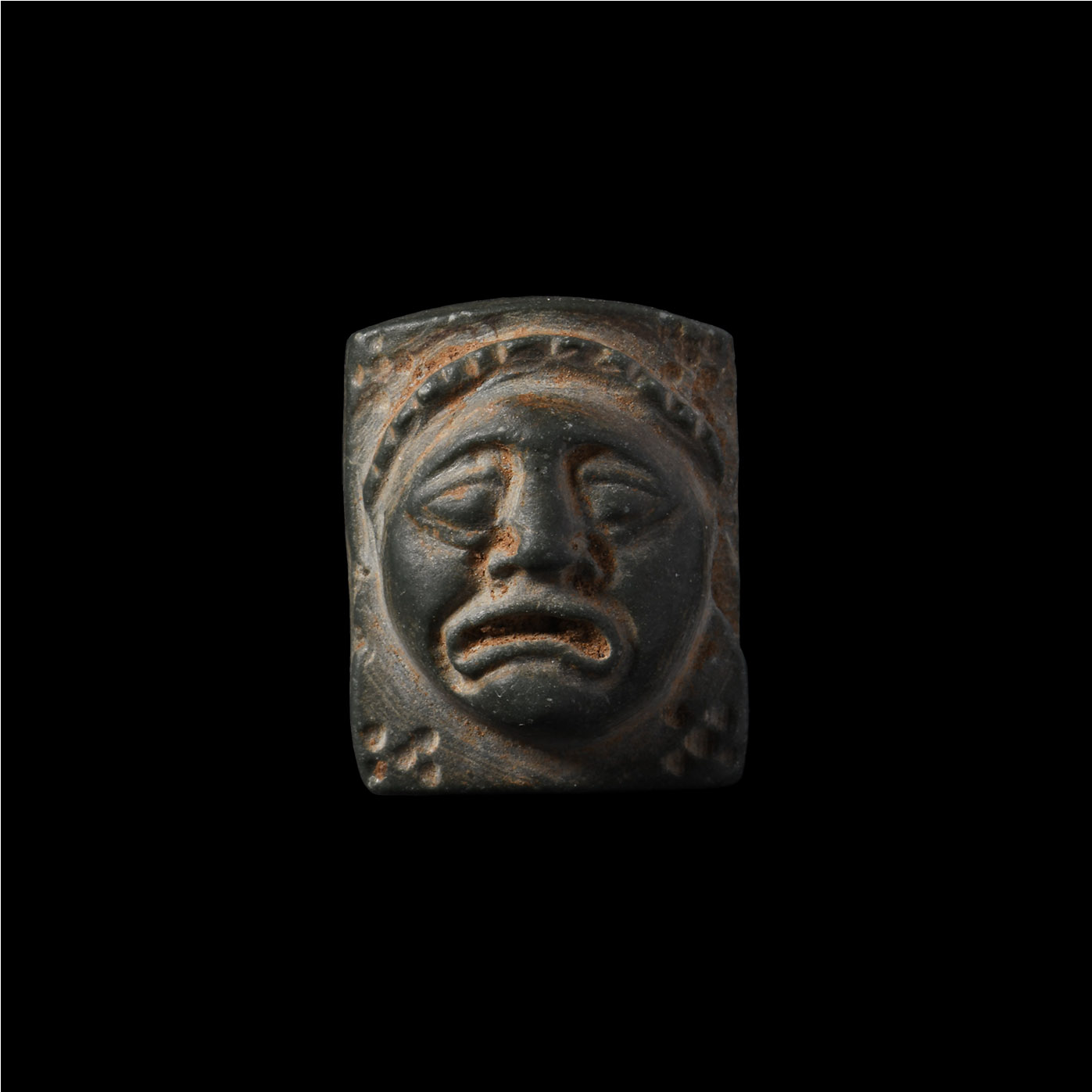
Roman Tragic Mask Applique
1ST CENTURY A.D. OR LATER
2/3 in. (3 grams, 16.2 mm).
A rectangular slate mount showing the head of a tragic mask with angular eyes, straight nose and a clownish, down-turned mouth. [No Reserve]
ProvenanceAcquired from Galerie Jean Phillipe Mariaud de Serres, 1990-2000.
Property of a French collector.
Cf. for similar appliqués Rolland, H., Bronzes Antiques De Haute Provence, Paris, 1965, items 330-332.
FootnotesSmall appliqués like this one were common in Roman furniture. In the Graeco-Roman world, comic and tragic masks played an important role in Greek drama, commonly performed in the Roman Empire. The actors had the ability to easily play more than one character in succession with a simple change of masks, and the characters of the masks became popular objects in the material culture.
CONDITIONTimeLine Auctions follows a vetting process to ensure the authenticity and legality of all items, reinforcing our commitment to integrity and responsible trading. Each antiquity, antique, and coin lot undergoes thorough examination by a vetting committee of at least ten external specialists, professional trade association members, scientists, and archaeologists: Our Vetting Process
AUCTIONS:
TimeLine is a leading auction house specialising in antiquities, ancient art, collectables, natural history, coins, medals, and books. Our auctions offer museums, collectors, historians, and enthusiasts the opportunity to acquire unique and historically significant pieces.
-
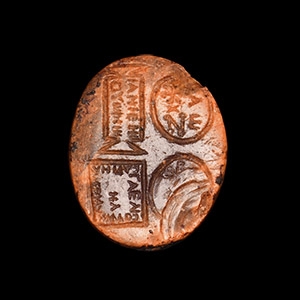
Roman Epigraphic Gemstone with Symbols
4th-5th century A.D.Sold for (Inc. bp): £910
An epigraphic gem of oval shape, with a smooth surface on one side and inscriptions of a magical-Christian nature engraved in tondos and tabulae ansatae on the other side, one bearing the Greek letters Α and ω (Alpha and Omega) above the letters I and X. 0.84 grams, 17 mm
Acquired before 1988. Ex family collection, by descent, Geneva.
The letter Alfa and Omega (A W) are a clear link with a Christian cult, especially in this case in which the two letters are incised over the other two letter Iota and Chi IX, initials of the Greek Iesus Xριστός 'Christ'. The letters Alpha and Omega are symbols of eternity of the Divine Figure (I am the Alpha and the Omega, the First and the Last, the Beginning and the End, Revelation, 22.13). -

Roman Style Silver Ring with Cupid Riding a Dolphin Gemstone
20th century A.D. or earlierEstimate: £300 - 400 (+bp*)
Opening Bid: £150
A silver finger ring with inset onyx gemstone, intaglio of a boy riding on the back of a dolphin and wielding a whip. 9.29 grams, 27.65 mm overall, 20.67 mm internal diameter (approximate size British O, USA 7, Europe 14.98, Japan 14)
English private collection. -
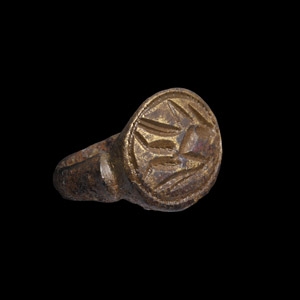
Late Roman Ring with Man Catching Fish
3rd century A.D.Sold for (Inc. bp): £70
A silvered bronze finger ring with stepped shoulders, large ellipsoid bezel with incuse ropework border and stylised figure raising a fish. 6.43 grams, 24.13 mm overall, 17.48 mm internal diameter (approximate size British O, USA 7, Europe 14.98, Japan 14)
Fine condition.
with M. Labarbe, Toulouse, France, 27 November 2011, lot 228. Property of a London gentleman
