
Loading, please wait...
_900x900.jpg "Roman 'The Wakefield' Bronze Founding of Rome Commemorative Military Phalera")
_200x200.jpg "Roman 'The Wakefield' Bronze Founding of Rome Commemorative Military Phalera")
.jpg "Roman 'The Wakefield' Bronze Founding of Rome Commemorative Military Phalera")
LOT 0168
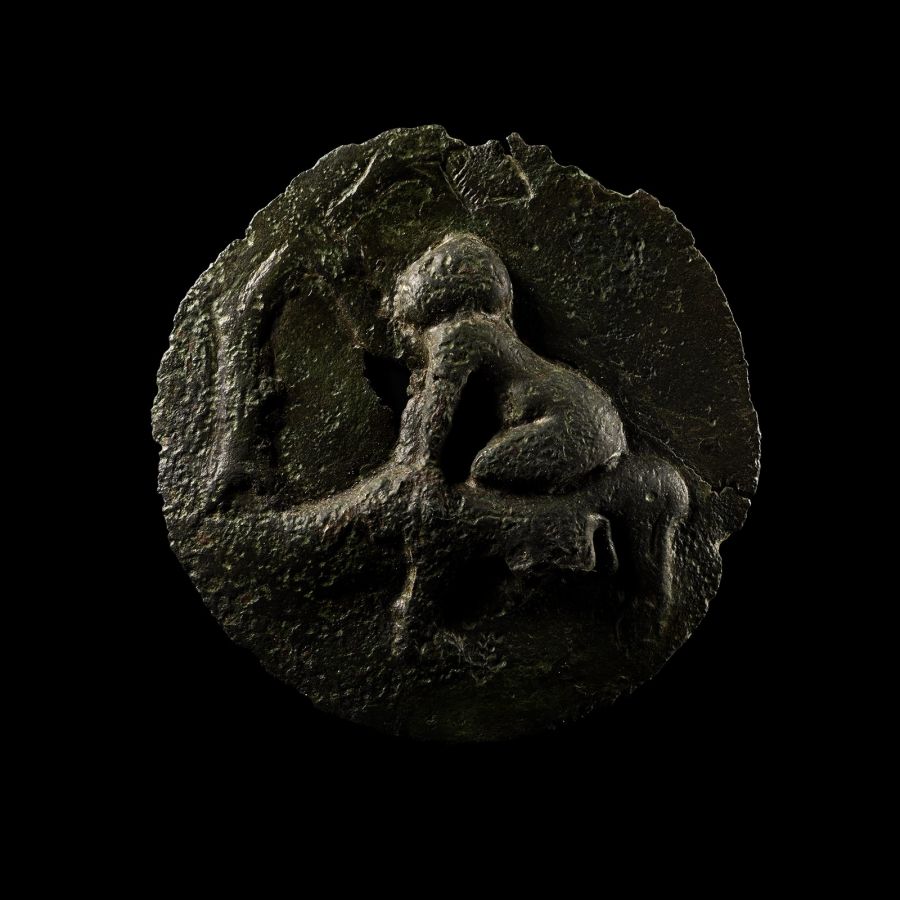
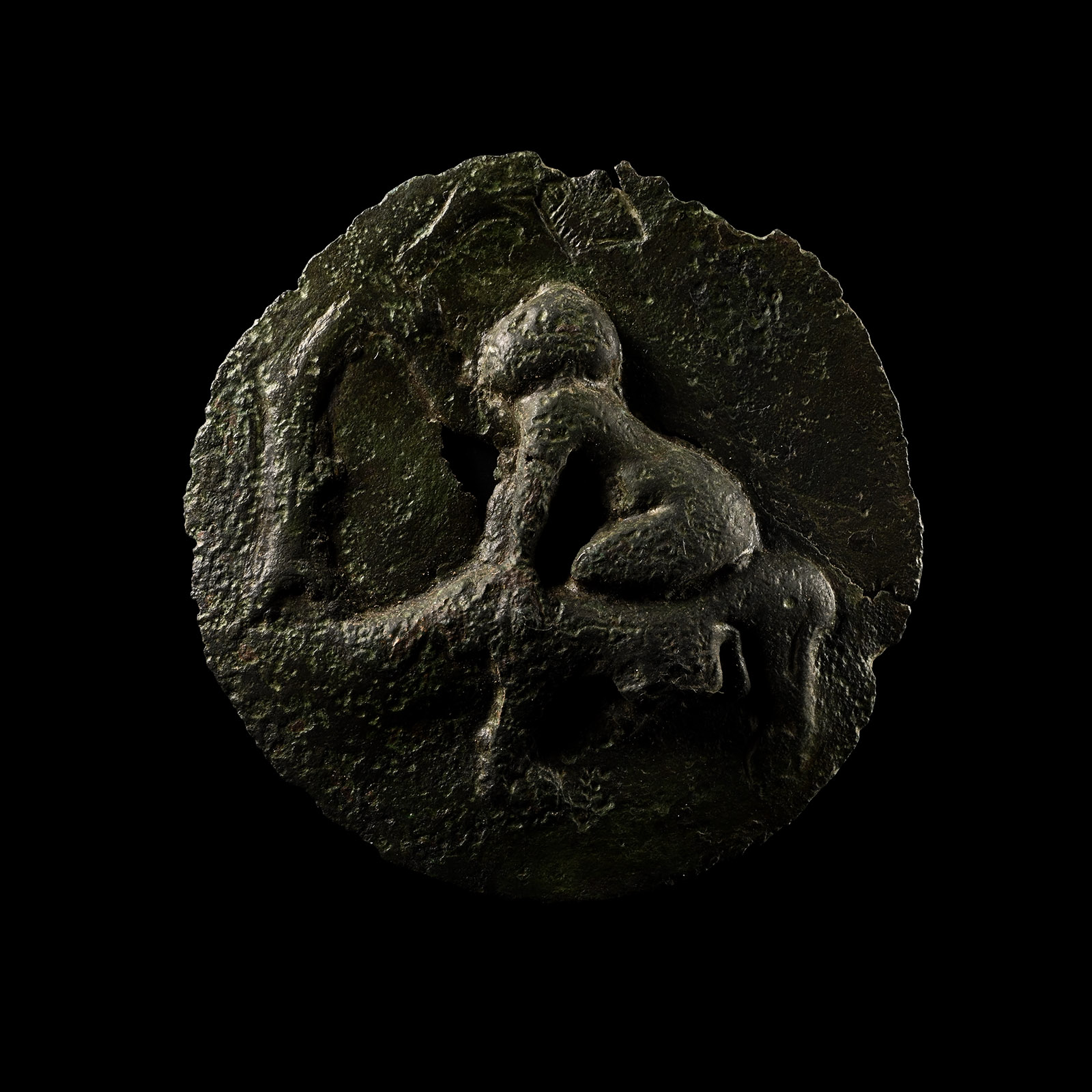
Roman 'The Wakefield' Bronze Founding of Rome Commemorative Military Phalera
1ST CENTURY B.C.-1ST CENTURY A.D.
2 3/8 in. (39 grams, 62 mm).
With high-relief image depicting a she-wolf in profile advancing beneath a tree, with an infant or boy (Romulus?) on its back, nude and looking up towards the tree.
ProvenanceBelieved to have been found in Wakefield, UK, in the 1960s.
From the Roman 'Invasion Period' private collection of Brian Riley, Wakefield, UK, 1960s-2007.
Acquired from Brian Riley, Yorkshire, UK, circa 2007.
Property of a Stowmarket, UK, gentleman.
Accompanied by an academic report by Dr Raffaele D’Amato.
Cf. Maxfield, V.A., The military decorations of the Roman Army, Los Angeles, 1981; D’Amato, R., Sumner G., Arms and Armour of the Imperial Roman Soldier: From Marius to Commodus, 112 BC-AD 192, London, 2009; cf. also a phalera in the Getty Museum collection, accession no.81.AM.87.2 (Hellenistic-Parthian phalera representing a lion attacking a stag).
FootnotesMilitary phalerae usually depicted heads of the gods, spirits of the underworld, birds and lions. The higher officers in the Roman army had the custom of wearing a rich suite of phalerae with its straps directly attached to leather garments or doublets, worn over their armour. These decorations were awarded in sets, commonly of nine, although sources confirm that this was not an always the case.
CONDITIONTimeLine Auctions follows a vetting process to ensure the authenticity and legality of all items, reinforcing our commitment to integrity and responsible trading. Each antiquity, antique, and coin lot undergoes thorough examination by a vetting committee of at least ten external specialists, professional trade association members, scientists, and archaeologists: Our Vetting Process
AUCTIONS:
TimeLine is a leading auction house specialising in antiquities, ancient art, collectables, natural history, coins, medals, and books. Our auctions offer museums, collectors, historians, and enthusiasts the opportunity to acquire unique and historically significant pieces.
LOT 0168
Roman 'The Wakefield' Bronze Founding of Rome Commemorative Military Phalera
Estimate £1,000 - 1,400€1,160 - 1,620 (for guidance only)$1,350 - 1,890 (for guidance only)
-
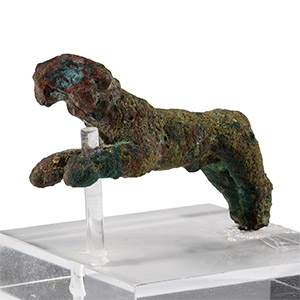
Roman Bronze Panther Statuette
Circa 3rd-4th century A.D.Sold for (Inc. bp): £124
Depicted in a leaping pose with the beast's foreleg extended and the head turned slightly right with open jaws; mounted on a custom-made display stand. 53.6 grams total, 47 mm including stand
Found near Newark/Lincoln, Nottinghamshire, UK. Acquired from Ancient & Oriental, Nottingham, UK, 2002. Property of a Nottinghamshire gentleman. -
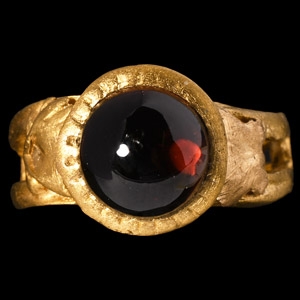
'The Great Chart' Roman Gold Ring
3rd-4th century A.D.Sold for (Inc. bp): £1,430
The hoop circular in plan and rectangular in cross-section, the sides divide into two segments which separate gradually to form triangular shoulders, on one of the shoulders applied scallop shells with one replaced, four pellets to the base of the bezel; the deep tubular bezel and everted rim decorated with radiating lines, reset with a cabochon garnet. 4.57 grams, 22.24 mm overall, 14.67 mm internal diameter (approximate size British F, USA 2 3/4, Europe 3.67, Japan 3)
Found whilst searching with a metal detector near Great Chart with Singleton, near Ashford, Kent, UK, by Mr Keith Collins on Thursday 5th November 2020. Accompanied by a copy of the British Museum's Portable Antiquities Scheme (PAS) report with record no.KENT-2D4C88. Accompanied by a copy of the British Museum's report on a find of potential treasure for H M Coroner with Treasure reference 2021T808, subsequently disclaimed.
Roman rings with circular hoops are categorised by Guiraud (1998) in her typology as Type 4, those with tubular bezels Types 4a- 4d, Type 4c is shown flanked by two pairs of spherical pellets, and with decorative shoulders (p.189, fig.29), however our example is more consistent with Type 4h. -
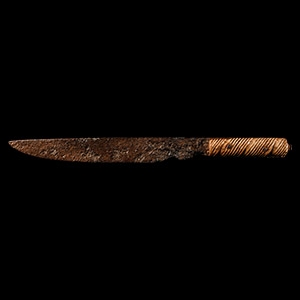
Roman Iron Knife with Bone Handle
1st-4th century A.D.Sold for (Inc. bp): £391
With single-edged blade gently curving towards the tip; applied bone handle with diagonally striated banding. 38.1 grams, 17.5 cm
Found near Wetwang, East Yorkshire, UK. Acquired from the finder in 2007. Property of a Nottinghamshire gentleman.
Tools which cannot be assigned to one of the more specific categories, such as agricultural or military equipment especially knife blades, tool handles, and hones. Three methods of attaching a handle to the tang of a knife or tool are distinguishable in the Roman culter. Rivetting was used on two-piece handles (like in our specimen). Driving the tang into the marrow-cavity of the bone, which was usually packed with wood-shavings, so that the irregularities of cancellous tissue and the wood-shavings prevented the tang from twisting or slipping out (often a collar was also used with this method). Lastly, the tang could be fixed to the handle by means of an iron clip.
