
Loading, please wait...
_900x900.jpg "Roman 'Thames' Samian Ware Stamped Fragment Group")
_200x200.jpg "Roman 'Thames' Samian Ware Stamped Fragment Group")
.jpg "Roman 'Thames' Samian Ware Stamped Fragment Group")
LOT 0759
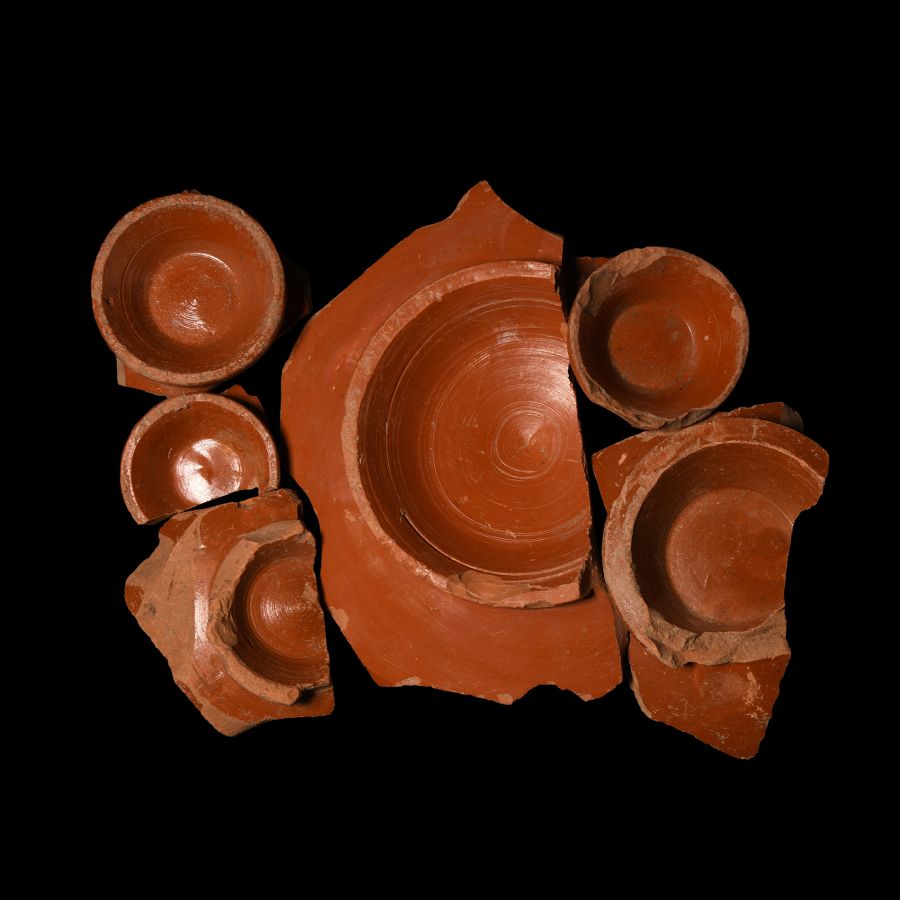
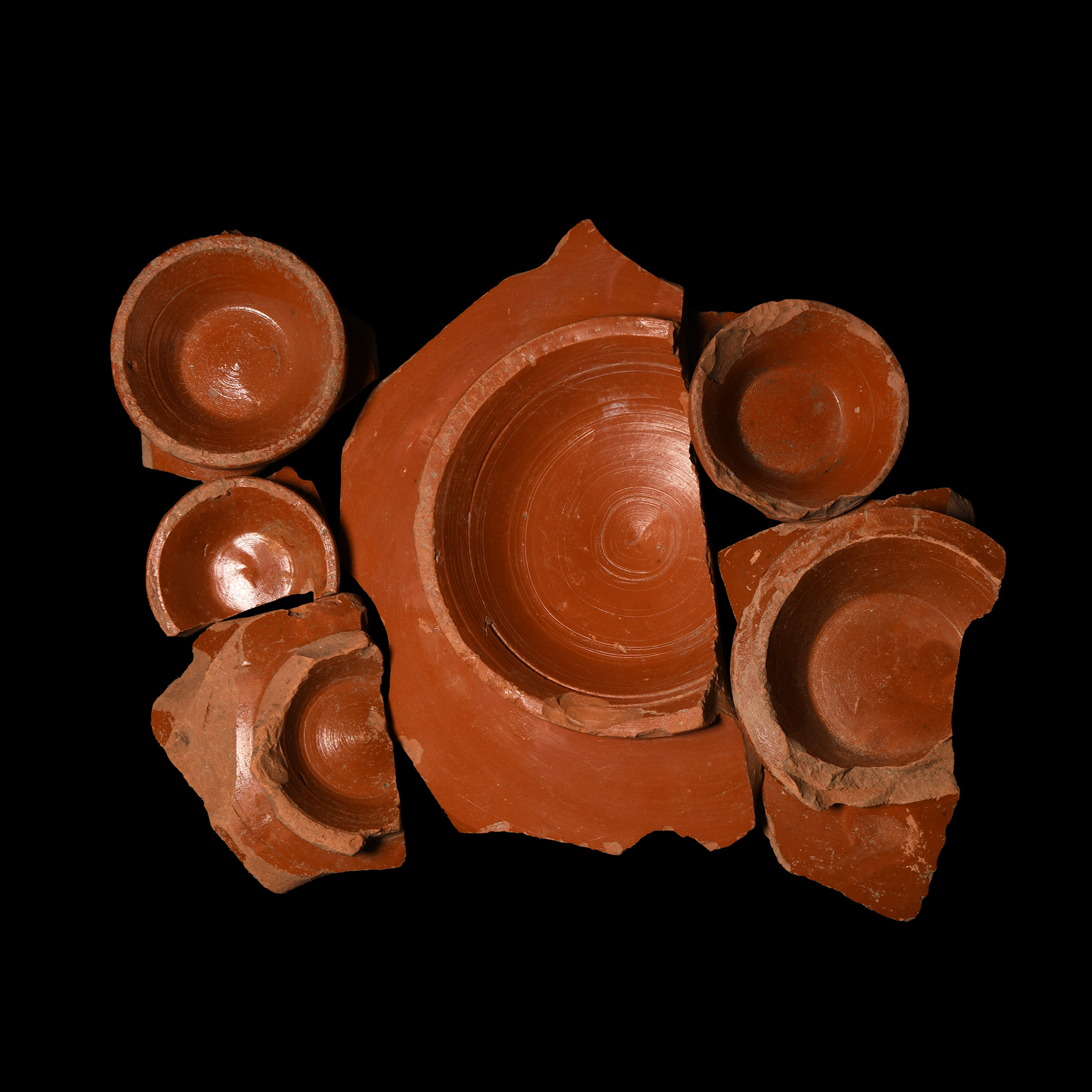
Roman 'Thames' Samian Ware Stamped Fragment Group
1ST-2ND CENTURY A.D.
1 5/8 - 5 3/8 in. (328 grams total, 4.2-13.7 cm).
A group of six Samian ware vessel bases labelled 'a-f', each stamped to the interior base; accompanied by an information sheet identifying the relevant workshop and approximate date: 'a. COSRVF Cosivs and Rufinus South Gaul late 1st century; b.Caddiron Caddiron Langres ?; c. BALBINVS F Balbinus (Fecit) Lubie early 2nd century; d.TITVRONIS O Tituro (officina workshop) Central Gaul early 2nd century; e. ALBVS F Albus Central Gaul early 2nd century; f. ]IVCVN ?'. [6, No Reserve]
ProvenanceFound Billingsgate spoil from the Thames foreshore, London, UK.
Acquired on the UK antiques market between 1974-1985.
Albert Ward collection, Essex, UK.
Accompanied by a typed original identification document from the Museum of London dated 29th August 1984.
TimeLine Auctions follows a vetting process to ensure the authenticity and legality of all items, reinforcing our commitment to integrity and responsible trading. Each antiquity, antique, and coin lot undergoes thorough examination by a vetting committee of at least ten external specialists, professional trade association members, scientists, and archaeologists: Our Vetting Process
AUCTIONS:
TimeLine is a leading auction house specialising in antiquities, ancient art, collectables, natural history, coins, medals, and books. Our auctions offer museums, collectors, historians, and enthusiasts the opportunity to acquire unique and historically significant pieces.
-
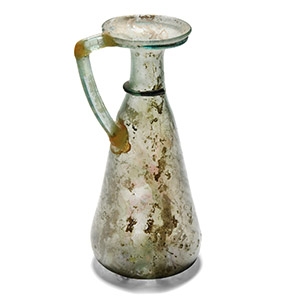
Roman Aqua Glass Jug
1st-4th century A.D.Estimate: £400 - 600 (‡+bp*)
Opening Bid: £200
An aqua-coloured glass vessel with rounded conical body, upward sloping everted rim with sloping internal face; applied trail to upper and lower neck, angular handle; iridescent surfaces; repaired. 57 grams, 14 cm high
Acquired early 1990s. Ex private American collection; thence by descent. Private collection since 1998. -
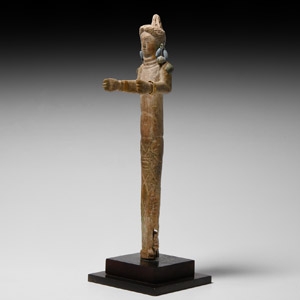
Roman Female Bone Doll
1st-2nd century A.D.Sold for (Inc. bp): £572
A Roman or Parthian bone figurine of a female with separate articulated bent arms, piled hairstyle, incised facial features, tiered collar, slender body with lattice detailing to the skirt; bronze stud to the shoulders, wire loop earrings with tubular blue glass beads, gold arm-rings; mounted on a custom-made stand. 355 grams total, 21.5 cm including stand
Fine condition.
Previously acquired in 1971. with Gallery Delalande, Paris, France. Property of a Brussels gentleman. -
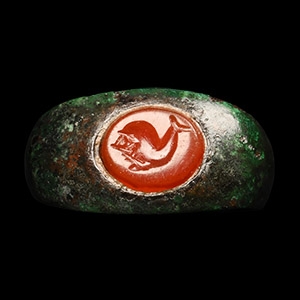
Roman Ring with Dolphin Gemstone
2nd-3rd century A.D.Sold for (Inc. bp): £208
A bronze ring with expanding, rounded shoulders, the oblong bezel set with a carnelian intaglio engraved with a dolphin. 3.21 grams, 19.41 mm overall, 16.07 mm internal diameter (approximate size British G, USA 3 1/4, Europe 4.92, Japan 4)
Acquired before 2000. From the collection of a European gentleman living in the UK.
