
Loading, please wait...
_900x900.jpg "Roman Terracotta Jar Fragment with Erotic Scenes")
_200x200.jpg "Roman Terracotta Jar Fragment with Erotic Scenes")
.jpg "Roman Terracotta Jar Fragment with Erotic Scenes")
LOT 0706
Roman Terracotta Jar Fragment with Erotic Scenes
1ST-3RD CENTURY A.D.
2 3/4 in. (33.7 grams, 71 mm).
A handled jar fragment decorated in raised relief with two erotic scenes, the first showing a masturbation scene, the second a copulating couple.
ProvenanceAcquired 1970-1999.
London collection of the late Mr S.M., thence by descent.
Cf. Ars Amatoria - The Haddad Family Collection of Ancient Erotic and Amuletic Art, Christie's, New York, 17 December 1998, lot 60, for similar.
CONDITIONTimeLine Auctions follows a vetting process to ensure the authenticity and legality of all items, reinforcing our commitment to integrity and responsible trading. Each antiquity, antique, and coin lot undergoes thorough examination by a vetting committee of at least ten external specialists, professional trade association members, scientists, and archaeologists: Our Vetting Process
AUCTIONS:
TimeLine is a leading auction house specialising in antiquities, ancient art, collectables, natural history, coins, medals, and books. Our auctions offer museums, collectors, historians, and enthusiasts the opportunity to acquire unique and historically significant pieces.
LOT 0706
Roman Terracotta Jar Fragment with Erotic Scenes
Estimate £250 - 350€290 - 410 (for guidance only)$340 - 470 (for guidance only)
-
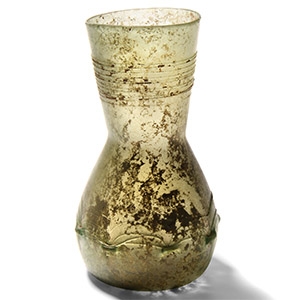
Roman Glass Flask with Trails
1st-3rd century A.D.Sold for (Inc. bp): £338
A pear-shaped pale green glass flask with broad flared neck, applied trails to the neck and broader, undulating trails to the equator embellished with raised ledges; areas of iridescence; old French collection label to base dated c.1900 A.D. 59 grams, 12 cm high
French collection, 1960s-early 2000s. From an important Paris gallery, France. -
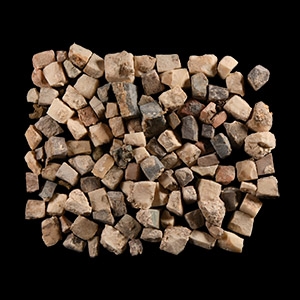
Roman Polychrome Tesserae Group
1st-4th century A.D.Sold for (Inc. bp): £143
A mixed group of over 100 single stone tesserae of various colours and sizes. 70 grams total, 5-14 mm
Acquired 1980-2015. Ex Abelita family collection. -
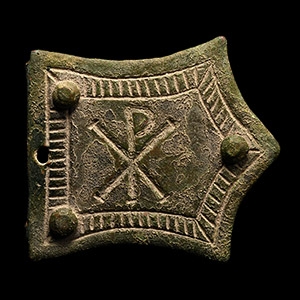
Roman Belt Mount with Chi Rho
Circa 3rd-4th century A.D.Sold for (Inc. bp): £156
A bronze pentagonal mount with scooped edges, four piercings to accept fixing rivets, hatched band enclosing an incuse Chi Rho christogram. 25.9 grams, 55 mm
Acquired in the late 1990s-2000. Property of an East London gentleman.
