
Loading, please wait...
LOT 0123
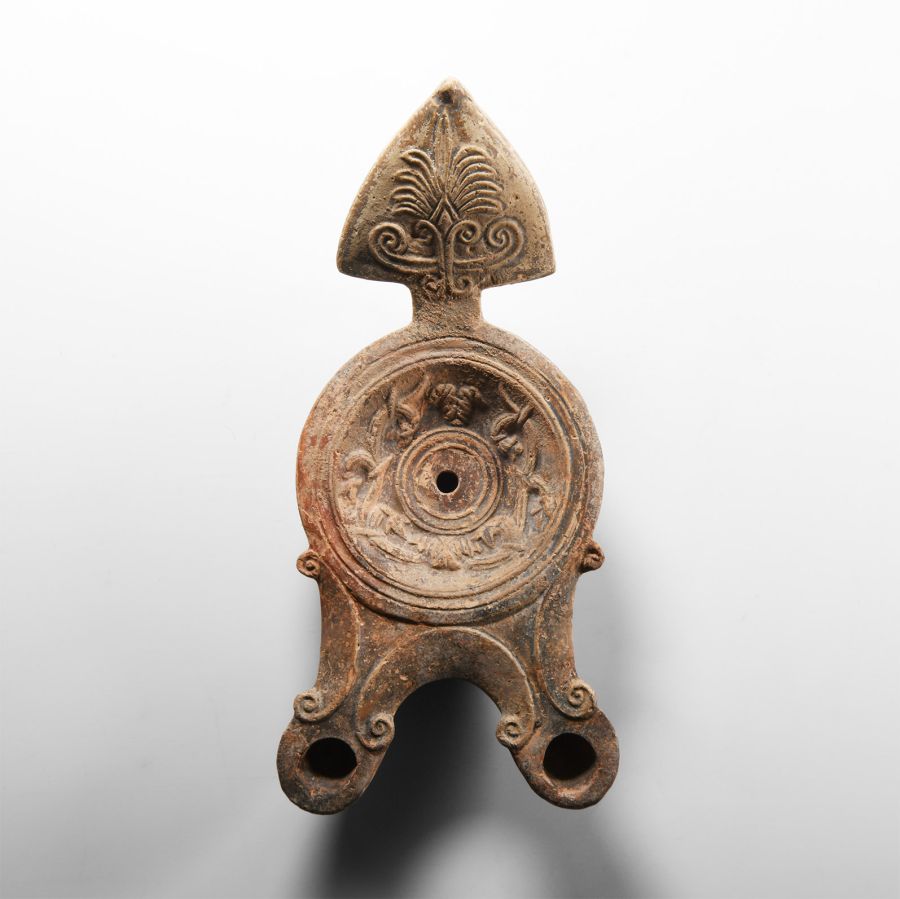
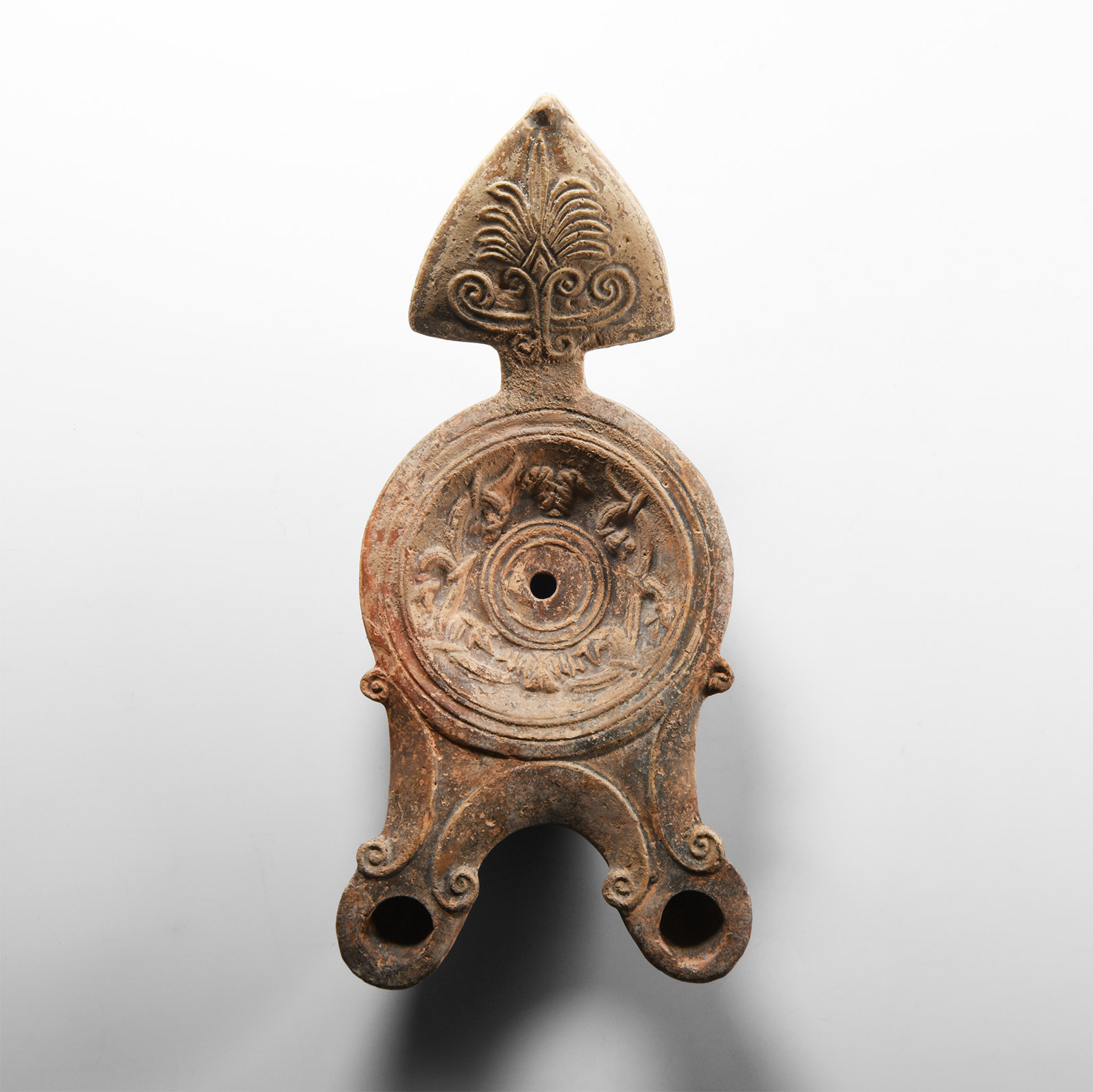
Roman Terracotta Double Oil Lamp with Reflector
LATE 1ST CENTURY A.D.
7 3/4 in. (139 grams, 19.5 cm wide).
A pottery lamp with triangular ornament handle with palmette above and acanthus leaves below, plain ring behind, concave discus with central filling-hole, two double-volute round tipped nozzles with conspicuous knobs, flat base-ring marked off by two circular grooves.
ProvenanceFrom a 19th century German collection.
Acquired in the 1990s.
Ex London, UK, collection.
See Bussière, J., Lindros Wohl, B., Ancient Lamps in the J. Paul Getty Museum, Malibu, 2017, p.112, no.157 and 160, for the type.
FootnotesThis lamp belongs to the classification of Loeschcke type III (Bailey type D). The type is characterised by a handle ornament that is either figurative or in the shape of a crescent, with decorated triangle, or two-lobed bud; and a usually round-tipped volute-nozzle, exceptionally with angular tip. Lamps may have one or two, or sometimes more nozzles. This type is typical of the Late Neronian-Flavian period.
CONDITIONTimeLine Auctions follows a vetting process to ensure the authenticity and legality of all items, reinforcing our commitment to integrity and responsible trading. Each antiquity, antique, and coin lot undergoes thorough examination by a vetting committee of at least ten external specialists, professional trade association members, scientists, and archaeologists: Our Vetting Process
AUCTIONS:
TimeLine is a leading auction house specialising in antiquities, ancient art, collectables, natural history, coins, medals, and books. Our auctions offer museums, collectors, historians, and enthusiasts the opportunity to acquire unique and historically significant pieces.
-
.jpg)
Roman 'Thames' Samian Ware Stamped Fragment Group
1st-2nd century A.D.Sold for (Inc. bp): £104
A group of six Samian ware vessel bases labelled 'a-f', each stamped to the interior base; accompanied by an information sheet identifying the relevant workshop and approximate date: 'a. COSRVF Cosivs and Rufinus South Gaul late 1st century; b.Caddiron Caddiron Langres ?; c. BALBINVS F Balbinus (Fecit) Lubie early 2nd century; d.TITVRONIS O Tituro (officina workshop) Central Gaul early 2nd century; e. ALBVS F Albus Central Gaul early 2nd century; f. ]IVCVN ?'. 328 grams total, 4.2-13.7 cm
Found Billingsgate spoil from the Thames foreshore, London, UK. Acquired on the UK antiques market between 1974-1985. Albert Ward collection, Essex, UK. Accompanied by a typed original identification document from the Museum of London dated 29th August 1984. -
Roman Military Eagle Staff Terminal
2nd-3rd century A.D.Sold for (Inc. bp): £11,050
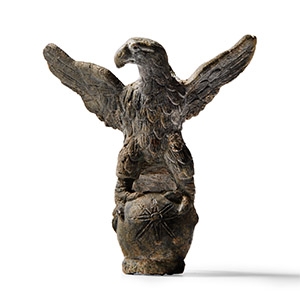
A free-standing bronze imperial or military eagle terminal from a staff or a sceptre, modelled in the round in a dynamic pose standing on a globe, wings spread, head turned to the right, semi-naturalistic anatomical and feather detailing; the globe bearing an incised eight-armed stylised Macedonian star; sub-triangular lug to back of the neck; collar to globe with hollow underside. 166 grams, 88 mm high
with Bonham's, London, Knightsbridge, UK, 16 May 2002, lot 301. Accompanied by a copy of the relevant Bonhams catalogue pages. Accompanied by an academic report by Dr Raffaele D'Amato. This lot has been checked against the Interpol Database of stolen works of art and is accompanied by search certificate number no.11582-198947
In the Roman world, the eagle was associated with the god Jupiter or Zeus, king of the Olympian gods, and was seen as ‘the symbol and agent of apotheosis after death’. An eagle was released from the top of an emperor’s funeral pyre to signal the journey of the soul towards heaven. A sacred attribute of Jupiter, this eagle terminal may have been attached to a sceptre of the statue of the god. Eagles were also the principal standard of the legions, and became the military symbol for excellence. -
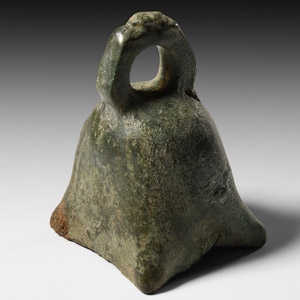
Roman Square-Shaped Bell
Circa 1st century A.D.Sold for (Inc. bp): £78
A bronze bell of quadrilateral form, with a rectangular cross-section at base, tapering to a rounded dome with large integral suspension loop with five facets to the outer face; clanger absent. 160 grams, 83 mm
Acquired before 2000. From the collection of a European gentleman living in the UK.
The Romans used bells in ritual and secular contexts, when they could be suspended from the necks of animals, worn for talismanic protection or as anklets by servants.
