
Loading, please wait...
_900x900.jpg "Roman Terracotta Bust of a Boy")
_200x200.jpg "Roman Terracotta Bust of a Boy")
.jpg "Roman Terracotta Bust of a Boy")
LOT 0644
Roman Terracotta Bust of a Boy
1ST-CENTURY B.C.-1ST CENTURY A.D.
6 3/4 in. (341 grams, 17 cm high).
A terracotta bust of a boy mounted on an integral channeled plinth base, modelled with semi-naturalistic facial features and a cropped hairstyle, wearing a bulla and a sash over the left shoulder.
ProvenanceEx private German collection, 1960; thence by descent.
with Auktionshaus Owl, Bielefeld, Germany, 5 September 2015, Lot 40605.
Cf. Papantoniou, G., Michaelides, D., Dikomitou-Eliadou, M., Hellenistic and Roman Terracottas, Monumenta Graeca et Romana, Brill, Leiden-Boston, 2019, fig.R22661, p.93, for similar style.
FootnotesIn ancient Rome, the bulla was an amulet given to every boy nine days after his birth. The meaning, origins and use of the bulla are in some ways enigmatic and still a subject of research for scholars. The bulla was worn around the neck during childhood and adolescence. Depending on the social status and wealth of the family who commissioned it, different materials were used; on rare occasions it was made fully in gold, if the child belonged to a family of the high Roman aristocracy, or more commonly made in lead covered with a gold foil. The bulla was also made for the poorer classes in lesser materials, such as fabric or leather.
CONDITIONTimeLine Auctions follows a vetting process to ensure the authenticity and legality of all items, reinforcing our commitment to integrity and responsible trading. Each antiquity, antique, and coin lot undergoes thorough examination by a vetting committee of at least ten external specialists, professional trade association members, scientists, and archaeologists: Our Vetting Process
AUCTIONS:
TimeLine is a leading auction house specialising in antiquities, ancient art, collectables, natural history, coins, medals, and books. Our auctions offer museums, collectors, historians, and enthusiasts the opportunity to acquire unique and historically significant pieces.
-
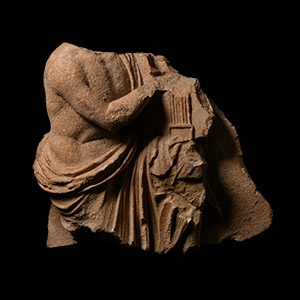
Roman Limestone Fragment of Draped Musician
Circa 1st century A.D.Sold for (Inc. bp): £1,430
A fragment of a carved limestone scene depicting a seated musician wearing a toga virilis draped to his shoulder and tucked at the waist, hanging over his bent knee supporting a lyre or cithara with seven strings. 1.98 kg, 17 cm
Ex Ingrid McAlpine, 1939-2018, London and Epsom, UK. -
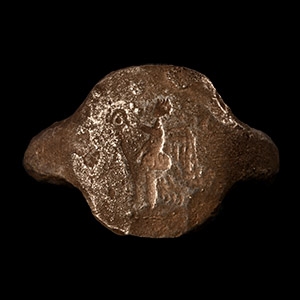
Roman Silver Ring with Victory
2nd-4th century A.D.Sold for (Inc. bp): £65
A silver ring composed of a D-section hoop and roughly oval-shaped bezel engraved with a figure of winged Victory standing left, wearing a helmet and holding a wreath in her extended hand. 4.95 grams, 21.19 mm overall, 18.30 mm internal diameter (approximate size British P 1/2, USA 7 3/4, Europe 16.86, Japan 16)
Private collection formed since the 1940s. UK art market. Property of an Essex gentleman. -
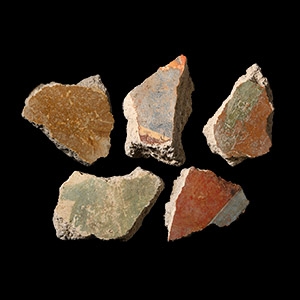
Roman Fresco Painted Wall Plaster Collection
1st century A.D.Sold for (Inc. bp): £104
A mixed group of coarse white wall plaster fragments from a fresco, with painted designs in white, ochre, claret, crimson and blue. 600 grams total, 73-89 mm
Fair condition.
Acquired in the 19th century. Jeger collection, Switzerland. Property of an English gentleman.
