Loading, please wait...

Roman Style Silver Statuette of a Drunken Naked Satyr Roman Style Silver Statuette of a Drunken Naked Satyr Roman Style Silver Statuette of a Drunken Naked Satyr
Use mousewheel to zoom in and out, click to enlarge
Details

LOT 1960

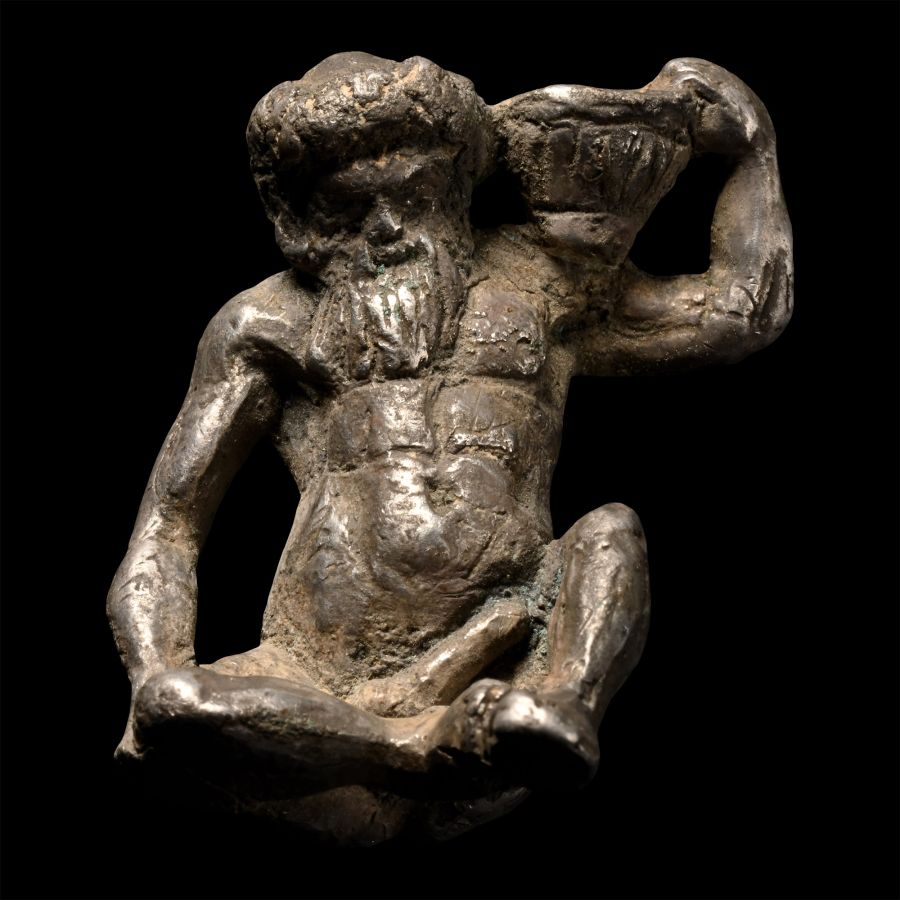
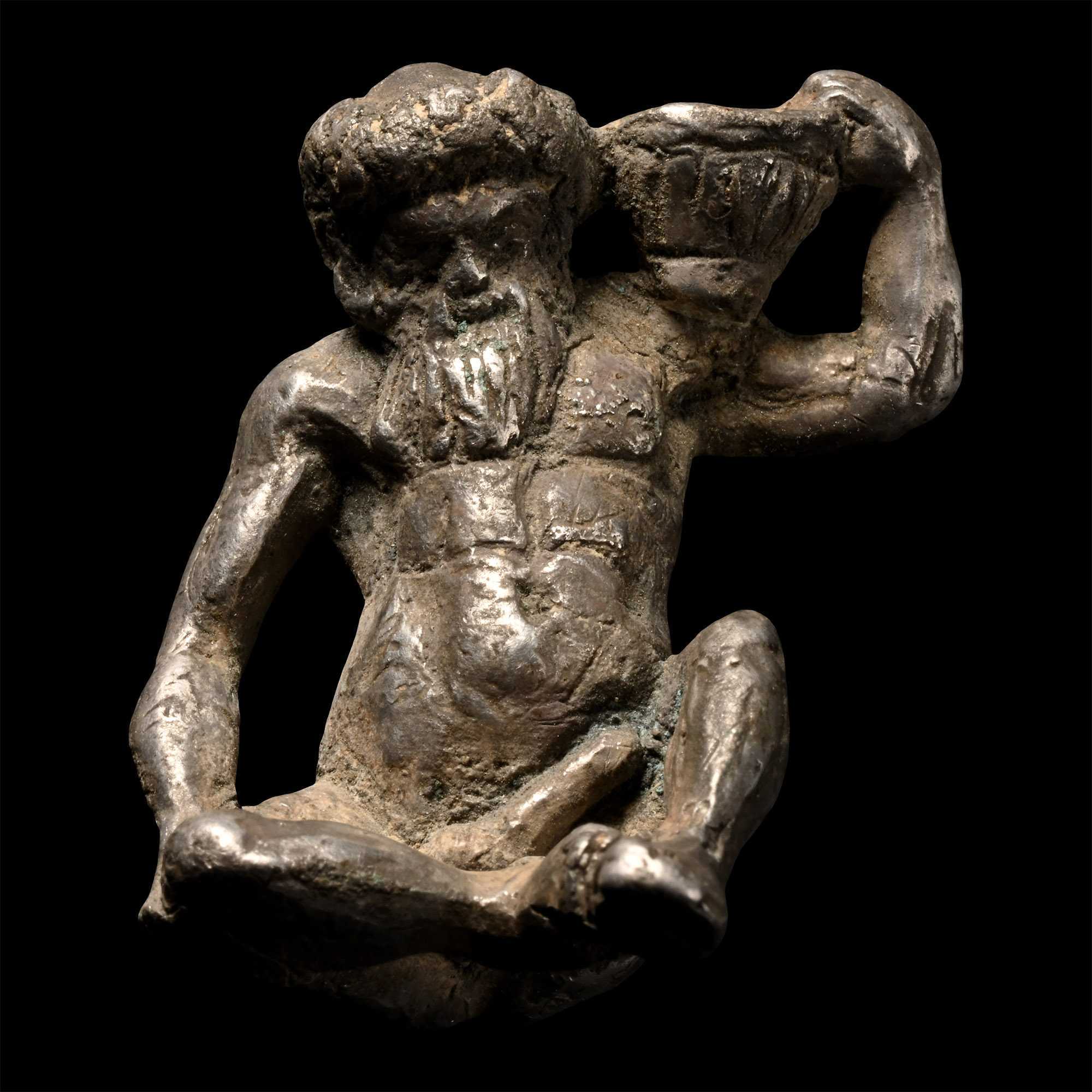
Roman Style Silver Statuette of a Drunken Naked Satyr

20TH CENTURY A.D.

1 3/4 in. (81 grams, 44 mm).

Modelled in the round sitting with legs spread, ithyphallic, supporting a bowl on his left shoulder. [No Reserve]

Provenance

Previously belonging to J Stewart, Mayfair, London, UK; acquired in the early 1980s.
Property of a Middlesex gentleman.

CONDITION
VETTING:

TimeLine Auctions follows a vetting process to ensure the authenticity and legality of all items, reinforcing our commitment to integrity and responsible trading. Each antiquity, antique, and coin lot undergoes thorough examination by a vetting committee of at least ten external specialists, professional trade association members, scientists, and archaeologists: Our Vetting Process


AUCTIONS:

TimeLine is a leading auction house specialising in antiquities, ancient art, collectables, natural history, coins, medals, and books. Our auctions offer museums, collectors, historians, and enthusiasts the opportunity to acquire unique and historically significant pieces.

LOT 1960

Roman Style Silver Statuette of a Drunken Naked Satyr

Estimate £50 - 70€58 - 81 (for guidance only)$68 - 95 (for guidance only)

Opening Bid
£5 (EUR 6; USD 7) +BP*

Sign in to Bid

Please enter a e-mail
Please enter a password
Or Create Account here.
Please confirm to accept TC and Privacy policy

Bids: 0
RELATED LOTS
  • Published Iron Peerman Splint Holder
    Published Iron 'Peerman' Splint Holder
    Austria, 18th century A.D.

    Estimate: £400 - 600 (+bp*)

    Opening Bid: £200

    The sprung nip on a tall stem wrought with three S-scrolls for holding spare splints, on a tripod base. 1.7 kg, 68.7 cm


    Ex Nic McElhatton, former chairman of Christie's South Kensington. Property of a Berkshire, UK, collector. Accompanied by a copy of McElhatton's cataloguing page. Accompanied by copies of the relevant book pages where published.

    Lot Details

  • Post Medieval Gold Ring with Sardonyx Cameo with Adoration of the Magi
    Post Medieval Gold Ring with Sardonyx Cameo with Adoration of the Magi
    Italy, 15th century A.D.

    Estimate: £5,000 - 7,000 (+bp*)

    Opening Bid: £2,500

    Featuring a finely carved sardonyx cameo illustrating the Nativity, with the Virgin Mary extending the Christ Child toward the three Magi bearing gifts, while Joseph stands beside her; the family shown emerging from an arched doorway, beneath the Star of Bethlehem; set in a 19th-century high-carat gold mount, probably English in origin. 4.62 grams, 21.88 mm overall, 18.25 mm internal diameter (approximate size British Q, USA 8, Europe 17.49, Japan 16)


    Acquired on the European art market. This lot has been checked against the Interpol Database of stolen works of art and is accompanied by search certificate number no.13334-258013.

    The scene is staged horizontally, with the Holy Family at one end and the Magi and their entourage proceeding towards it, essentially unfolding in the foreground in a sort of procession, one behind the other. This was the standard image, although in the Italian School of Renaissance the same scene was often modified according to the vision of Botticelli, who put at the centre the Holy Family.

    Lot Details

  • Bourbon Era Gold Devotional Pendant with Verre Eglomise Miniatures of Saint Catherine of Alexandria and Saint John of Nepomuk
    Bourbon Era Gold Devotional Pendant with Verre Eglomise Miniatures of Saint Catherine of Alexandria and Saint John of Nepomuk
    Spain, circa 1700 A.D.

    Estimate: £1,000 - 1,400 (+bp*)

    Opening Bid: £500

    Featuring a gold mount with twisted ropework border and scalloped edges securing bevelled glass coverings, one side depicting nimbate Saint Catherine of Alexandria wearing a pale blue dress with a red cloak, holding a gilt palm frond; the other side with Saint John of Nepomuk dressed in clerical attire and holding a gilt cross and a palm frond. 29.1 grams, 43 mm


    Acquired on the European art market.

    Saint Catherine of Alexandria was a Christian saint and virgin who was martyred in the early 4th century at the hands of the Emperor Maxentius. She was both a princess and a noted scholar who became a Christian around the age of 14, converted hundreds of people to Christianity and was martyred around the age of 18. More than 1,100 years after Catherine's martyrdom, Joan of Arc identified her as one of the saints who appeared to and counselled her. Saint John of Nepomuk (c. 1345 – 20 March 1393) was the saint of Bohemia (Czech Republic) who was drowned in the Vltava River at the behest of Wenceslaus IV of Bohemia. Later accounts state that he was the confessor of the queen of Bohemia and refused to divulge the secrets of the confessional. Based on this account, John of Nepomuk is considered the first martyr of the Seal of the Confessional, a patron against calumnies and, because of the manner of his death, a protector from floods and drowning. Verre églomisé is a French term referring to the process of applying both a design and gilding onto the rear face of glass to produce a mirror finish. The name is derived from the 18th-century French decorator and art-dealer Jean-Baptiste Glomy (1711–1786), who was responsible for its revival. Glomy's technique was a relatively simple one of applying decorative designs in a combination of plain colour and gilding, usually to glass picture frames. However, over time, it has come to be used to describe nearly any process involving back-painted and gilded glass, however elaborate.

    Lot Details