
Loading, please wait...
LOT 0616
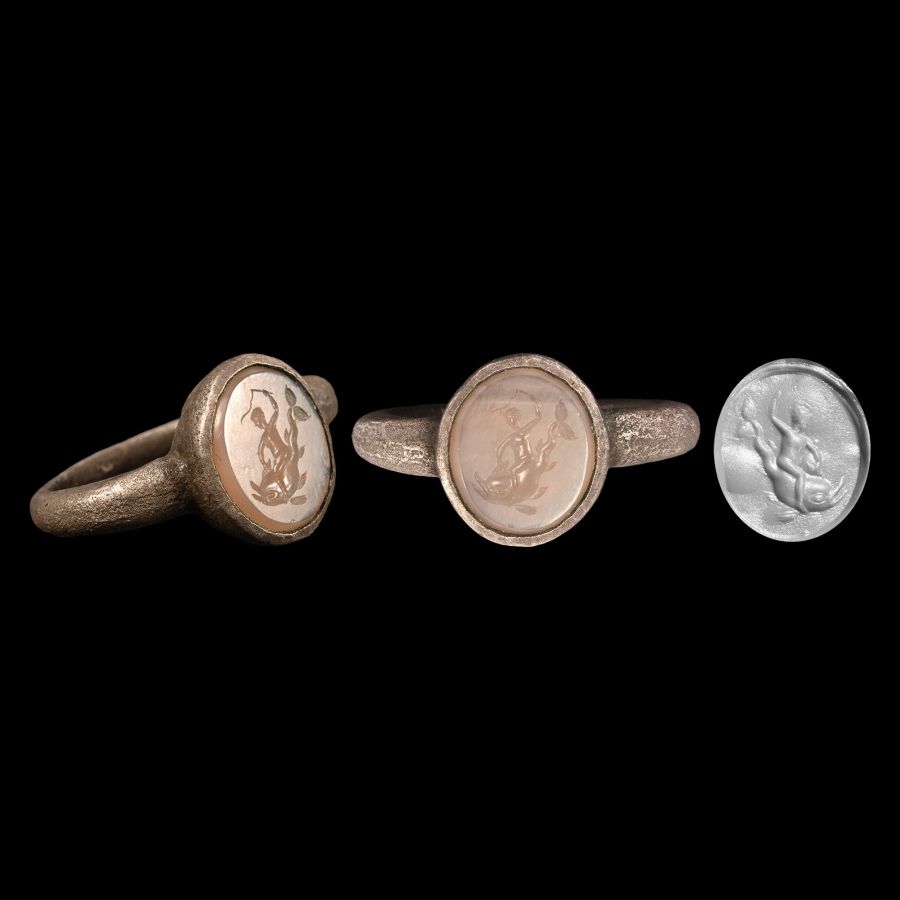
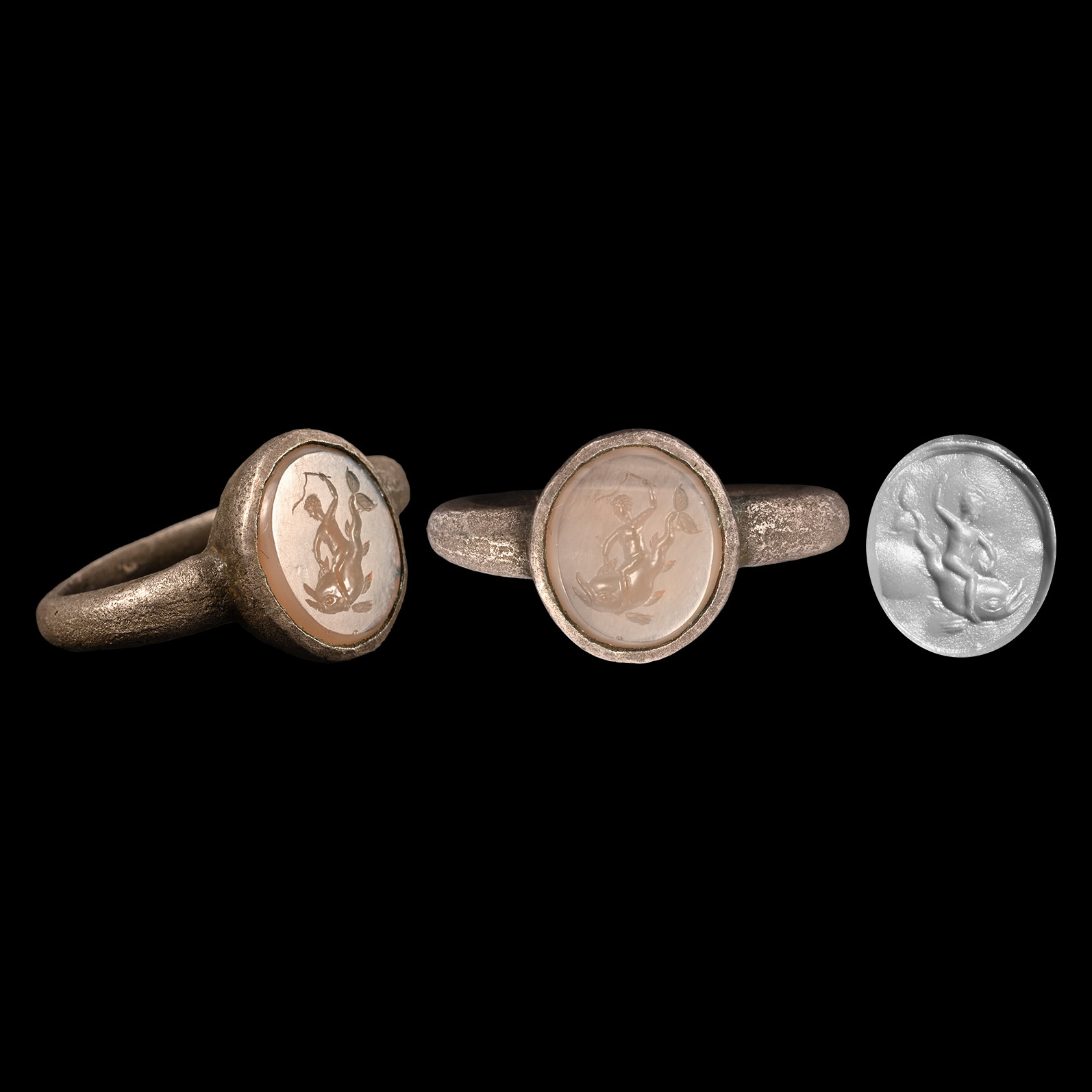
Roman Style Silver Ring with Cupid Riding a Dolphin Gemstone
20TH CENTURY A.D. OR EARLIER
1 in. (9.29 grams, 27.65 mm overall, 20.67 mm internal diameter (approximate size British O, USA 7, Europe 14.98, Japan 14)).
A silver finger ring with inset onyx gemstone, intaglio of a boy riding on the back of a dolphin and wielding a whip.
ProvenanceEnglish private collection.
CONDITIONTimeLine Auctions follows a vetting process to ensure the authenticity and legality of all items, reinforcing our commitment to integrity and responsible trading. Each antiquity, antique, and coin lot undergoes thorough examination by a vetting committee of at least ten external specialists, professional trade association members, scientists, and archaeologists: Our Vetting Process
AUCTIONS:
TimeLine is a leading auction house specialising in antiquities, ancient art, collectables, natural history, coins, medals, and books. Our auctions offer museums, collectors, historians, and enthusiasts the opportunity to acquire unique and historically significant pieces.
LOT 0616
Roman Style Silver Ring with Cupid Riding a Dolphin Gemstone
Estimate £300 - 400€350 - 460 (for guidance only)$410 - 540 (for guidance only)
-

Roman Decorated Glass Bowl
3rd-5th century A.D.Sold for (Inc. bp): £234
A transparent glass bowl with gently tapering sidewalls and iridescent surfaces; base displaying a geometric motif with cut or engraved shallow dimples at centre surrounded by curved, radiating lines, circular dimples around the perimeter, with possible shallow ovals to the exterior wall. 131 grams, 14.3 cm wide
Fine condition, repaired.
Acquired in the 1980s-1990s. Previously with Mansour Gallery, London W1. Property of a North West London gentleman. -

Roman Marble Herm Boundary Marker
Circa 1st century B.C.Sold for (Inc. bp): £4,680
A carved marble herm boundary marker carved in the round as the bust of an adult male wearing a conical cap and with a full beard; dorsal pillar terminating behind the head. 7.3 kg, 31.5 cm high
French collection, 1960s-early 2000s. From an important Paris gallery, France. This lot has been checked against the Interpol Database of stolen works of art and is accompanied by search certificate no.11629-199364.
Possibly an architectural element or herm: herma (Ancient Greek: ἑρμῆς, usually called a 'herm' in English), is a sculptured stone block with a head and often a chest above an undecorated lower section on which male genitals may additionally be carved. From the Neolithic period onwards, in parts of Europe, divinities were worshipped in the form of either a heap of stones (cairn) or a wooden column. Piles of stones were created beside roads and at the borders of fields as they were cleared of pebbles, and religious respect was shown through the custom of each passer-by throwing a stone on the heap or offering a libation. In due course, the addition of a carved head (and phallus) to the column encouraged the belief that these monuments were especially favoured by divinities. -
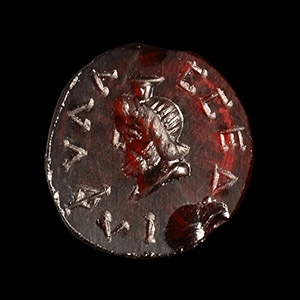
Roman Epigraphic Gemstone with Head of Zeus Serapis
3rd-4th century A.D.or laterSold for (Inc. bp): £468
A gemstone with one side incised with the head of Zeus Serapis wearing a modius crown, seen in profile to the left, surrounded by Greek letters I,Λ,φ, ν, Λ,Λ,Ϲ,Ϲ,Ε,Δ; the other side with enigmatic inscription 'BIKIω PIΗΔνMΗ IΔ φI ΛA'. 0.86 grams, 12 mm
Acquired before 1988. Ex family collection, by descent, Geneva.
Serapis was a Graeco-Egyptian god, whose cult was popularised during the 3rd century B.C. on the orders of Ptolemy I of Egypt, to facilitate the religious syncretism of his kingdom. During the Roman Empire his image was widely diffused in the east. Usually a third of these gems carry magical words which shows that they were used as amulets or for some other ritual purpose. These magical gems were inscribed with acclamations or prayers that suggest they were used as amulets for protection (in this case of Serapis) or to acquire charm, but only some of them can be linked with some divinatory or prophylactic purpose.
