
Loading, please wait...
_900x900.jpg "Roman Style Silver Dog Brooch")
_200x200.jpg "Roman Style Silver Dog Brooch")
.jpg "Roman Style Silver Dog Brooch")
LOT 2200
Roman Style Silver Dog Brooch
20TH CENTURY A.D.
1 3/8 in. (16.6 grams, 34 mm).
Hollow-formed dog with its head resting on it forepaws, with textured fur, catch beneath the head and pin-lugs beneath the hindlegs, hinged pin. [No Reserve]
ProvenanceAcquired on the UK art market from various auction houses and collections mostly before 2000.
From an important Cambridgeshire estate; thence by descent.
This lot is accompanied by an illustrated lot declaration signed by the Head of the Antiquities Department, Dr Raffaele D’Amato.
TimeLine Auctions follows a vetting process to ensure the authenticity and legality of all items, reinforcing our commitment to integrity and responsible trading. Each antiquity, antique, and coin lot undergoes thorough examination by a vetting committee of at least ten external specialists, professional trade association members, scientists, and archaeologists: Our Vetting Process
AUCTIONS:
TimeLine is a leading auction house specialising in antiquities, ancient art, collectables, natural history, coins, medals, and books. Our auctions offer museums, collectors, historians, and enthusiasts the opportunity to acquire unique and historically significant pieces.
-
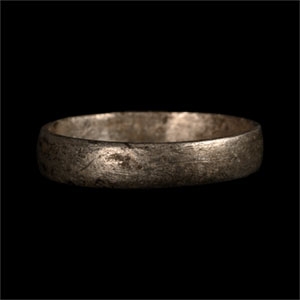
Silver Ring with Plain Hoop
17th-18th century A.D.Sold for (Inc. bp): £20
A large ring with a D-section hoop. 3.41 grams, 24.45 mm overall, 21.57 mm internal diameter (approximate size British X 1/2, USA 11 3/4, Europe 26.92, Japan 25)
From an English collection formed before 2000. This lot is accompanied by an illustrated lot declaration signed by the Head of the Antiquities Department, Dr Raffaele D’Amato. -
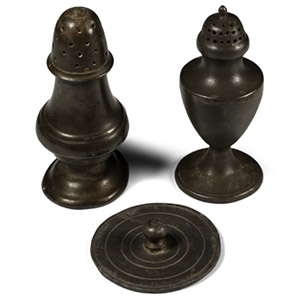
Pewter Vessel Group
19th century A.D.Sold for (Inc. bp): £1
Including a salt shaker with median collar and pierced dome, and other items. 360 grams total, 7-11.8 cm
From an early 20th century collection From a Hampshire, UK, private collection. This lot is accompanied by an illustrated lot declaration signed by the Head of the Antiquities Department, Dr Raffaele D’Amato. -
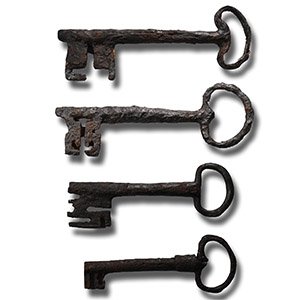
Post Medieval Iron Door Key Collection
17th-18th century A.D.Sold for (Inc. bp): £78
Comprising four large keys with loop handles and long shanks. 362 grams total, 11.5-15.5 cm
Found on various UK sites since 1974. Property of an Essex collector. This lot is accompanied by an illustrated lot declaration signed by the Head of the Antiquities Department, Dr Raffaele D’Amato.
