
Loading, please wait...
LOT 1998
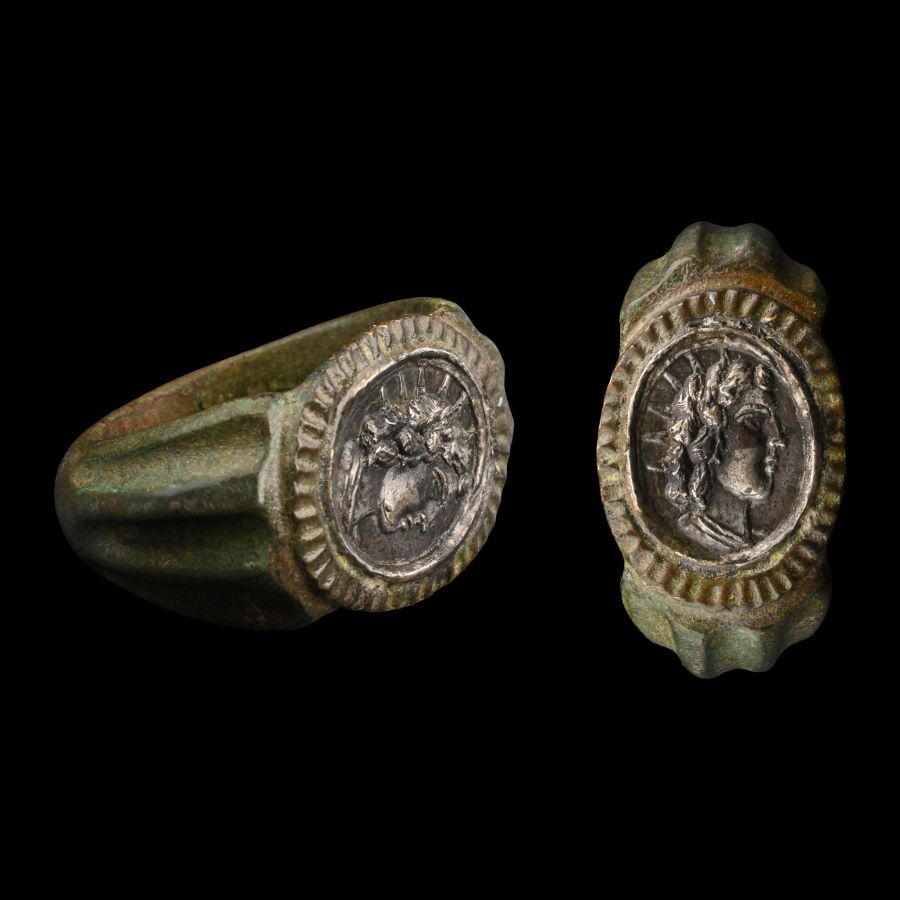
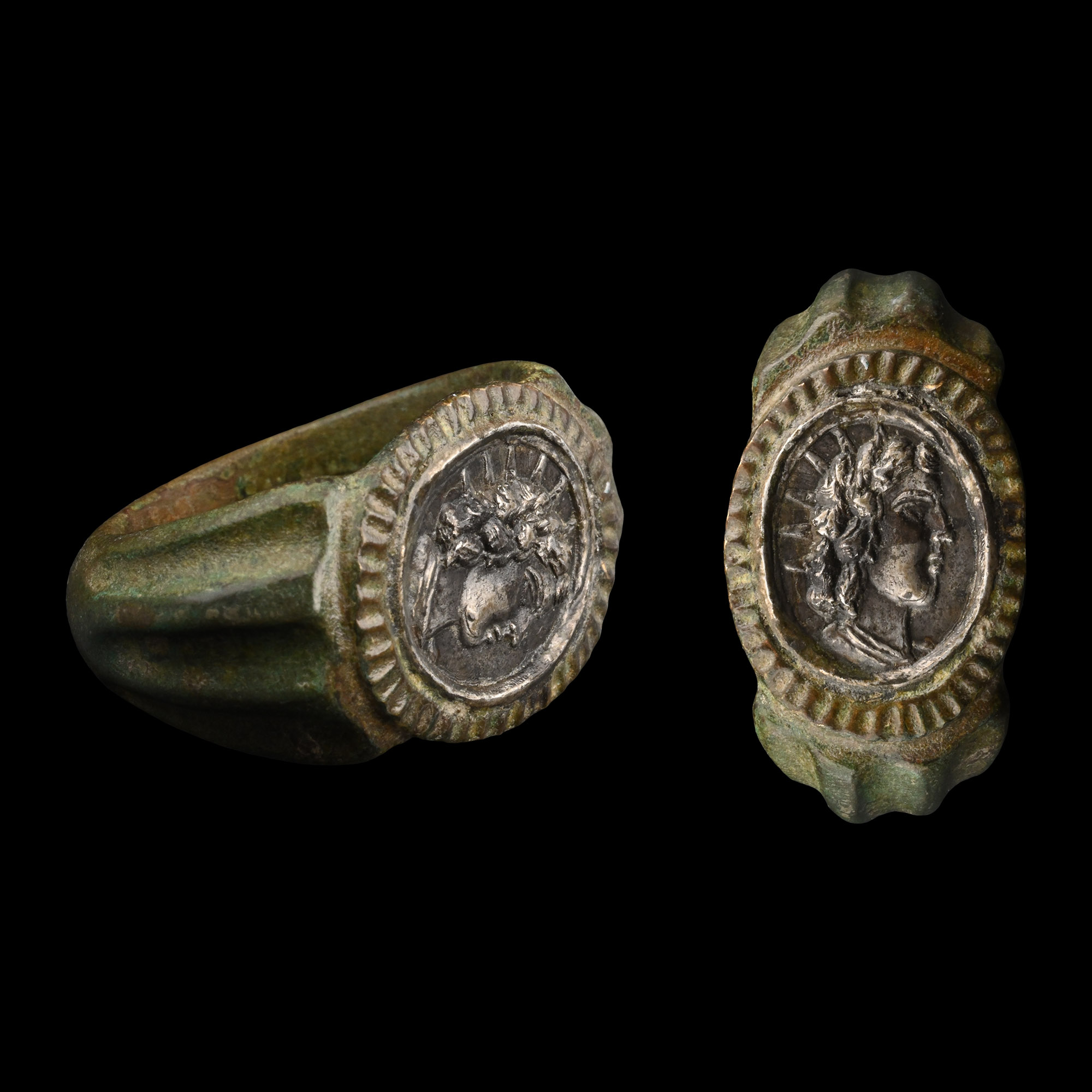
Roman Style Bronze Ring with Head of Sol Invictus
20TH CENTURY A.D.
1 1/4 in. (18.87 grams, 31.20 mm overall, 20.45 mm internal diameter (approximate size British P, USA 7 /2, Europe 16.23, Japan 15)).
With broad ribbed shoulders, bezel set with a silver bust of Sol Invictus. [No Reserve]
ProvenanceEx German art market, 2000s.
Acquired from an EU collector living in London.
From the collection of a Surrey, UK, gentleman.
TimeLine Auctions follows a vetting process to ensure the authenticity and legality of all items, reinforcing our commitment to integrity and responsible trading. Each antiquity, antique, and coin lot undergoes thorough examination by a vetting committee of at least ten external specialists, professional trade association members, scientists, and archaeologists: Our Vetting Process
AUCTIONS:
TimeLine is a leading auction house specialising in antiquities, ancient art, collectables, natural history, coins, medals, and books. Our auctions offer museums, collectors, historians, and enthusiasts the opportunity to acquire unique and historically significant pieces.
-
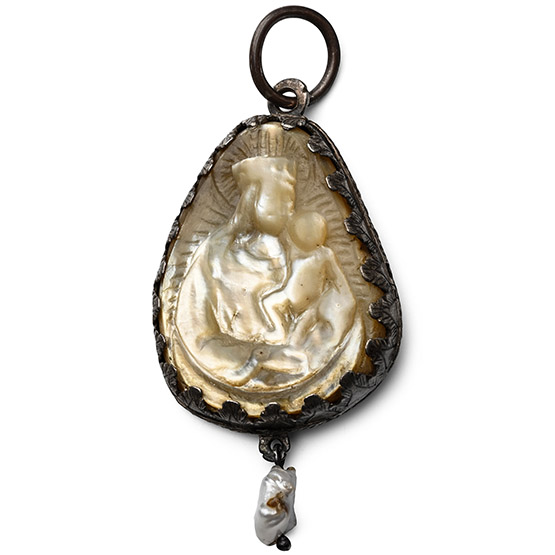
Medieval Silver Pendant with Mother-of-Pearl Scene of Virgin and Child
Germany, 15th century A.D.Sold for (Inc. bp): £2,210
Tear-shaped frame with loop and irregular dangle below; carved nacre relief of the Virgin and Child; Mother of God shown crowned and in profile, tenderly supporting the Christ Child on her lap; applied gold Corpus Christi to reverse. 20.5 grams, 70 mm
Private collection, Europe. Acquired on the German art market. This lot has been checked against the Interpol Database of stolen works of art and is accompanied by search certificate number no.13056-248332.
The carving, with its luminous iridescence and softly modelled planes, captures both the sacred intimacy of the subject and the shimmering qualities of the material. The mount is worked in silver with chased foliate detail and suspends a natural baroque pearl drop. The reverse is finely engraved with radiating rays, clouds, and the inscription INRI, centred by a parcel-gilt figure of the Crucified Christ affixed to the ground. This juxtaposition of the Virgin and Child with the Passion underscores the dual themes of Incarnation and Redemption, reflecting late medieval devotional practices. -
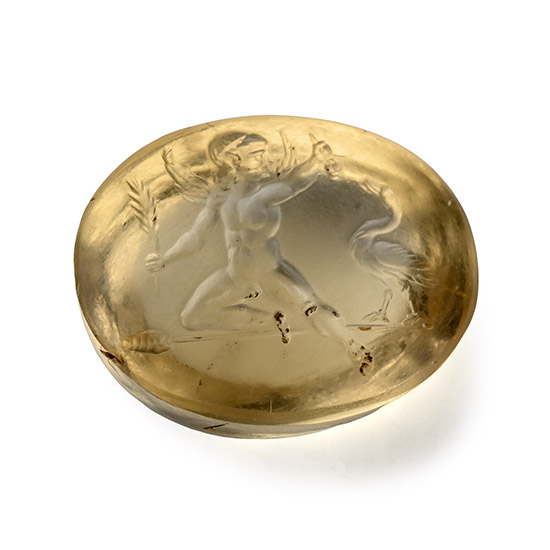
Neoclassical Citrine Gemstone with Putto and Goose
18th-19th century A.D.Sold for (Inc. bp): £1,430
Plano-convex type with incuse scene of a putto kneeling on an arrow with one leg extended over it, holding the flight-feather of a bird in one hand and encouraging a goose to feed from the other hand; with traces of copper tooling; supplied with a museum-quality impression. 1.32 grams, 12 mm
Private English collection, formed between the late 1970s and early 1990s. Private collection, London, UK.
Perhaps the putto is encouraging the goose to approach him so that he can pluck its flight-feathers for use on the shafts of his arrows. -
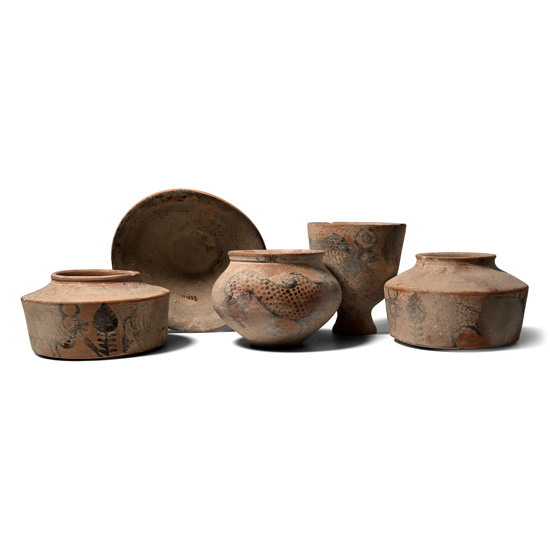
Indus Valley Style Terracotta Vessel Group
20th century A.D.Sold for (Inc. bp): £26
Mixed group of jars and a cup with painted details. 983 grams, 80-125 mm wide
Very fine condition.
From the private collection of John Meredith, acquired since the 1990s; thence by descent.
