
Loading, please wait...
_900x900.jpg "Roman Storage Jar")
_200x200.jpg "Roman Storage Jar")
.jpg "Roman Storage Jar")
LOT 0587
Roman Storage Jar
1ST-4TH CENTURY A.D.
5 1/2 in. (486 grams, 14 cm).
A bulbous ceramic storage jar with everted rim and splayed foot. [No Reserve]
ProvenanceEnglish collection formed in the 1990s.
UK art market.
Property of an Essex gentleman.
TimeLine Auctions follows a vetting process to ensure the authenticity and legality of all items, reinforcing our commitment to integrity and responsible trading. Each antiquity, antique, and coin lot undergoes thorough examination by a vetting committee of at least ten external specialists, professional trade association members, scientists, and archaeologists: Our Vetting Process
AUCTIONS:
TimeLine is a leading auction house specialising in antiquities, ancient art, collectables, natural history, coins, medals, and books. Our auctions offer museums, collectors, historians, and enthusiasts the opportunity to acquire unique and historically significant pieces.
-
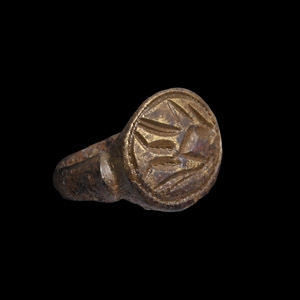
Late Roman Ring with Man Catching Fish
3rd century A.D.Sold for (Inc. bp): £70
A silvered bronze finger ring with stepped shoulders, large ellipsoid bezel with incuse ropework border and stylised figure raising a fish. 6.43 grams, 24.13 mm overall, 17.48 mm internal diameter (approximate size British O, USA 7, Europe 14.98, Japan 14)
Fine condition.
with M. Labarbe, Toulouse, France, 27 November 2011, lot 228. Property of a London gentleman -
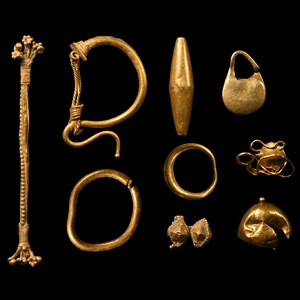
Roman Gold Jewellery Group
1st-3rd century A.D.Sold for (Inc. bp): £845
A mixed group of gold items including a biconical bead, an earring with recurved bow, granule finial and filigree closure, a domed bell-pendant with granule to the apex and other items. 18 grams total, 11-58 mm
Acquired early 1990s. Ex private American collection; thence by descent. Private collection since 1998. -
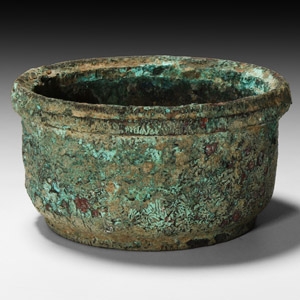
Roman Bronze Bowl
1st-3rd century A.D.Sold for (Inc. bp): £585
A bronze bowl with a squat, barrel-shaped body, broad rim and foot; concentric raised basal rings; old French collection label to the body. 335 grams, 78 mm wide
Ex collection of Louis-Gabriel Bellon (1819-1899), France.
