
Loading, please wait...
_900x900.jpg "Roman Statuette of Attis")
_200x200.jpg "Roman Statuette of Attis")
.jpg "Roman Statuette of Attis")
LOT 0129
Roman Statuette of Attis
1ST-2ND CENTURY A.D.
3 3/4 in. (117 grams total, 97 mm high including stand).
A bronze figure of Attis standing wearing the distinctive Phrygian cap, advancing wearing a flounced tunic and cloak, holding a falx in the left hand; right arm absent; mounted on a custom-made stand.
ProvenanceGerman art market, 1990s.
Mr A.H., a North American collector living in the UK.
Cf. bronze figure of Attis with curved falx in one hand, forming the handle of a folding knife: in the British Museum, London, under reference no. 1772,0312.87.
CONDITIONTimeLine Auctions follows a vetting process to ensure the authenticity and legality of all items, reinforcing our commitment to integrity and responsible trading. Each antiquity, antique, and coin lot undergoes thorough examination by a vetting committee of at least ten external specialists, professional trade association members, scientists, and archaeologists: Our Vetting Process
AUCTIONS:
TimeLine is a leading auction house specialising in antiquities, ancient art, collectables, natural history, coins, medals, and books. Our auctions offer museums, collectors, historians, and enthusiasts the opportunity to acquire unique and historically significant pieces.
-
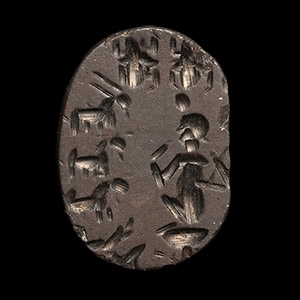
Gnostic Epigraphic Gemstone
3rd-5th century A.D.Sold for (Inc. bp): £468
An engraved gemstone with a stylised image of Harpocrates, depicted as a naked child with a finger raised on his mouth, seated on a lotus flower in a boat, groups of wild animals arranged in threes surrounding; the other side with a magic inscription in Greek letters 'I, E, A, P, Φ, K, Ο, Γ'. 1.25 grams, 14 mm
Acquired before 1988. Ex family collection, by descent, Geneva.
Egyptian deities are often represented on magical gems. One of the most interesting figures is the image of Harpocrates seated on a lotus flower, called ‘the young sun’. This figure had a solar nature and a protective function. -
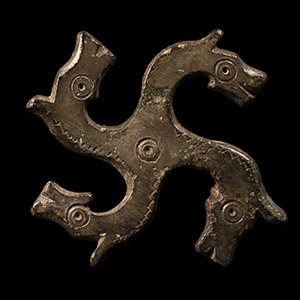
Roman Horse Head Whorl Brooch
3rd-4th century A.D.Sold for (Inc. bp): £598
A bronze swastika-shaped fibula with horse-head decoration, each head with punched ring-and-dot eye, a similar motif to the centre. 16.7 grams, 45 mm
Acquired before 2000. From the collection of a European gentleman living in the UK.
In the 3rd century A.D., several examples of fibulae in the shape of four horses’ heads forming a swastika (type Almgren 232) seem to be related to the creation of the Illyrian cavalry corps in Roman army. Many examples of these military fibulae were found in ancient Roman Dacia (Romania), in Roman Illyricum and Moesia. -
.jpg)
Roman Medical Instrument Group
1st-3rd century A.D.Sold for (Inc. bp): £25
A group of two medical instruments comprising: a probe with one thick rounded end and a triangular blade to the other; a probe with one knopped end and a flat spoon or pallette to the other. 26.9 grams total, 12.3-16 cm
Fine condition.
Ex UK art market, 1970s. Property of a London gentleman.
