
Loading, please wait...
LOT 1062
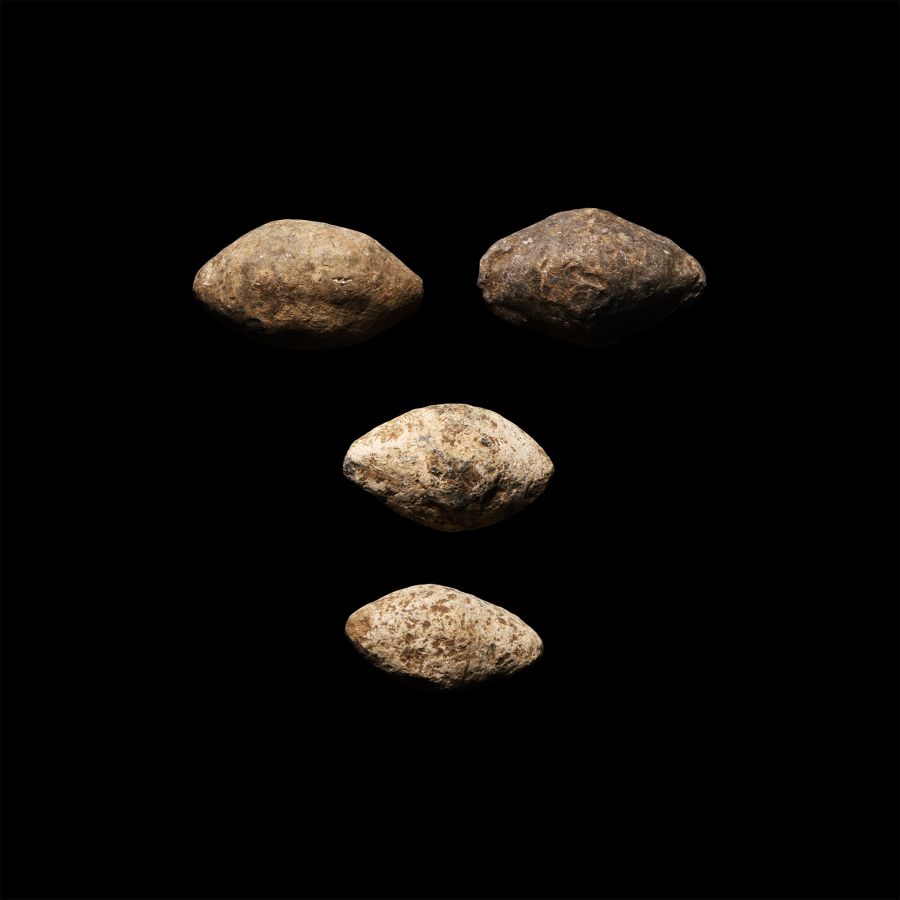
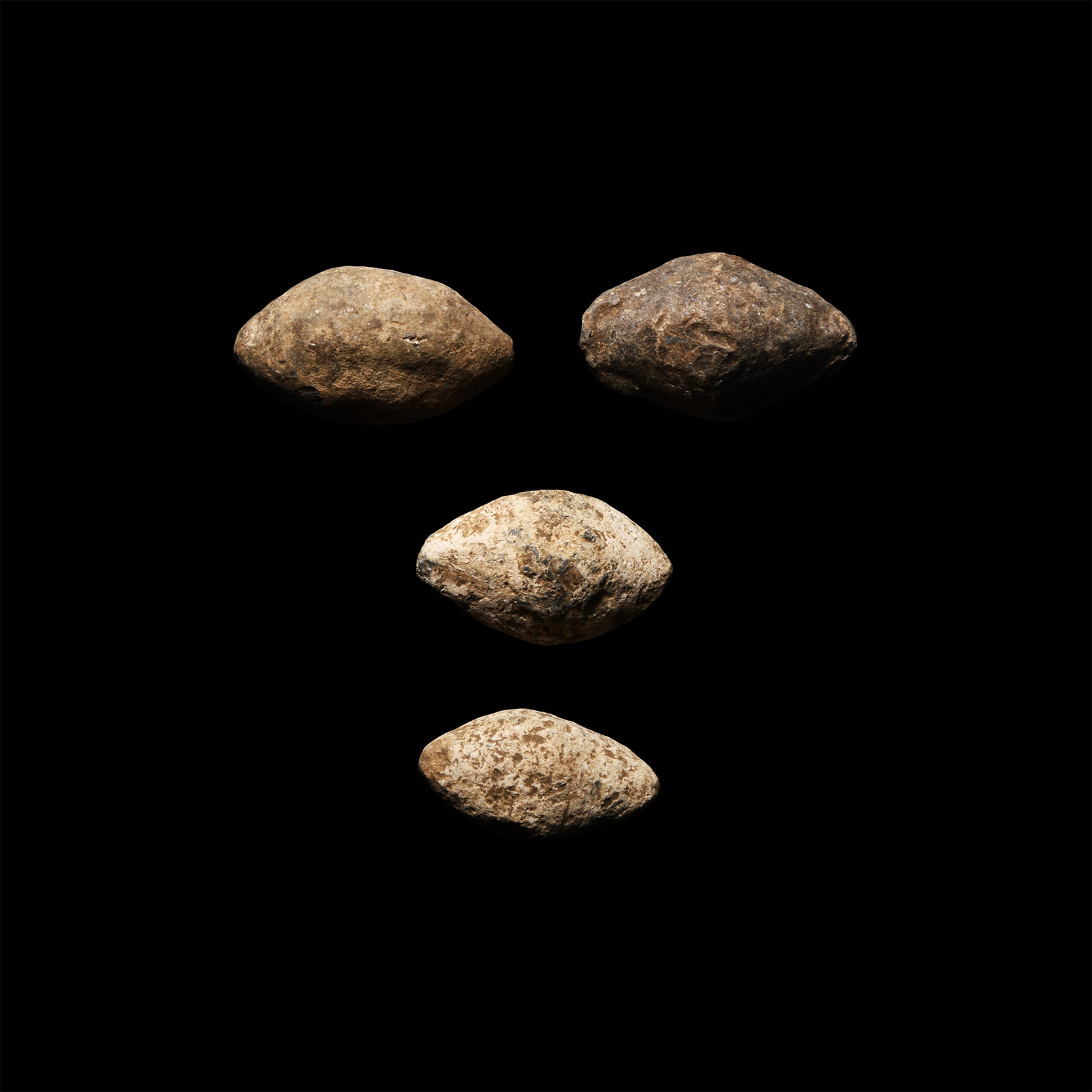
Roman Sling Shot Group
1ST-4TH CENTURY A.D.
1 1/8 - 1 3/8 in. (185 grams total, 29-34 mm).
A lentoid-section lead slingshot (glans) specimen group. [4, No Reserve]
ProvenanceFound Roding, Essex, UK.
Acquired on the UK antiques market between 1974-1985.
Albert Ward collection, Essex, UK.
Similar shots were used in the civil war among Pompey and Caesar, and in all of Caesar's wars. The funditores of Caesa's age were part of the light infantry. Caesar speaks of his Balearic slingers during the conquest of Gaul. They wore a short tunic, with leather or rope sandals to the feet, and a warm overcoat which could also have been used to store projectiles. They also used a satchel to carry very deadly lead-like stones or bullets.
CONDITIONTimeLine Auctions follows a vetting process to ensure the authenticity and legality of all items, reinforcing our commitment to integrity and responsible trading. Each antiquity, antique, and coin lot undergoes thorough examination by a vetting committee of at least ten external specialists, professional trade association members, scientists, and archaeologists: Our Vetting Process
AUCTIONS:
TimeLine is a leading auction house specialising in antiquities, ancient art, collectables, natural history, coins, medals, and books. Our auctions offer museums, collectors, historians, and enthusiasts the opportunity to acquire unique and historically significant pieces.
-
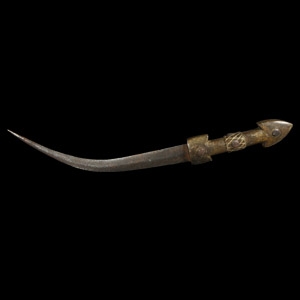
Khandjar Type Dagger
19th century A.D.Estimate: £180 - 240 (+bp*)
Opening Bid: £100
A very large iron dagger, curved with a thick double edge blade, handle composed of wood and iron, ornately decorated with lozenges, fastened by eight iron flat-headed rivets. 118 grams, 32 cm long
Fine condition.
Private family collection formed in London, mid 1980s to early 1990s.
Among the various Arab dagger groups, the one from North Africa is characterised by rather fine blades made in the Turkish-Persian style. Usually the handles (in wood, ivory and metal) feature a large rounded pommel in the guise of peacock feathers. This type is common in Morocco, Tunisia and all the way to Egypt, and is a type of Khandjar usually called Koummiya or Goummiya (a term later adopted in Spanish as Goumia, to indicate all the short Arab daggers). -
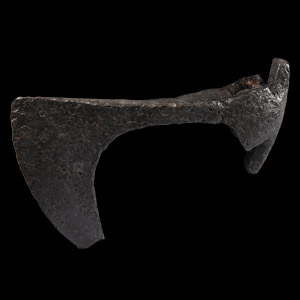
Viking Period Bearded Type Axehead
Circa 9th-11th century A.D.Sold for (Inc. bp): £546
An iron axehead with broad curved blade and spur to the chin, narrow neck, deep socket with lateral spurs and extended plate to the reverse. 777 grams, 20 cm
Acquired 1971-1972. From the collection of the vendor's father. Property of a London, UK, collector.
Iron axeheads of this typology show a sub-trapezoidal asymmetrical blade, sometimes perforated through the centre. They are characterised by two projecting spurs to the back of the shaft-hole. -
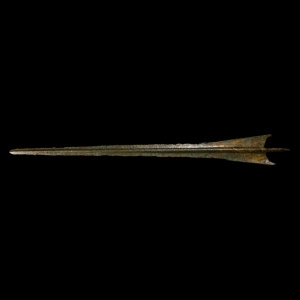
Western Asiatic Dagger Blade with Winged Guards
Late 2nd-mid 1st millennium B.C.Sold for (Inc. bp): £410
A bronze dagger with prominently curved or winged guard, extending out from the ricasso and partly framing the tang, once covered by an organic hilt; the thick midrib extending slightly above the ricasso. 484 grams, 60 cm
Acquired 1980-2015. Ex Abelita family collection.
Many examples of these blades have been excavated in the South Caspian area at Ghalekuti, and in the area of Talish. They have been found primarily in Iron Age graves, although the curves of the guards are reminiscent of the barbed arrow and javelin heads associated with Bronze Age Marlik. This is why some scholars (Dyson) dated them to the second millennium BC and others (Muscarella) to the recent Iron Age. It is possible that this style represents continuity from the Bronze to the Iron Age.
