
Loading, please wait...
LOT 0807
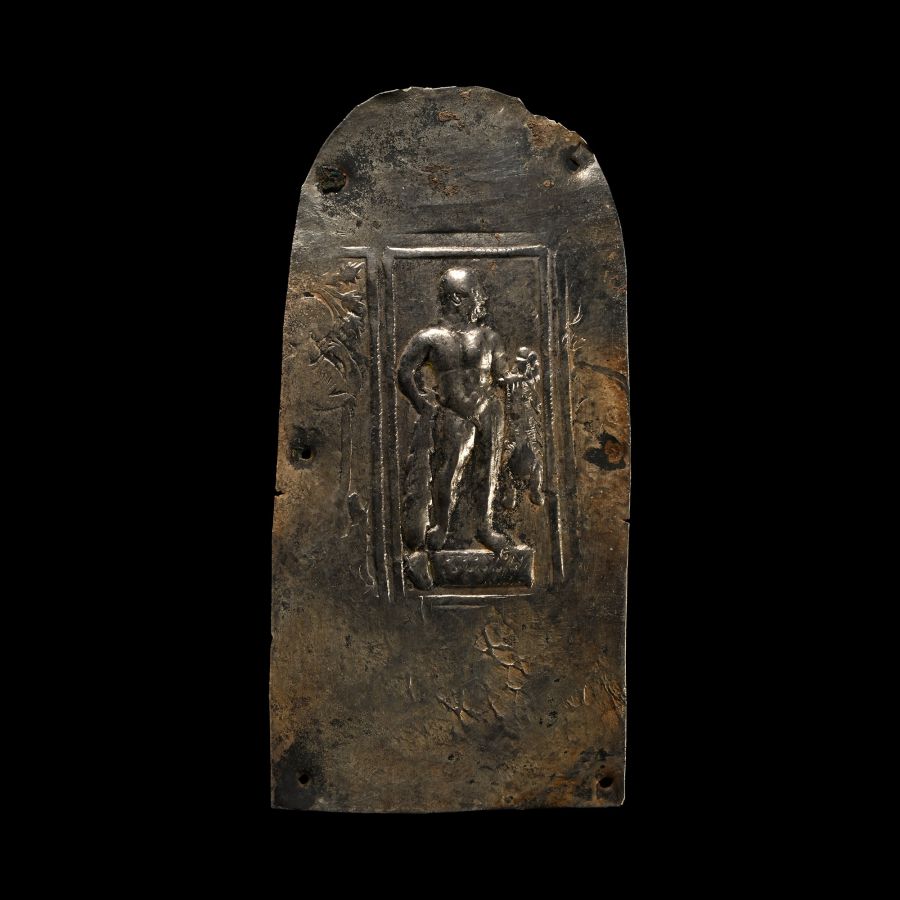
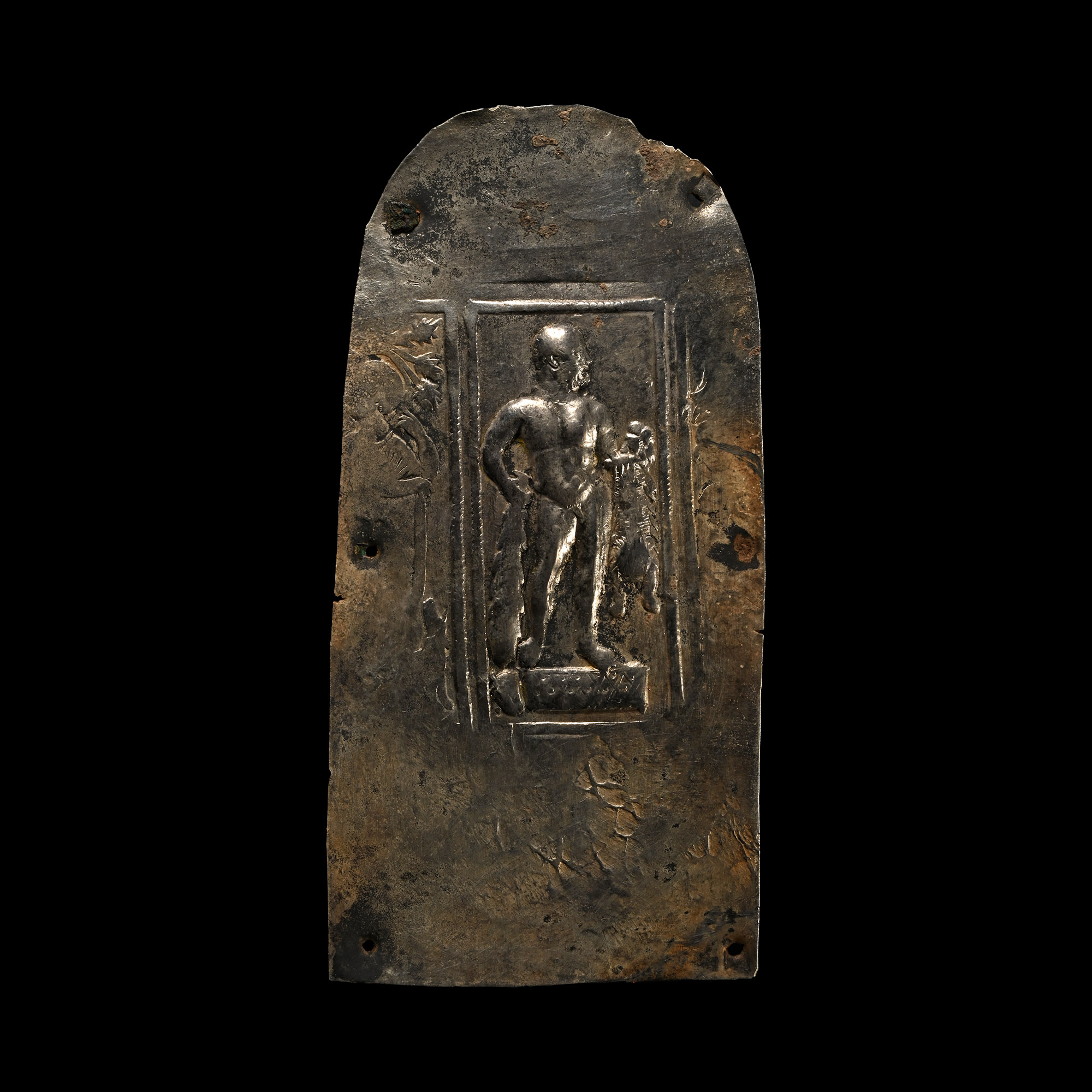
Roman Silver Votive Plaque with Hercules
2ND-4TH CENTURY A.D.
4 in. (30 grams, 99 mm).
Tongue-shaped with central repoussé motif of Hercules standing nude on a plinth supporting his club and with lionskin mantle draped over his bent forearm; rectangular frame surrounding; traces of similar frames to both sides; six holes for attachment.
ProvenanceAcquired in the mid 1980s-1990s.
Private collection, Switzerland, thence by descent.
Private collection, since the late 1990s.
Cf. Martin, M., Römermuseum und Römerhaus Augst, Augst, 1987, item 110, for type.
FootnotesThe panel has clearly been cut from a larger sheet of silver which was stamped with low-relief figures: to the left of Hercules is a frame with fronds at the top and the bent arms of a figure wearing a palla.
CONDITIONTimeLine Auctions follows a vetting process to ensure the authenticity and legality of all items, reinforcing our commitment to integrity and responsible trading. Each antiquity, antique, and coin lot undergoes thorough examination by a vetting committee of at least ten external specialists, professional trade association members, scientists, and archaeologists: Our Vetting Process
AUCTIONS:
TimeLine is a leading auction house specialising in antiquities, ancient art, collectables, natural history, coins, medals, and books. Our auctions offer museums, collectors, historians, and enthusiasts the opportunity to acquire unique and historically significant pieces.
-
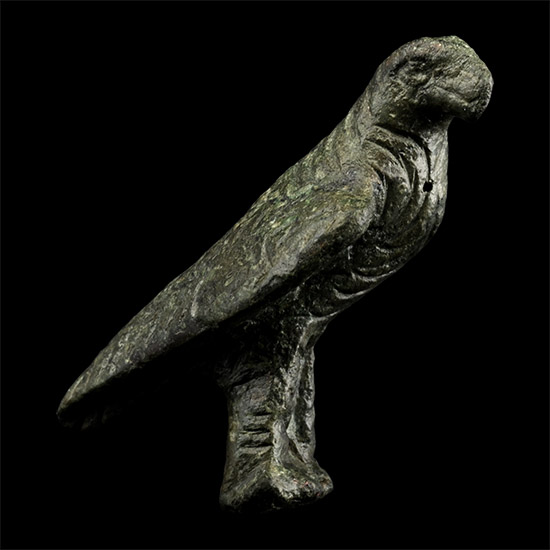
Roman Bronze Eagle Statuette
2nd-3rd century A.D.Sold for (Inc. bp): £143
Modelled in the round perching on the knop with wings closed and head turned. 41.38 grams, 48 mm
Ex German art market, 2000s. Acquired from an EU collector living in London. From the collection of a Surrey, UK, gentleman. -

Roman Bronze Figure of a Bathing Young Girl
3rd-4th century A.D.Sold for (Inc. bp): £2,340
Depicted as a standing nude female figure with hair dressed in a chignon, left hand clasped to the chest, and right arm bent; mounted on a tiered display stand. 448 grams total, 17.4 cm including stand
Acquired in the late 1980s. Private collection, since the late 1990s. This lot has been checked against the Interpol Database of stolen works of art and is accompanied by a search certificate number no.12862-241687.
The girl is depicted in the act of girding her chest with a fascia, similar to the one illustrated in the famous mosaics of Piazza Armerina, where the band is worn together with a subligaculum that covers her lower parts. It is modelled after a real two-piece bath costume of the ancient Romans. -
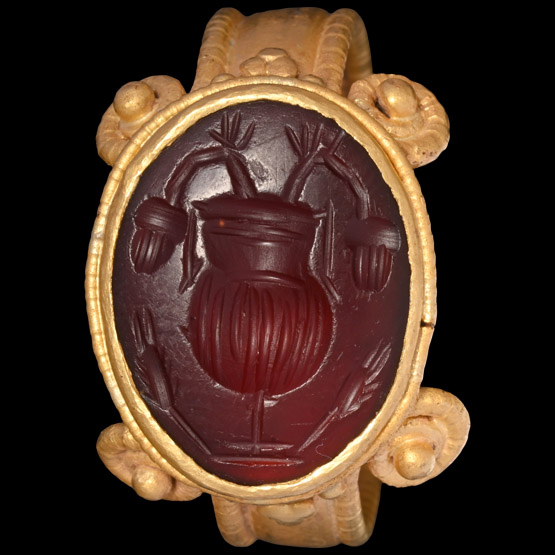
Roman Vase Gemstone in Gold Ring
2nd-3rd century A.D.Estimate: £1,200 - 1,700 (+bp*)
Opening Bid: £600
A cloison garnet intaglio with vase, flowers and seeds; set into a later gold finger ring comprising a broad hoop with beaded wire rims, scrolled shoulders with granule detailing, discoid bezel; set into a later gold ring; supplied with a museum-quality impression. 8.48 grams, 22.56 mm overall, 19.58 mm internal diameter (approximate size British Q, USA 8, Europe 17.49, Japan 16)
Private collection, before 1975. Private collection, England.
