
Loading, please wait...
_900x900.jpg "Roman Silver 'TOT' Toutatis Ring")
_200x200.jpg "Roman Silver 'TOT' Toutatis Ring")
.jpg "Roman Silver 'TOT' Toutatis Ring")
LOT 0664
Roman Silver 'TOT' Toutatis Ring
1ST-2ND CENTURY A.D.
1 in. (5.02 grams, 23.37 mm overall, 19.65 mm internal diameter (approximate size British P, USA 7 1/2, Europe 16.23, Japan 15)).
With a wide, grooved hoop expanding at the shoulders, rectangular plaque with ropework border enclosing amuletic inscription 'ToT, an abbreviation for the name of the Celtic god Toutatis.
ProvenanceEx private collection, 1970s.
Property of a Nottinghamshire gentleman.
This lot is accompanied by an illustrated lot declaration signed by the Head of the Antiquities Department, Dr Raffaele D’Amato.
A number of rings have been found in eastern Roman Britain inscribed with the word TOT. It is thought that they refer to the Celtic deity Toutatis, later associated by the Romans with Mars and Mercury. The rings have been found mainly in the area corresponding to the native British tribe of the Corieltauvi who may have worshipped Toutatis as their primary tribal deity. The likelihood of the presence of his cult is strengthened by several inscriptions found in Britain mentioning this deity. However, his origin may be sought in the religion of the Continental Celtae, as the Roman writer Lucan in the 1st century AD mentioned the worship of 'Teutatis' together with two other deities, Esus and Taranis.
CONDITIONTimeLine Auctions follows a vetting process to ensure the authenticity and legality of all items, reinforcing our commitment to integrity and responsible trading. Each antiquity, antique, and coin lot undergoes thorough examination by a vetting committee of at least ten external specialists, professional trade association members, scientists, and archaeologists: Our Vetting Process
AUCTIONS:
TimeLine is a leading auction house specialising in antiquities, ancient art, collectables, natural history, coins, medals, and books. Our auctions offer museums, collectors, historians, and enthusiasts the opportunity to acquire unique and historically significant pieces.
-
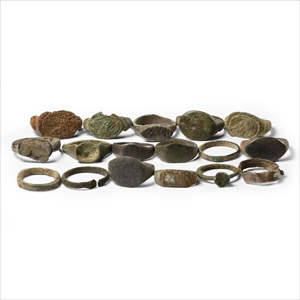
Roman and Other Bronze and Silver Ring Collection
1st-4th century A.D. and laterSold for (Inc. bp): £520
Including trumpet-bezel, carinated shoulder and other types. 59 grams total, 19-25 mm
Ex Nigel Mills, London, UK, circa 2000. This lot is accompanied by an illustrated lot declaration signed by the Head of the Antiquities Department, Dr Raffaele D’Amato. -
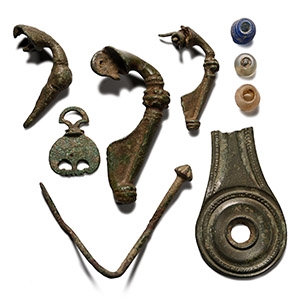
Romano-British Bronze Artefact Collection
1st-4th century A.D.Sold for (Inc. bp): £33
Including a patera handle, trumpet brooch, dress pin and other items. 100 grams total, 9-65 mm
The brooches found near Wetwang, North Yorkshire, UK, 1990s-2005, and acquired UK, in 2008. The rest found Nottinghamshire, UK, and acquired from Ancient & Oriental, UK, in the 1980s. Ian Wilkinson collection, Nottinghamshire, UK, formed since 1985. This lot is accompanied by an illustrated lot declaration signed by the Head of the Antiquities Department, Dr Raffaele D’Amato. -
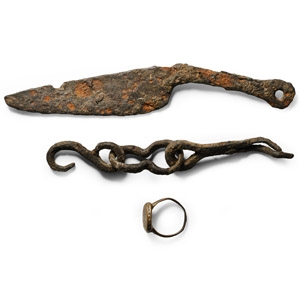
Roman and Later Thames Mudlarking Finds
1st-16th century A.D.Sold for (Inc. bp): £65
Including a bronze finger ring, iron knife and other items. 76 grams total, 2.3-15.6 cm
Found on the Thames foreshore by Steve Brooker, in the early 2000s. Ian Wilkinson collection, Nottinghamshire, UK, formed since 1985. This lot is accompanied by an illustrated lot declaration signed by the Head of the Antiquities Department, Dr Raffaele D’Amato.
