
Loading, please wait...
_900x900.jpg "Roman Silver Ring with Victory")
_200x200.jpg "Roman Silver Ring with Victory")
.jpg "Roman Silver Ring with Victory")
LOT 0638
Roman Silver Ring with Victory
2ND-4TH CENTURY A.D.
3/4 in. (4.95 grams, 21.19 mm overall, 18.30 mm internal diameter (approximate size British P 1/2, USA 7 3/4, Europe 16.86, Japan 16)).
A silver ring composed of a D-section hoop and roughly oval-shaped bezel engraved with a figure of winged Victory standing left, wearing a helmet and holding a wreath in her extended hand. [No Reserve]
ProvenancePrivate collection formed since the 1940s.
UK art market.
Property of an Essex gentleman.
TimeLine Auctions follows a vetting process to ensure the authenticity and legality of all items, reinforcing our commitment to integrity and responsible trading. Each antiquity, antique, and coin lot undergoes thorough examination by a vetting committee of at least ten external specialists, professional trade association members, scientists, and archaeologists: Our Vetting Process
AUCTIONS:
TimeLine is a leading auction house specialising in antiquities, ancient art, collectables, natural history, coins, medals, and books. Our auctions offer museums, collectors, historians, and enthusiasts the opportunity to acquire unique and historically significant pieces.
-
.jpg)
Large Roman Aubergine Glass Twin-Handled Jar
3rd-4th century A.D.Sold for (Inc. bp): £1,778
An aubergine glass jar with onion-shaped body, cylindrical neck, trumpet-style mouth and rolled lip; two applied green glass handles and pie crust frill around neck, body with decorative raised lobes; some iridescence. 246 grams, 18 cm high
Fine condition.
Mitsukoshi, Tokyo, Japan, 1981. Kokusai Bijutsu: Ninth International Art Exhibition, no.46. Acquired Bonhams, New Bond Street, 28 November 2019, lot 146. Ex J.L. collection Surrey, UK. Accompanied by copies of the Bonhams catalogue pages. -
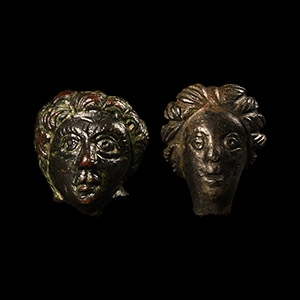
Roman Goddess Statuette Heads
Circa 1st-3rd century A.D.Estimate: £300 - 400 (+bp*)
Opening Bid: £150
A pair of semi-naturalistic bronze statue heads modelled in the round: a female with hair held in a chignon at the nape; figure with hair dressed in short wavy tufts, large eyes with exaggerated eyelashes. 71 grams total, 23-25 mm
Acquired before 2000. From the collection of a European gentleman living in the UK.
Bronze statuettes of Roman work representing Roman gods and goddesses were widespread all around the empire, and are also known as far as archaeological sites of Jutland and the islands. The two heads represent probably tutela divinities of the home, like Vesta and Juno (Greek Hera). -
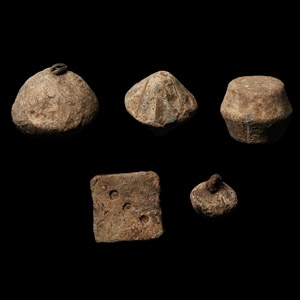
Roman Steelyard and Other Weight Group
1st-4th century A.D.Sold for (Inc. bp): £26
A group of various weights comprising three biconical steelyard weights each with the remains of the iron loop, a barrel-shaped weight with five dots to one end, and a tabular-shaped weight with three large stamped dimples to one fate surface. 478 grams total, 24-34 mm
Found Rodings, Essex, UK. Acquired on the UK antiques market between 1974-1985. Albert Ward collection, Essex, UK.
