
Loading, please wait...
_900x900.jpg "Roman Silver Ring with Gemstone of Cupid Riding a Dolphin")
_200x200.jpg "Roman Silver Ring with Gemstone of Cupid Riding a Dolphin")
.jpg "Roman Silver Ring with Gemstone of Cupid Riding a Dolphin")
LOT 0916
Roman Silver Ring with Gemstone of Cupid Riding a Dolphin
2ND-3RD CENTURY A.D.
1 in. (9.29 grams, 27.65 mm overall, 20.67 mm internal diameter (approximate size British O, USA 7, Europe 14.98, Japan14).
With an inset onyx gemstone, intaglio of a boy riding on the back of a dolphin and wielding a whip; supplied with a museum-quality impression.
ProvenancePrivate collection, before 1975.
Private collection, England.
Cf. Chadour, A.B., Rings. The Alice and Louis Koch Collection, volume I, Leeds, 1994, item 320, for type.
CONDITIONTimeLine Auctions follows a vetting process to ensure the authenticity and legality of all items, reinforcing our commitment to integrity and responsible trading. Each antiquity, antique, and coin lot undergoes thorough examination by a vetting committee of at least ten external specialists, professional trade association members, scientists, and archaeologists: Our Vetting Process
AUCTIONS:
TimeLine is a leading auction house specialising in antiquities, ancient art, collectables, natural history, coins, medals, and books. Our auctions offer museums, collectors, historians, and enthusiasts the opportunity to acquire unique and historically significant pieces.
LOT 0916
Roman Silver Ring with Gemstone of Cupid Riding a Dolphin
Sold for (Inc. bp): £715
-
.jpg)
Roman Silver Ring with Agate Gemstone with Roman War Ship with Trophy
2nd-3rd century A.D.Estimate: £1,000 - 1,400 (+bp*)
Opening Bid: £500
Comprising a triangular-section hoop with keeled shoulders, an ellipsoid bezel with inset carnelian intaglio with oared ship, trophy of arms at prow, and floral decoration at stern; supplied with a museum-quality impression. 8.48 grams, 29.64 mm overall, 21.60 × 16.35 mm internal diameter (approximate size British O, USA 7, Europe 14.98, Japan 14)
Private collection, before 1975. Private collection, England. -
.jpg)
Large Roman Green Mosaic Glass Fragment
Late 1st century B.C.-early 1st century A.D.Estimate: £3,000 - 4,000 (+bp*)
Opening Bid: £1,500
Sub-rectangular panel fragment made from mosaic-type glass in shades of green and cream; one polished face, edge chipped; mounted on a custom-made stand. 460 grams total, glass: 11.9 cm
with old 19th-century label ‘240’ to the reverse. Dr Jutaro Kawabe, Nagoya, Japan, assembled during the 1960s-1980s. with Hoshigaoka Gallery until the late 1990s. This lot has been checked against the Interpol Database of stolen works of art and is accompanied by search certificate number no.13094-248079.
The decoration is well documented in the Eastern Roman Empire, especially the Syro-Palestinian coast. The most frequently occurring colours in these glass mosaics are opaque red, but green and blue tints are not uncommon. -
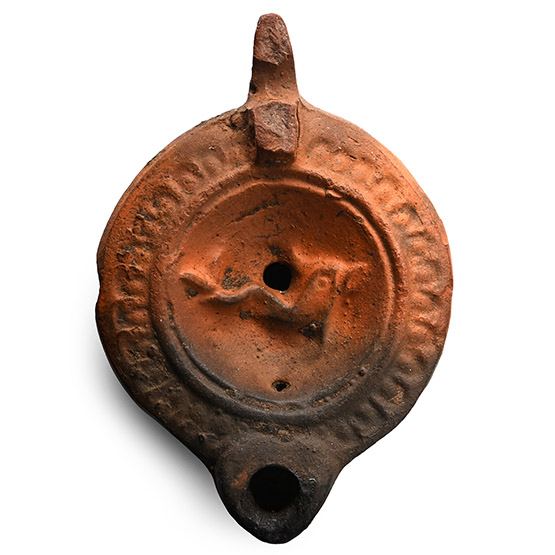
Roman Terracotta Oil Lamp with Dolphin
2nd century A.D.Sold for (Inc. bp): £182
Discoid in plan with short D-shaped nozzle, loop handle (top absent), discus with low-relief image of a dolphin; shoulder with radiating scales; base marked off with a circular groove. 46.3 grams, 89 mm
From the Lloyd and Jeanne Raport collection, Washington, D.C. and Florida, USA, formed between 1972-2000. Acquired through Bonhams, London, UK.
