
Loading, please wait...


LOT 0107
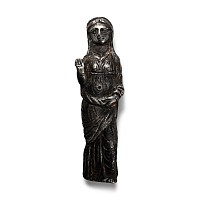
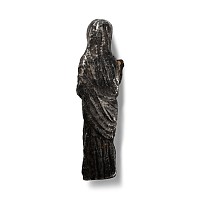
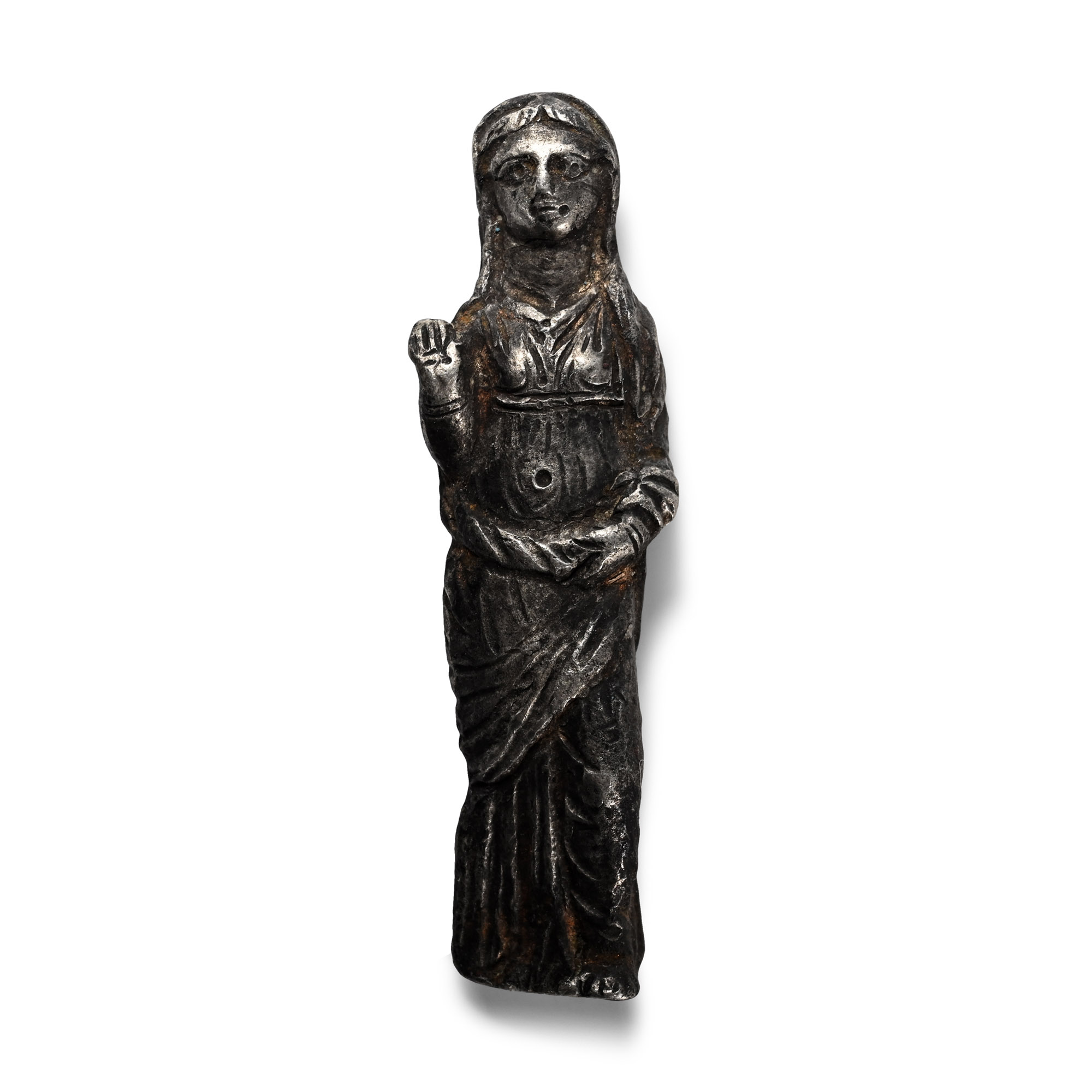
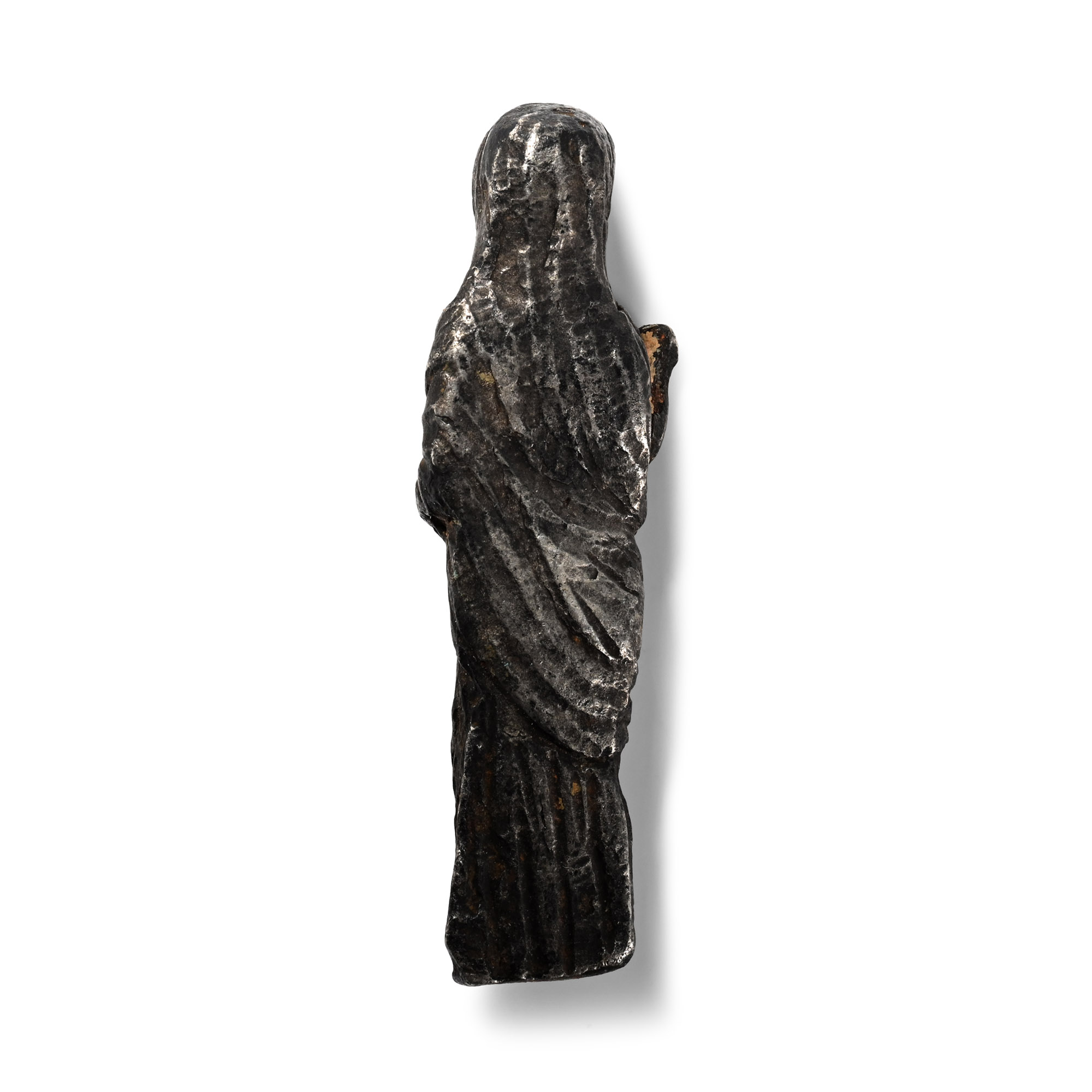
Roman Silver Priestess of Vesta Statuette
1ST-3RD CENTURY A.D.
1 3/8 in. (11.8 grams, 41 mm).
Solid cast standing female wearing a loosely draped robe draped over her head, the hem gathered at her waist and held in her left hand, right hand raised in greeting; probably a priestess of Vesta.
ProvenanceAcquired in the mid 1980s-1990s.
Private collection, Switzerland, thence by descent.
Private collection, since the late 1990s.
This lot has been checked against the Interpol Database of stolen works of art and is accompanied by search certificate number no.12227-222180.
This lot has been cleared against the Art Loss Register database, and is accompanied by an illustrated lot declaration signed by the Head of the Antiquities Department, Dr Raffaele D’Amato.
Cf. bronze statue of empress Julia Aquilia Severa, sometime priestess of Vesta and later wife to Emperor Elagabalus, dating from 220/222 AD, now in the National Archaeological Museum in Athens.
CONDITIONTimeLine Auctions follows a vetting process to ensure the authenticity and legality of all items, reinforcing our commitment to integrity and responsible trading. Each antiquity, antique, and coin lot undergoes thorough examination by a vetting committee of at least ten external specialists, professional trade association members, scientists, and archaeologists: Our Vetting Process
AUCTIONS:
TimeLine is a leading auction house specialising in antiquities, ancient art, collectables, natural history, coins, medals, and books. Our auctions offer museums, collectors, historians, and enthusiasts the opportunity to acquire unique and historically significant pieces.
LOT 0107
Roman Silver Priestess of Vesta Statuette
Estimate £1,500 - 2,000€1,740 - 2,320 (for guidance only)$2,030 - 2,700 (for guidance only)
-
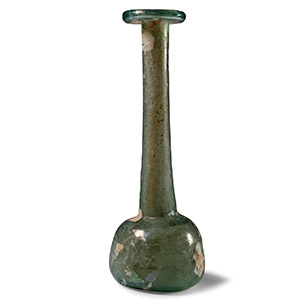
Roman Tall Glass Bottle
1st-2nd century A.D.Sold for (Inc. bp): £572
With plano-convex body and flat base, tapering neck and everted rim; some iridescence to surface. 140 grams, 17.5 cm
Private collection, Luxembourg, 2002. Swiss private collection, 2003. Ex Vittorio Rizzi, Basel, prior 2005. Accompanied by a copy of an Art Loss Register certificate no.S00035605. This lot is accompanied by an illustrated lot declaration signed by the Head of the Antiquities Department, Dr Raffaele D’Amato. -
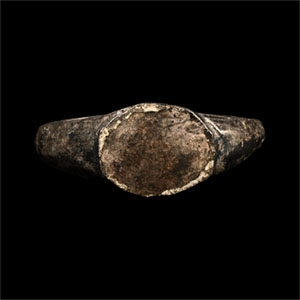
Roman Silver Ring with Plain Bezel
2nd-3rd century A.D.Sold for (Inc. bp): £124
Comprising a thick hoop with angled shoulders, expanding towards a discoid bezel. 3.35 grams, 22.45 mm overall, 17.53 mm internal diameter (approximate size British I, USA 4 1/4, Europe 7.44, Japan 7)
From an English collection formed before 2000. This lot is accompanied by an illustrated lot declaration signed by the Head of the Antiquities Department, Dr Raffaele D’Amato. -
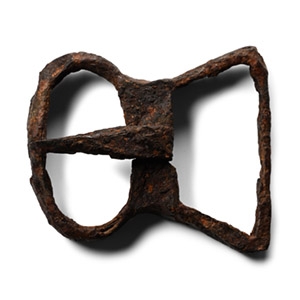
Romano-British Iron Military Buckle
Circa 2nd century A.D.Sold for (Inc. bp): £33
With rectangular frame and kidney-shaped loop broad crossbar with waisted scentre and coiled tongue. 14 grams, 47 mm
Found Ilchester, Somerset, UK, in 1981. Acquired from Brigantia Antiques, York, UK, circa 2008. Ian Wilkinson collection, Nottinghamshire, UK, formed since 1985. Accompanied by an old handwritten dealer's ticket. This lot is accompanied by an illustrated lot declaration signed by the Head of the Antiquities Department, Dr Raffaele D’Amato.
