
Loading, please wait...
LOT 0151
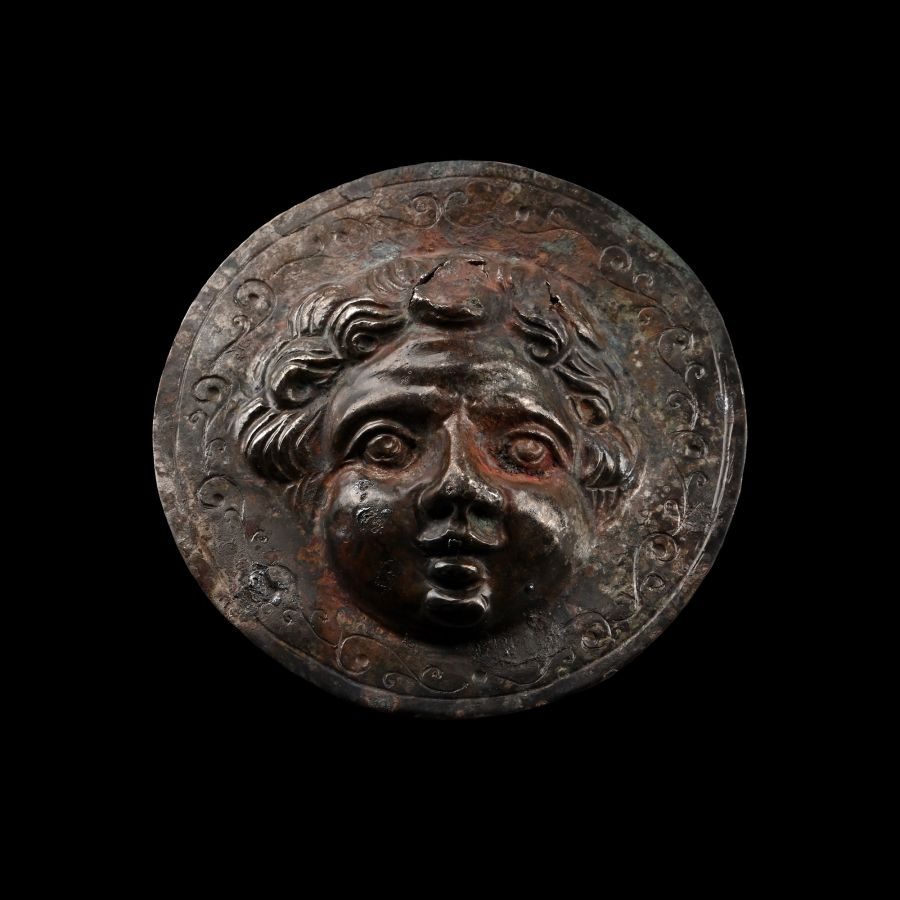
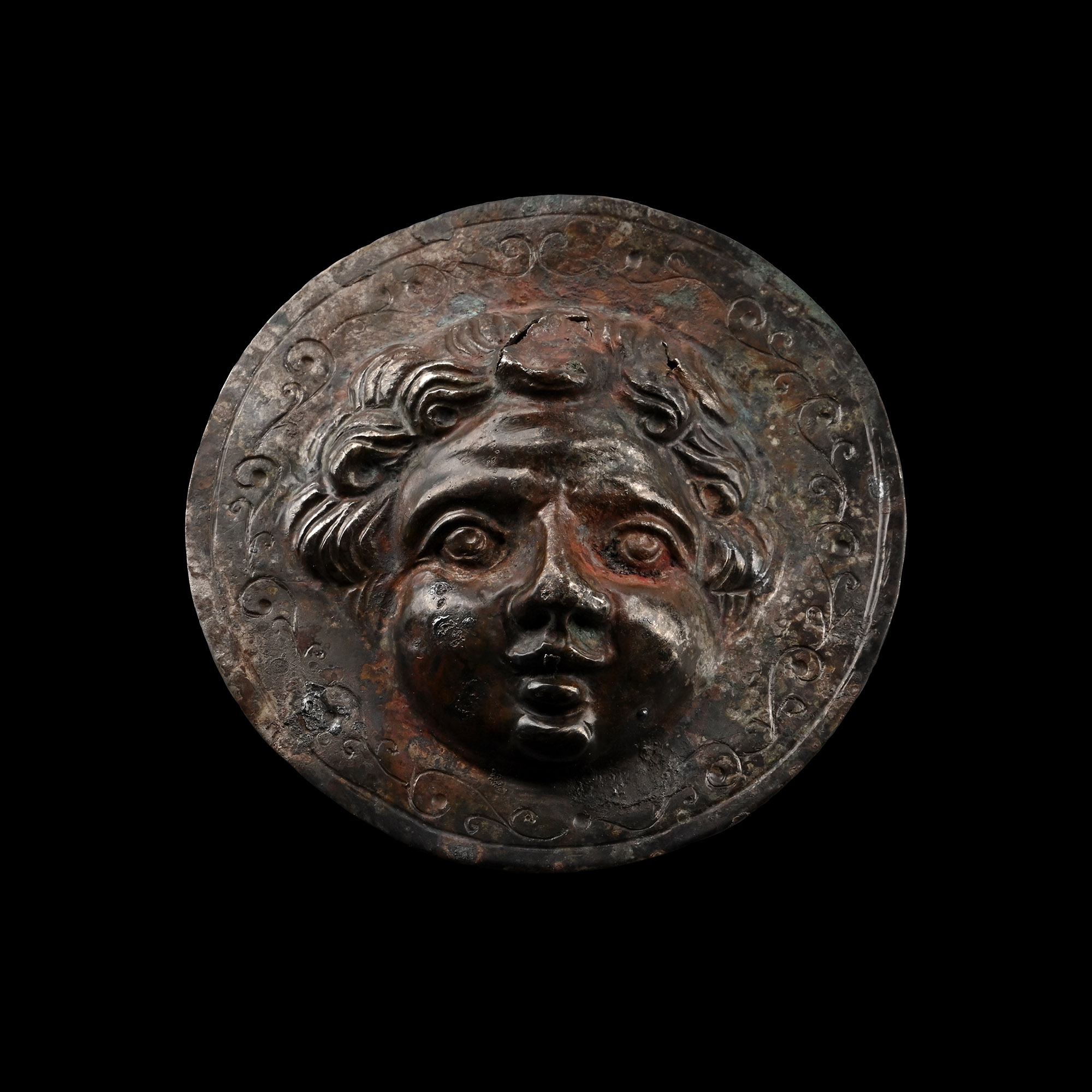
Roman Silver Phalera with Face of Eros, the Greek God of Love
1ST-2ND CENTURY A.D.
2 7/8 in. (27.1 grams, 74 mm).
Discoid in plan with running scrolled tendrils to the outer edge, central mask with curly hair and fleshy features.
ProvenanceEx German art market, 2000s.
Acquired from an EU collector living in London.
From the collection of a Surrey, UK, gentleman.
Cf. similar in the British Museum under accession no.1854,0717.23.
CONDITIONTimeLine Auctions follows a vetting process to ensure the authenticity and legality of all items, reinforcing our commitment to integrity and responsible trading. Each antiquity, antique, and coin lot undergoes thorough examination by a vetting committee of at least ten external specialists, professional trade association members, scientists, and archaeologists: Our Vetting Process
AUCTIONS:
TimeLine is a leading auction house specialising in antiquities, ancient art, collectables, natural history, coins, medals, and books. Our auctions offer museums, collectors, historians, and enthusiasts the opportunity to acquire unique and historically significant pieces.
LOT 0151
Roman Silver Phalera with Face of Eros, the Greek God of Love
Sold for (Inc. bp): £1,300
-

Roman Bronze Figure of Hercules
2nd-3rd century A.D.Estimate: £1,500 - 2,000 (‡+bp*)
Opening Bid: £750
Depicted nude in a contrapposto stance with the weight on his left leg, holding a club in the crook of his left hand with a lion-skin draped over the arm, and a cup in his right hand. 115 grams, 86 mm
Acquired in the 1980s. Private collection, Switzerland, thence by descent. Private collection, since the late 1990s. This lot has been checked against the Interpol Database of stolen works of art and is accompanied by search certificate number no.12615-234681.
The statuette, perhaps of Gallo-Roman origin, was likely part of a private lararium. It is a provincial work, but well-proportioned. Unlike other statuettes of this type, Hercules is beardless. The upper part of the head was probably covered by a laurel crown. -

Roman Bronze Ring with Head of Lion
2nd-3rd century A.D.Sold for (Inc. bp): £26
Slender round-section hoop and a round bezel with a raised lion-head with recessed eyes. 2.99 grams, 24.31 mm overall, 16.94 mm internal diameter (approximate size British J, USA 4 3/4, Europe 8.69, Japan 8)
Found North Tamworth, Staffordshire, UK. Acquired on the UK and EU art market before 2000. From the private collection of a Surrey, UK, gentleman.
The shape of the ring belongs to the typologies of the Severan Age. Under Caracalla, the theme of the lion was popular on rings of civilians and soldiers, being the emperor's favourite animal. Stars and lions were, from the age of Caracalla, symbols of the Praetorian Guard. -

Roman and Later Ring Collection
3rd century B.C.-19th century A.D.Sold for (Inc. bp): £221
Comprising: Roman orange glass ring; Roman iron ring with glass intaglio; three early Byzantine bronze rings with solar symbols engraved on the bezel; two early Medieval bronze rings, one with a coat of arms and one with an eagle; one late Medieval silver ring with a floriated cross; two Renaissance rings set with coloured glass insert. 50 grams total, 20-28 mm
From the stock of a former UK antiquarian, acquired at trade fairs and from private collection formed in the 1980s-1990s. Private collection, Europe.
