
Loading, please wait...
_900x900.jpg "Roman Silver Lunar Pendant")
_200x200.jpg "Roman Silver Lunar Pendant")
.jpg "Roman Silver Lunar Pendant")
LOT 0794
Roman Silver Lunar Pendant
1ST-2ND CENTURY A.D.
3/4 in. (1.1 grams, 19 mm).
Comprising a discoid crescent-shaped pendant with openwork decoration. [No Reserve]
ProvenanceEx German art market, 2000s.
Acquired from an EU collector living in London.
From the collection of Surrey, UK, gentleman.
This lot is accompanied by an illustrated lot declaration signed by the Head of the Antiquities Department, Dr Raffaele D’Amato.
TimeLine Auctions follows a vetting process to ensure the authenticity and legality of all items, reinforcing our commitment to integrity and responsible trading. Each antiquity, antique, and coin lot undergoes thorough examination by a vetting committee of at least ten external specialists, professional trade association members, scientists, and archaeologists: Our Vetting Process
AUCTIONS:
TimeLine is a leading auction house specialising in antiquities, ancient art, collectables, natural history, coins, medals, and books. Our auctions offer museums, collectors, historians, and enthusiasts the opportunity to acquire unique and historically significant pieces.
-
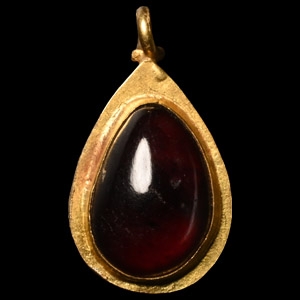
Roman Gold and Garnet Pendant
1st-4th century A.D.Sold for (Inc. bp): £494
Gold teardrop pendant with inset cabochon garnet in stepped cell, loop above. 1.20 grams, 15 mm
Ex property of a late Japanese collector, 1970-2000s. This lot is accompanied by an illustrated lot declaration signed by the Head of the Antiquities Department, Dr Raffaele D’Amato. -
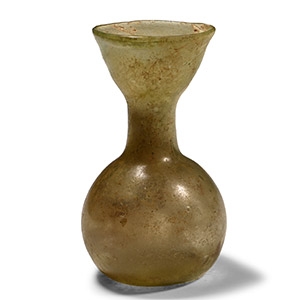
Roman Pale Green Glass Vase with Flared Neck
4th-5th century A.D.Sold for (Inc. bp): £111
In yellow-greenish translucent glass, globular body with flaring funnel neck, dimpled base. 26.8 grams, 86 mm
Acquired 1980-2015. Ex Abelita family collection. Property of a Stockport, UK, collector. This lot is accompanied by an illustrated lot declaration signed by the Head of the Antiquities Department, Dr Raffaele D’Amato.
The type was popular in the late Roman period, especially in the east. Its characteristic trait is an oval body, convex base and a neck with a funnel-like upper part. -
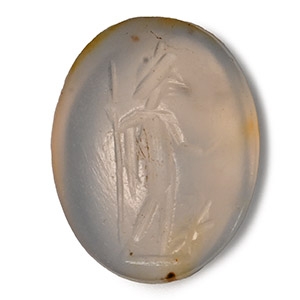
Roman Chalcedony Gemstone with Jupiter
2nd-3rd century A.D.Sold for (Inc. bp): £234
An oval intaglio with convex faces, engraved with an image of standing god Jupiter holding a long spear, an eagle at his feet. 0.66 grams, 12 mm
Ex Swiss collection formed in the 1980s onwards. This lot is accompanied by an illustrated lot declaration signed by the Head of the Antiquities Department, Dr Raffaele D’Amato.
