
Loading, please wait...
_900x900.jpg "Roman Silver-Gilt Statuette of Jupiter")
_200x200.jpg "Roman Silver-Gilt Statuette of Jupiter")
.jpg "Roman Silver-Gilt Statuette of Jupiter")
LOT 0101
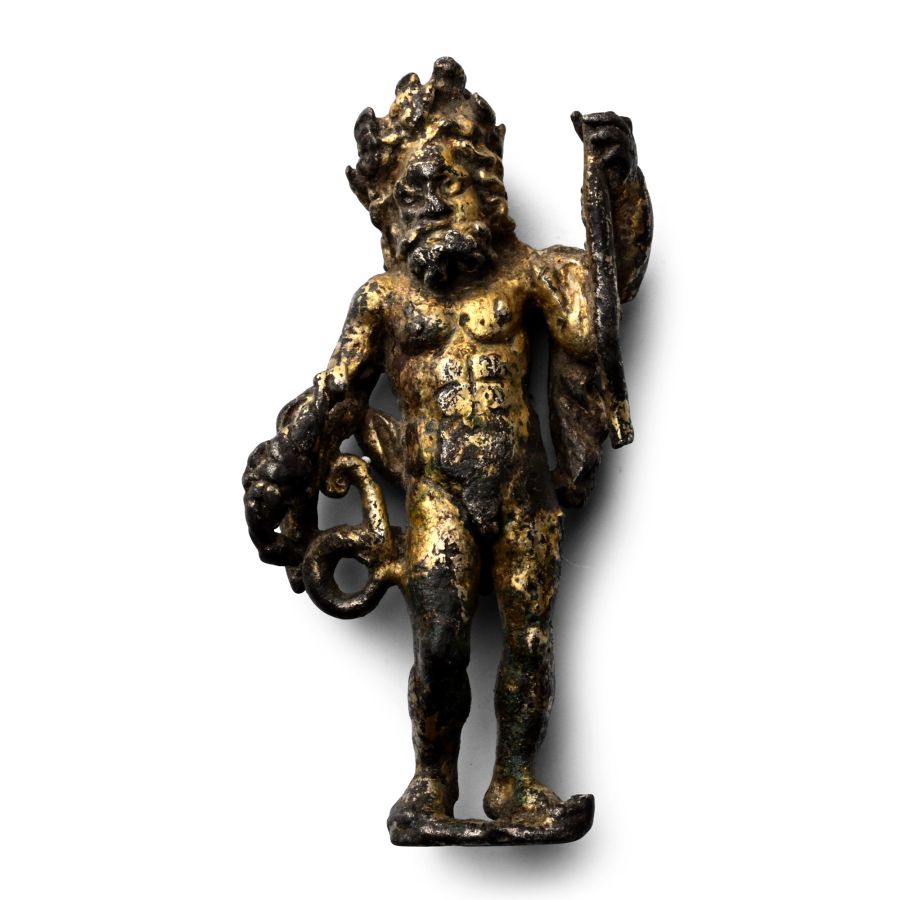
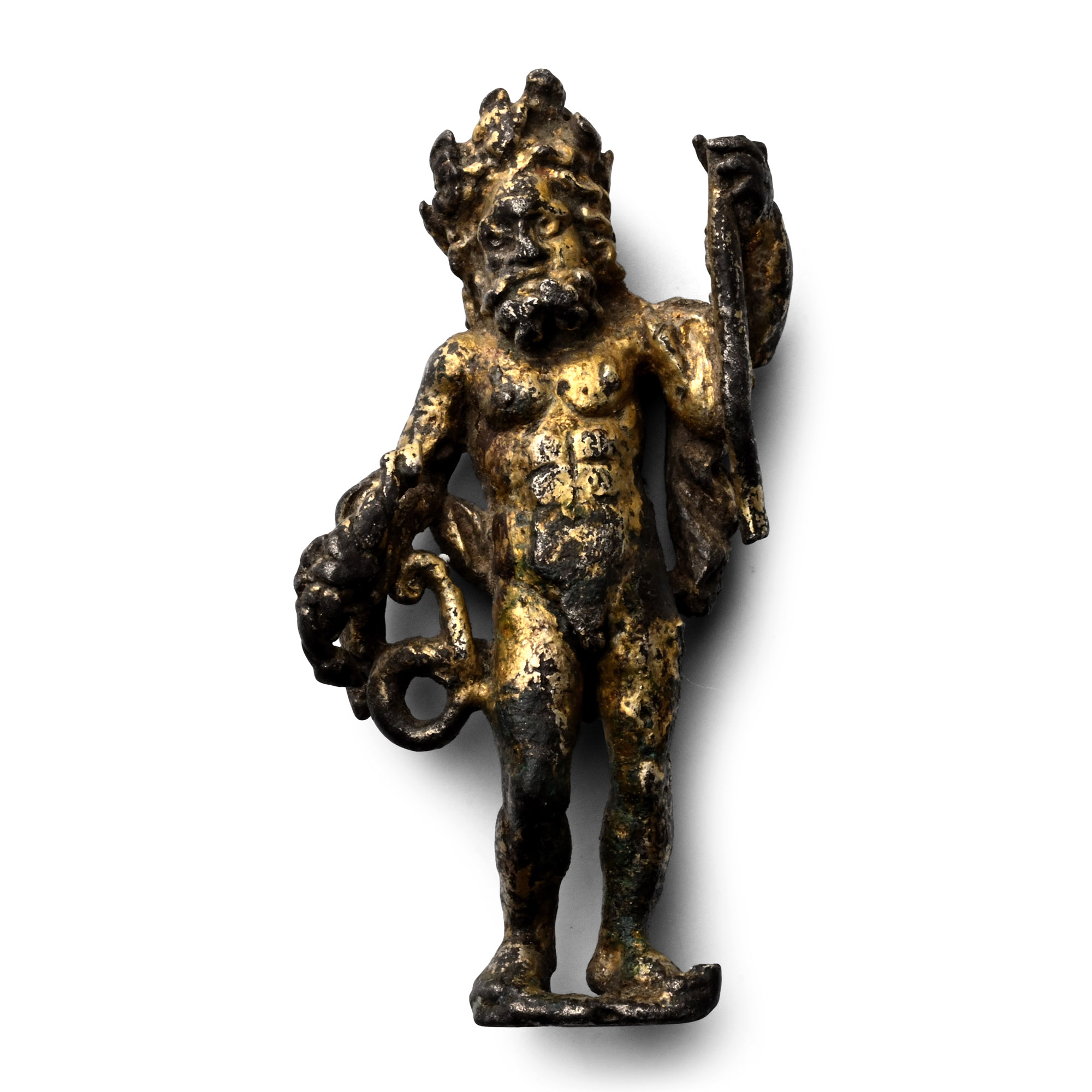
Roman Silver-Gilt Statuette of Jupiter
1ST-2ND CENTURY A.D.
2 in. (20.63 grams, 51 mm).
Modelled standing nude with wreath to the luxuriant hair, full beard and in erect pose; staff in the left hand (part absent); thunderbolt in the right hand with looped tendril; hollow to the reverse with mounting peg.
ProvenanceAcquired in the late 1980s-early 1990s.
Private collection, London, UK.
This lot has been cleared against the Art Loss Register database, and is accompanied by an illustrated lot declaration signed by the Head of the Antiquities Department, Dr Raffaele D'Amato.
Cf. similar statuette in Boucher, S., Recherches sur les Bronzes Figurés de Gaule Pré-Romaine et Romaine, Rome, 1976, item 231.
CONDITIONTimeLine Auctions follows a vetting process to ensure the authenticity and legality of all items, reinforcing our commitment to integrity and responsible trading. Each antiquity, antique, and coin lot undergoes thorough examination by a vetting committee of at least ten external specialists, professional trade association members, scientists, and archaeologists: Our Vetting Process
AUCTIONS:
TimeLine is a leading auction house specialising in antiquities, ancient art, collectables, natural history, coins, medals, and books. Our auctions offer museums, collectors, historians, and enthusiasts the opportunity to acquire unique and historically significant pieces.
-
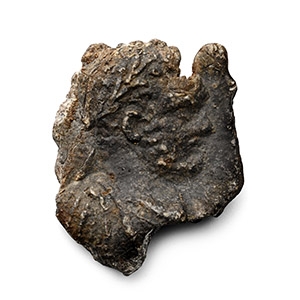
Roman Lead Tag with Bust of Caracalla
Early 3rd century A.D.Sold for (Inc. bp): £117
Irregular seal with low-relief profile bust to obverse, impressed textile pattern to reverse. 5.25 grams, 24 mm
From the collection of a gentleman, acquired on the London art market in the 1990s. This lot is accompanied by an illustrated lot declaration signed by the Head of the Antiquities Department, Dr Raffaele D'Amato. -
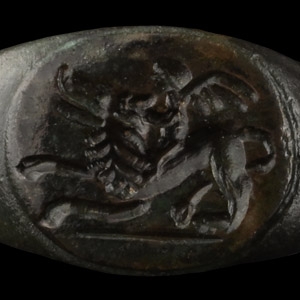
Roman Bronze Ring with Cupid Riding a Lion
2nd-3rd century A.D.Sold for (Inc. bp): £195
Incuse ribbing to the shoulders, ellipsoid plaque with incuse crouching lion and winged putto or Cupid above. 5.55 grams, 20.18 mm overall, 16.51 mm internal diameter (approximate size British G, USA 3 1/4, Europe 4.92, Japan 4)
Ex German art market, 2000s. Acquired from an EU collector living in London. From the collection of a Surrey, UK, gentleman. This lot is accompanied by an illustrated lot declaration signed by the Head of the Antiquities Department, Dr Raffaele D'Amato. -
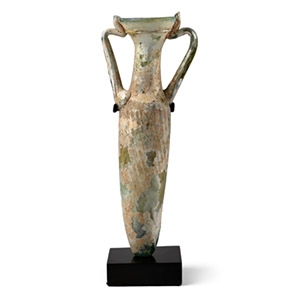
Roman Fine Glass Amphora
1st-3rd century A.D.Sold for (Inc. bp): £1,170
Aqua glass with sloping rounded shoulder, tubular body tapering to a rounded base, cylindrical neck and everted rim, applied scrolling handles; iridescent surfaces; mounted on a custom-made stand. 250 grams total, 22.3 cm including stand
Ex Mayfair, London, UK, gallery, 1990s-2000s. From an important collection of glass, the property of a London gentleman. This lot is accompanied by an illustrated lot declaration signed by the Head of the Antiquities Department, Dr Raffaele D'Amato.
