
Loading, please wait...
LOT 0547
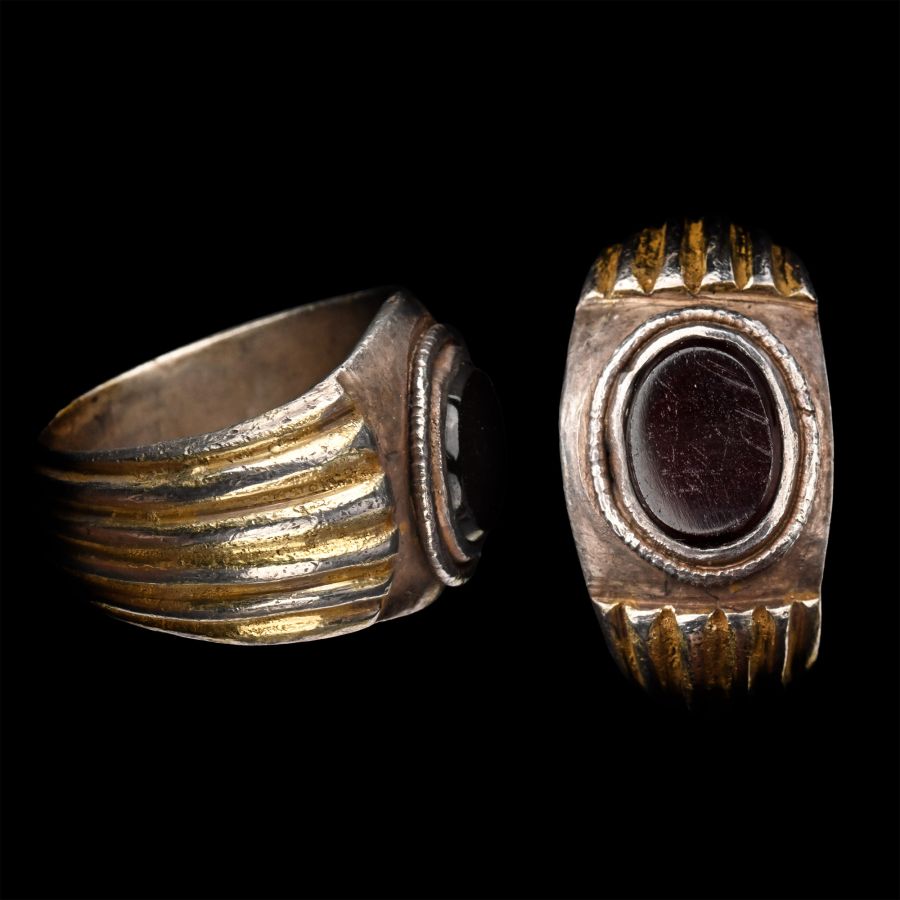
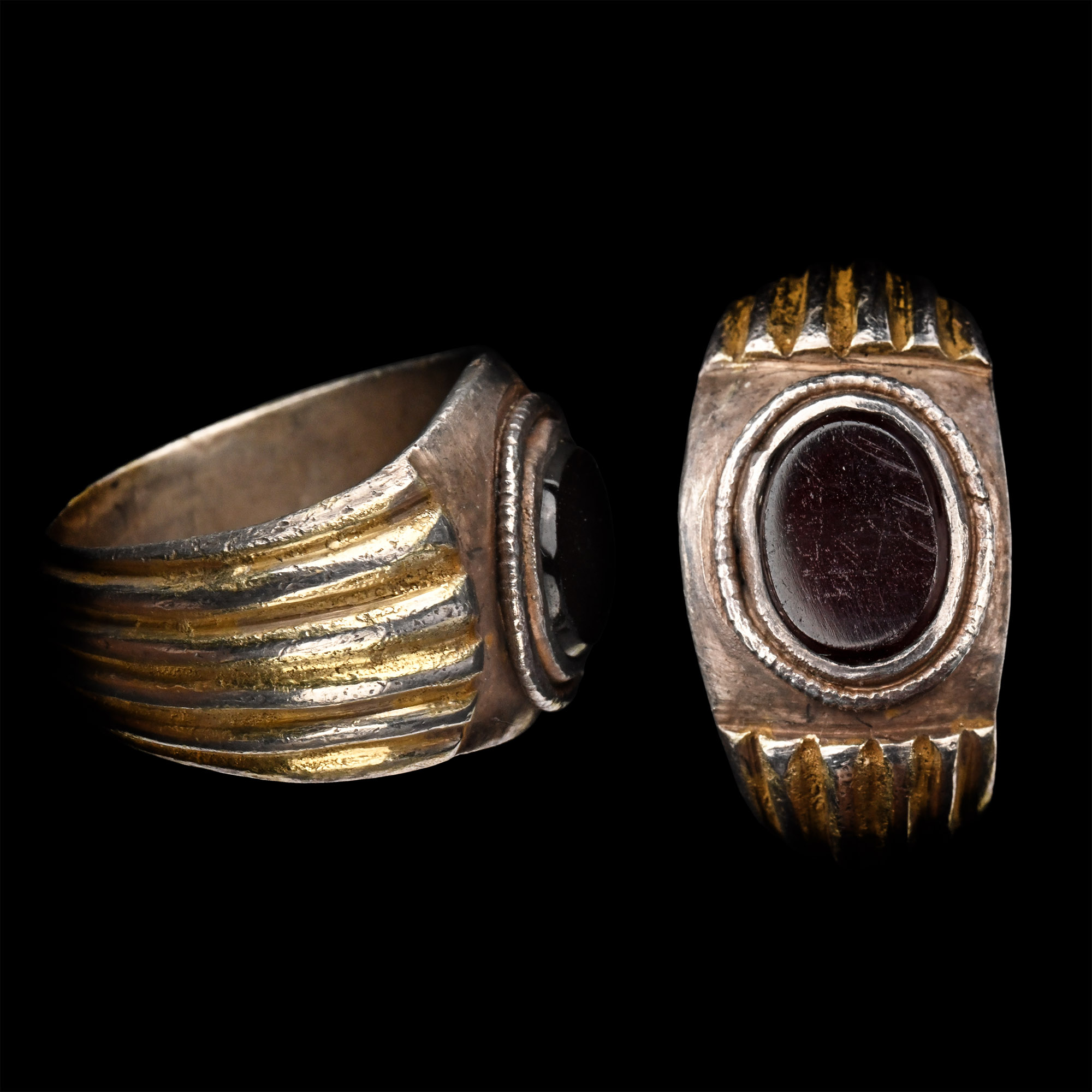
Roman Silver-Gilt Ring with Gemstone
2ND-3RD CENTURY A.D. OR LATER
1 in. (15.33 grams, 27.34 mm overall, 20.41 x 16.53 mm internal diameter (approximate size British N 1/2, USA 6 3/4, Europe 14.35, Japan 13)).
With a ribbed hoop, rectangular bezel with central cell and beaded wire collar, inset with later garnet cloison.
ProvenanceFrom the collection of a European gentleman living in South London; acquired 1970-1980.
Private collection, Suffolk, UK.
Cf. Chadour, A.B., Rings. The Alice and Louis Koch Collection, volume I, Leeds, 1994, item 353.
CONDITIONTimeLine Auctions follows a vetting process to ensure the authenticity and legality of all items, reinforcing our commitment to integrity and responsible trading. Each antiquity, antique, and coin lot undergoes thorough examination by a vetting committee of at least ten external specialists, professional trade association members, scientists, and archaeologists: Our Vetting Process
AUCTIONS:
TimeLine is a leading auction house specialising in antiquities, ancient art, collectables, natural history, coins, medals, and books. Our auctions offer museums, collectors, historians, and enthusiasts the opportunity to acquire unique and historically significant pieces.
-
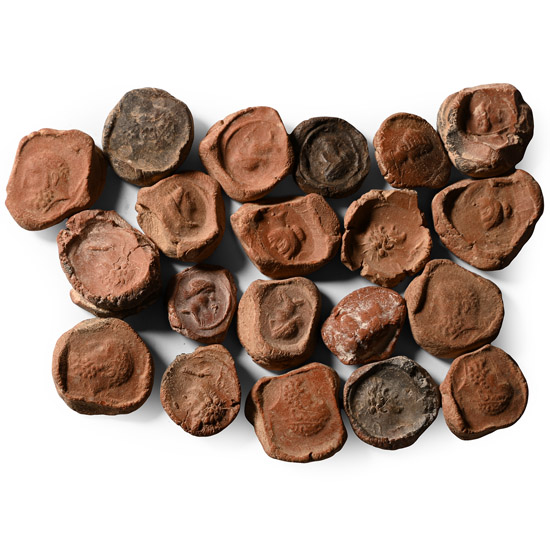
Roman Terracotta Bullae, Tesserae or Token Group
3rd century B.C.-1st century A.D.Sold for (Inc. bp): £130
A mixed group of ceramic bullae, tesserae or theatre tokens bearing low-relief motifs, mainly consisting of profile busts of deities. 36.7 grams total, 16-22 mm
From the private collection of a European gentleman (1942-2024), formed since the 1970s.
The term 'tessera' was used in Roman times to convey the Greek term σύμβολον (token). Small tiles are known as tokens, often shaped like coins, made of metal (copper, lead, iron), clay, bone, wood, or glass, stamped as well as engraved. The tokens, however, are not exclusively coin-shaped, as the Latin term 'tessera' refers to a four-sided shape. Tokens and tesserae seem to have been used both in Athens and Rome for the distribution of goods. According to written sources, the term ‘token’ is identified with credentials of the official authorities. They have also been interpreted as tokens of identity, as entrance tickets to theatre performances, tribunals or assemblies of citizens, archival material of seal engraving, as pawns in games, Charon’s obols and even as amulets. -
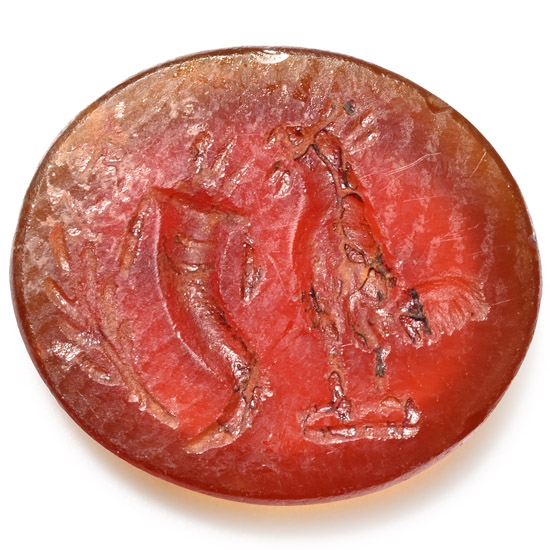
Roman Carnelian Gemstone with Cockerel and Cornucopia
2nd-3rd century A.D.Sold for (Inc. bp): £176
Oval translucent intaglio with a standing cockerel before a cornucopia and an olive sprig on the left. 0.40 grams, 11 mm
UK private collection before 2000. London collection, acquired on the UK art market. -
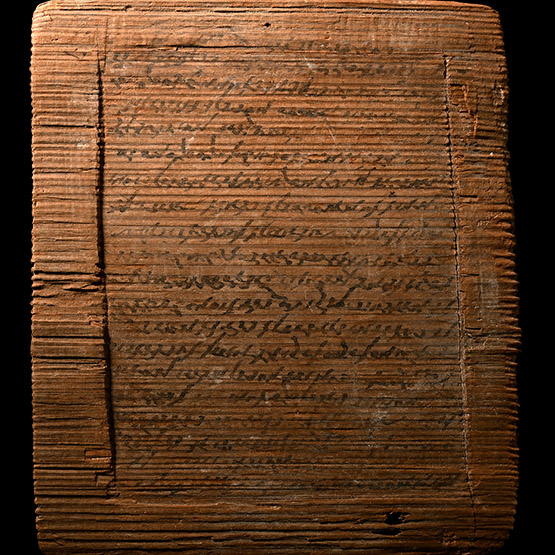
Roman Wooden Tablet with 'Pactum Dotis' Marriage Contract
First half of 4th century A.D.Sold for (Inc. bp): £4,160
Rectangular wooden tablet, probably cedarwood, the inner side with a recessed panel inscribed with 20 lines of inked text in Roman cursive script, two small holes, the bigger in the upper rim, the smaller in the centre of the lower rim; the flat outer side inscribed with 14 lines of inked text; in a good state of preservation with signs of age and parts of the text barely visible. 27 grams, 14 x 16.1 cm
Acquired by Albert Sfez in the early 1950s. Formerly the property of Monsieur Alain Sfez, a Belgian collector; acquired by gift from his father, Albert Sfez, in 1965. Acquired by a London dealer in 1973. From an important London collection since 1975; thence by descent. Accompanied by a copy of an illustrated academic report by Professor Dr phil. Peter Rothenhöfer.
Professor Dr Peter Rothenhöfer, Department of History (Zhuhai Campus) states: 'This important tablet shows that its use was apparently not restricted to the administrative sphere but widely spread in civic life and used for private purposes. As handwritten documents from the late 3rd and 4th century AD are quite rare, this tablet is generally of great importance for the history of Latin palaeography. The text is fluently written and shows a uniform typeface. Typical features of ancient writing can be observed: The text is continuously written without any separation between words (scriptio continua), sentences have no dots at the end.' Wax tablets written in Greek or Latin, were used by Romans as account registers (codices accepti et expensi); for transactions (for example, the tablets of the banker Lucius Caecilius Iucundus found in Pompeii); for lists of goods, inventories, and notes to be kept and archived; for Roman magistrates to annotate the salient events of their bureaucratic activities; for writing letters; for drawing up legal texts of various kinds: legacies, declarations of births and citizenship, reports of trials and diplomata militaria.
