
Loading, please wait...
LOT 0643
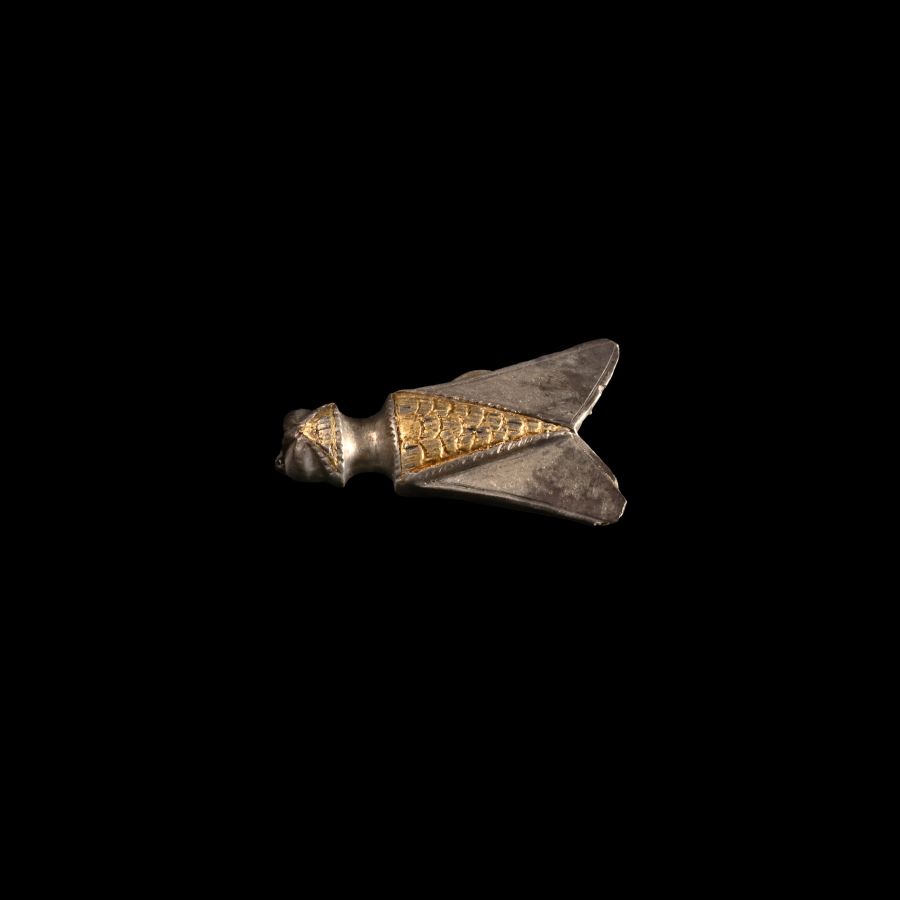
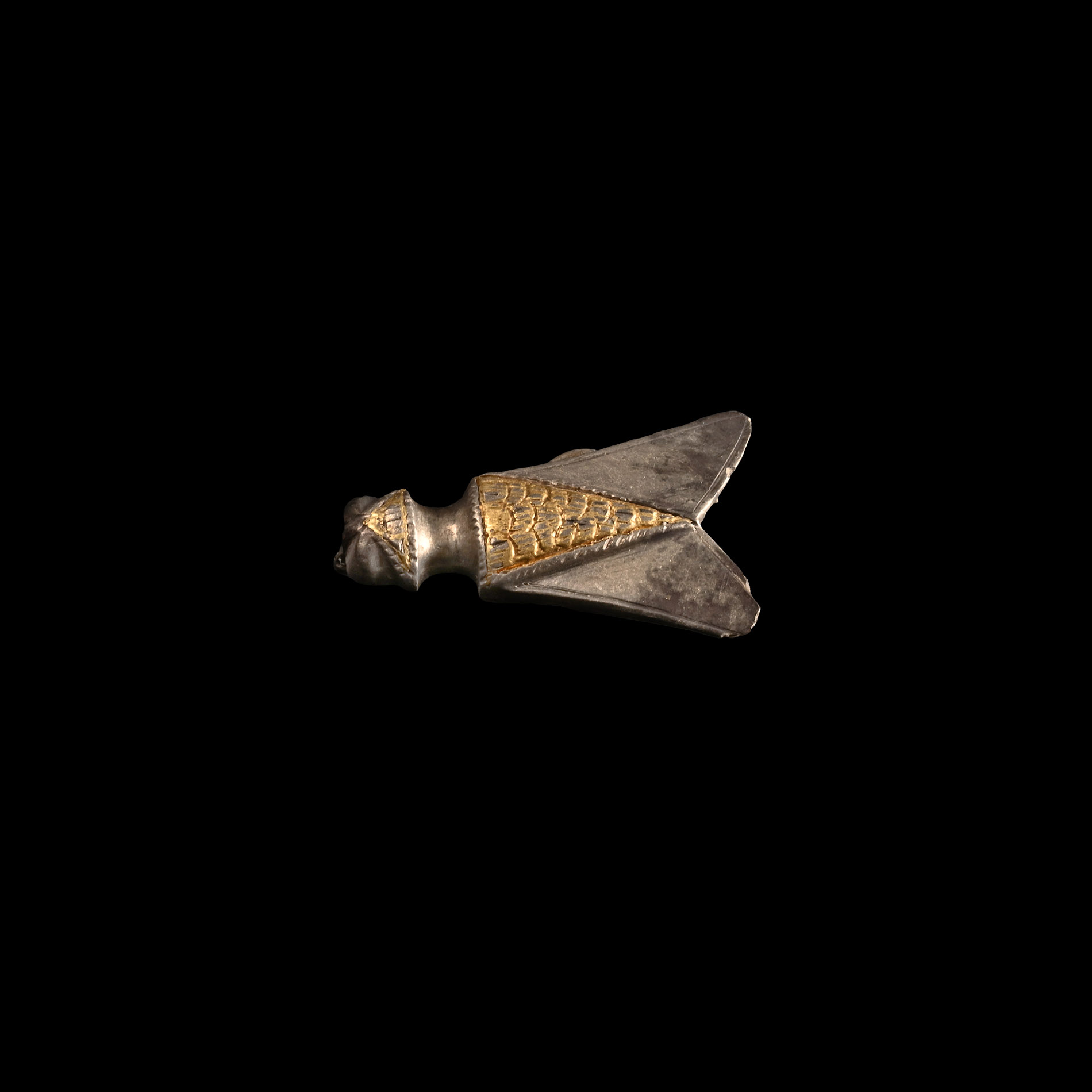
Roman Silver-Gilt Cicada Brooch
4TH-5TH CENTURY A.D.
7/8 in. (3.82 grams, 23 mm).
A silver-gilt brooch in form of cicada with hollow-formed D-section head and neck, flat triangular wings; the head with bulbous eyes above a waisted neck; granule detailing to the head; pin-lug and catch-wire to the reverse.
ProvenanceAcquire in the 1990s.
Ex Cambridgeshire, UK, collection.
Cf. Bona, I., Les Huns, Le Grand empire barbare d'Europe,IV-V siècles, Paris, 2002, figs.178-179, for similar examples.
FootnotesThis type of brooch was popular among the Hunnic tribes, as well as in Roman Pannonia and Illyricum before the arrival of the Huns. Early Hunnic designs from Pannonia may have borrowed from late Roman types. With the arrival of new populations due to migration from the east,
a new material culture developed, described as the Danubian or Ponto-Danubian style, as many of its features appear in the Pontic region as
well. Although the exact meaning of the cicada brooch is not known to us, it is possible that it retained its ancient symbolism of rebirth or regeneration of the soul.
TimeLine Auctions follows a vetting process to ensure the authenticity and legality of all items, reinforcing our commitment to integrity and responsible trading. Each antiquity, antique, and coin lot undergoes thorough examination by a vetting committee of at least ten external specialists, professional trade association members, scientists, and archaeologists: Our Vetting Process
AUCTIONS:
TimeLine is a leading auction house specialising in antiquities, ancient art, collectables, natural history, coins, medals, and books. Our auctions offer museums, collectors, historians, and enthusiasts the opportunity to acquire unique and historically significant pieces.
-
.jpg)
Roman Terracotta Bust of a Boy
1st-century B.C.-1st century A.D.Sold for (Inc. bp): £351
A terracotta bust of a boy mounted on an integral channeled plinth base, modelled with semi-naturalistic facial features and a cropped hairstyle, wearing a bulla and a sash over the left shoulder. 341 grams, 17 cm high
Ex private German collection, 1960; thence by descent. with Auktionshaus Owl, Bielefeld, Germany, 5 September 2015, Lot 40605.
In ancient Rome, the bulla was an amulet given to every boy nine days after his birth. The meaning, origins and use of the bulla are in some ways enigmatic and still a subject of research for scholars. The bulla was worn around the neck during childhood and adolescence. Depending on the social status and wealth of the family who commissioned it, different materials were used; on rare occasions it was made fully in gold, if the child belonged to a family of the high Roman aristocracy, or more commonly made in lead covered with a gold foil. The bulla was also made for the poorer classes in lesser materials, such as fabric or leather. -
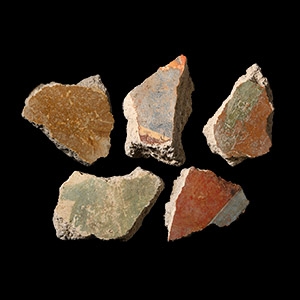
Roman Fresco Painted Wall Plaster Collection
1st century A.D.Sold for (Inc. bp): £104
A mixed group of coarse white wall plaster fragments from a fresco, with painted designs in white, ochre, claret, crimson and blue. 600 grams total, 73-89 mm
Fair condition.
Acquired in the 19th century. Jeger collection, Switzerland. Property of an English gentleman. -
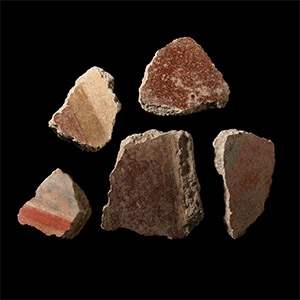
Roman Fresco Painted Wall Plaster Collection
1st century A.D.Sold for (Inc. bp): £98
A mixed group of coarse white wall plaster fragments from a fresco, with painted designs in white, ochre, claret, crimson and blue. 10 kg total, 7.4-12 cm
Fair condition.
Acquired in the 19th century. Jeger collection, Switzerland. Property of an English gentleman.
