
Loading, please wait...
LOT 0774
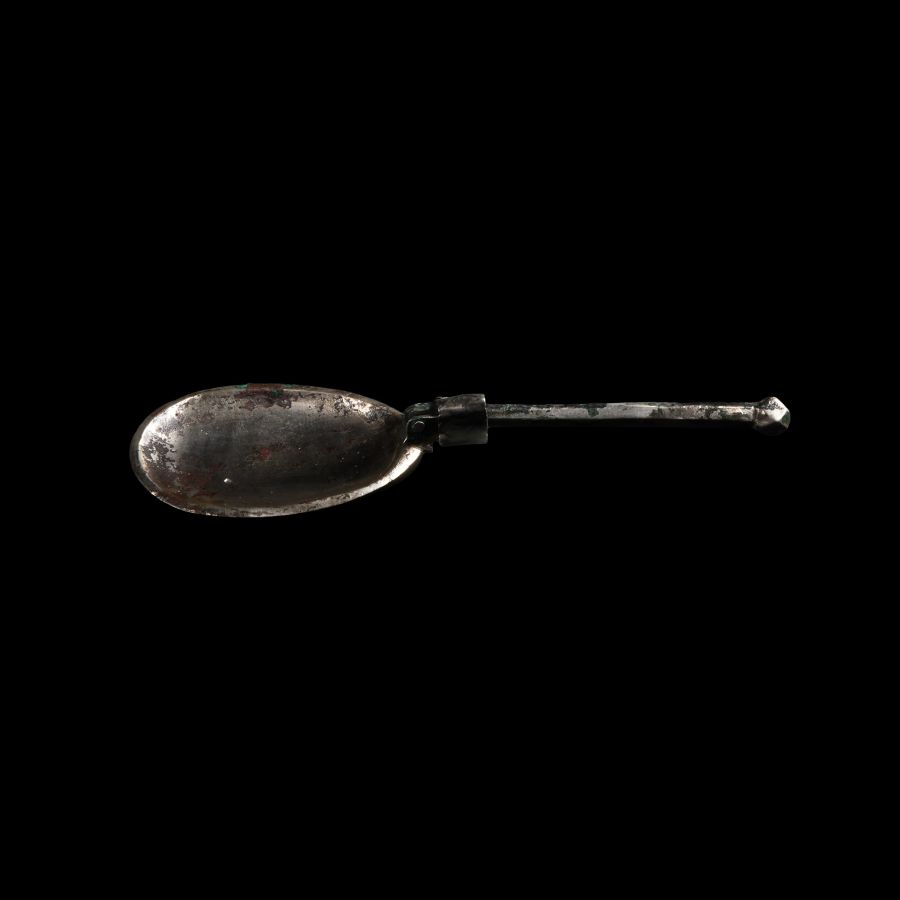
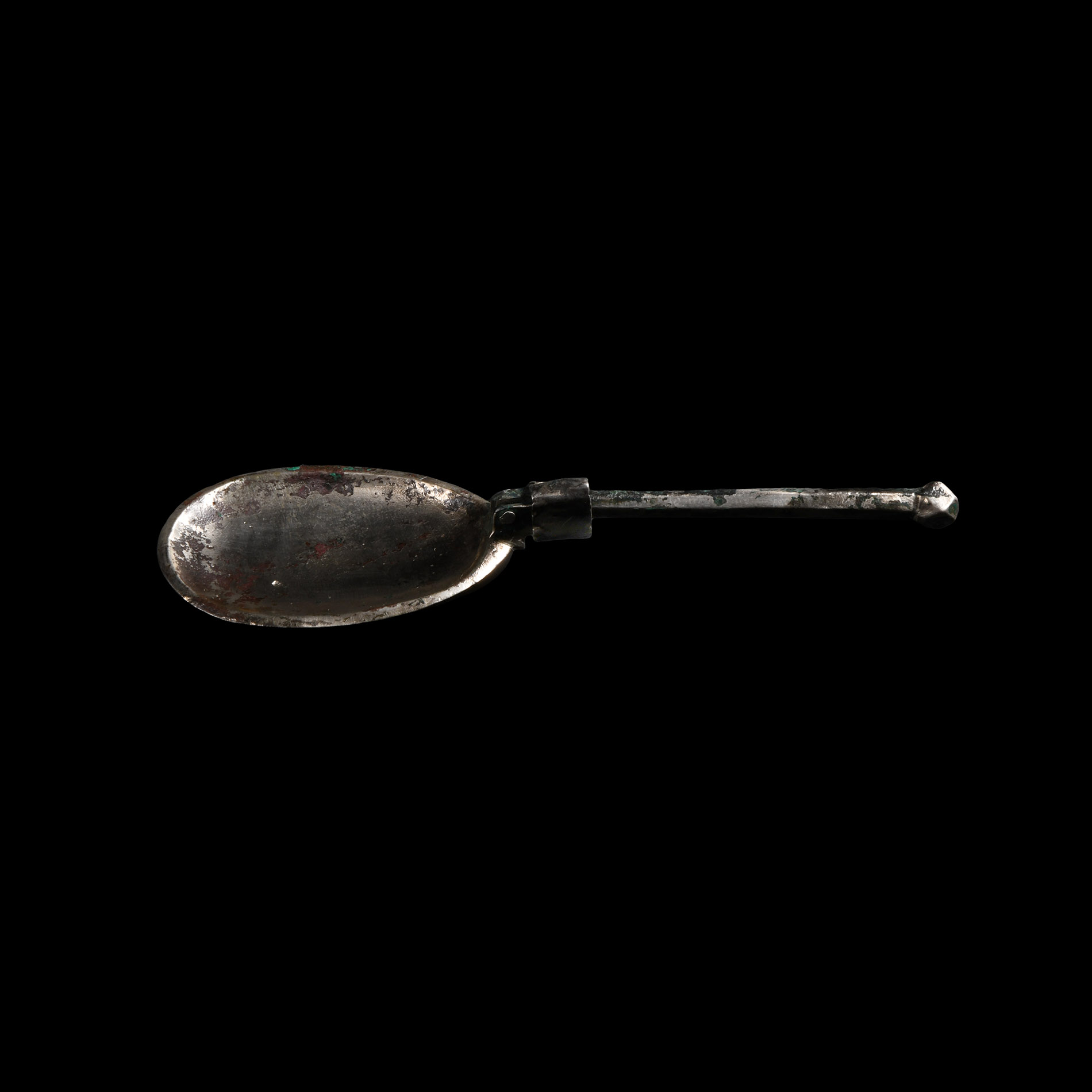
Roman Silver Folding 'Travel' Spoon
CIRCA 4TH CENTURY A.D.
4 3/8 in. (28 grams, 11.2 cm long).
A short silver spoon with shallow piriform bowl, raised neck with movable pinned hinge attached to the hexagonal-section handle and shortened polyhedral knob finial, allowing the handle to be folded into the bowl. [No Reserve]
ProvenanceEarly 1990s London collection.
Acquired on the UK art market.
From a private collection, Lancashire, UK.
Cf. Shelton, K.J., The Esquiline Treasure, London, 1981, item 27, for type.
FootnotesAs today, the spoon was used as a measure for dosage in ancient times. Both the cochlear and the ligula could have been used to measure different quantities, particularly in the practice of medicine and in the kitchen. Isidore (Origines, XVI, 26.3) tells us that the cochlear was the smallest unit size and was worth half a drachma.
CONDITIONTimeLine Auctions follows a vetting process to ensure the authenticity and legality of all items, reinforcing our commitment to integrity and responsible trading. Each antiquity, antique, and coin lot undergoes thorough examination by a vetting committee of at least ten external specialists, professional trade association members, scientists, and archaeologists: Our Vetting Process
AUCTIONS:
TimeLine is a leading auction house specialising in antiquities, ancient art, collectables, natural history, coins, medals, and books. Our auctions offer museums, collectors, historians, and enthusiasts the opportunity to acquire unique and historically significant pieces.
-
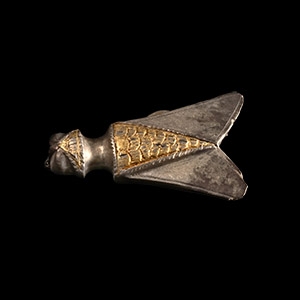
Roman Silver-Gilt Cicada Brooch
4th-5th century A.D.Sold for (Inc. bp): £494
A silver-gilt brooch in form of cicada with hollow-formed D-section head and neck, flat triangular wings; the head with bulbous eyes above a waisted neck; granule detailing to the head; pin-lug and catch-wire to the reverse. 3.82 grams, 23 mm
Acquire in the 1990s. Ex Cambridgeshire, UK, collection.
This type of brooch was popular among the Hunnic tribes, as well as in Roman Pannonia and Illyricum before the arrival of the Huns. Early Hunnic designs from Pannonia may have borrowed from late Roman types. With the arrival of new populations due to migration from the east, a new material culture developed, described as the Danubian or Ponto-Danubian style, as many of its features appear in the Pontic region as well. Although the exact meaning of the cicada brooch is not known to us, it is possible that it retained its ancient symbolism of rebirth or regeneration of the soul. -
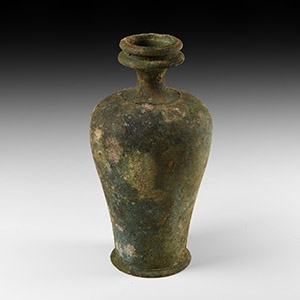
Roman Balsamarium with Spool-Type Mouth
1st-2nd century A.D.Sold for (Inc. bp): £845
A piriform bronze balsamarium with a broad rounded shoulder, slender waisted neck and squat, spool-type mouth. 207 grams, 12 cm high
From the collection of the late Dr D.G., Surrey, UK.
Such vessels, with their high-bellied body, are similar to examples from Palestine, Pompeii, Phocis, Brigetio and Salona. They are not fitted with handles, meaning that they were not part of a portable set. -
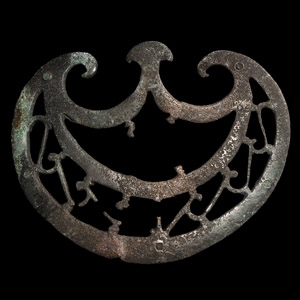
Roman Military Baldric Fitting
3rd century A.D.Sold for (Inc. bp): £72
A copper-alloy military baldric phalera of crescentic form, with scrolled terminals and openwork centre; remains of mounting lugs to reverse. 25.2 grams, 75 mm
Acquired before 2000. From the collection of a European gentleman living in the UK.
