
Loading, please wait...
_900x900.jpg "Roman Silver Dionysus Pendant")
_200x200.jpg "Roman Silver Dionysus Pendant")
.jpg "Roman Silver Dionysus Pendant")
LOT 0680
Roman Silver Dionysus Pendant
1ST-3RD CENTURY A.D.
1 in. (6.2 grams, 23 mm).
Ellipsoid pendant, hollow to the reverse with high-relief mask of Dionysus flanked by vine leaves and bunches of grapes. [No Reserve]
ProvenanceFrom the glyptic collection of Mr X; thence by descent.
Acquired Hotel des Ventes, Drouot, Eve SVV, Paris, France, 28 June 2017, no.147 (Part).
Property of a French collector.
Cf. similar motif on an iscillium in the British Museum under accession no.1873,0820.562.
CONDITIONTimeLine Auctions follows a vetting process to ensure the authenticity and legality of all items, reinforcing our commitment to integrity and responsible trading. Each antiquity, antique, and coin lot undergoes thorough examination by a vetting committee of at least ten external specialists, professional trade association members, scientists, and archaeologists: Our Vetting Process
AUCTIONS:
TimeLine is a leading auction house specialising in antiquities, ancient art, collectables, natural history, coins, medals, and books. Our auctions offer museums, collectors, historians, and enthusiasts the opportunity to acquire unique and historically significant pieces.
-
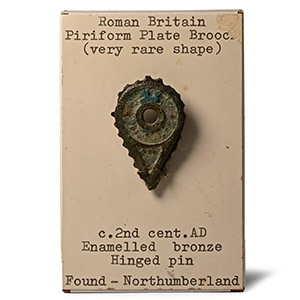
Romano-British 'Hattatt' Enamelled Bronze Plate Brooch
Circa 2nd century A.D.Sold for (Inc. bp): £33
Piriform type with open roundel to centre, scalloped edge, traces of blue enamel to plaque; mounted on old Hattatt's collector's stand with typed details 'Roman Britain Piriform Plate Brooc[h] / (very rare shape) / c. 2nd cent. AD / Enamelled bronze / Hinged pin / Found Northumberland' and to reverse 'M.R. Hull's corpus records only one other (with part missing) pl.781, no.2173' and handwritten note below 'Published Hattatt 1985-No.592'. 50 grams total, 85 mm (Brooch: 35 mm)
Found Northumberland. Acquired from Bonhams, London, 29 April 2009, lot 296 (part). From a family collection of a North American gentleman living in the UK. -
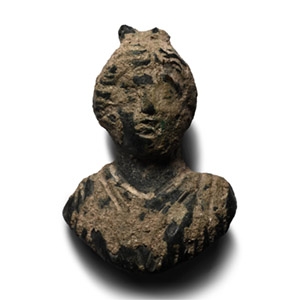
Roman Bronze Bust of a Woman
2nd-3rd century A.D.Estimate: £200 - 300 (‡+bp*)
Opening Bid: £100
Modelled in the round with stephane to the hair, peplos dress with undertunic; mounting lug to reverse. 140 grams, 60 mm
Acquired in the mid 1980s-1990s. Private collection, Switzerland, thence by descent. Private collection, since the late 1990s. -
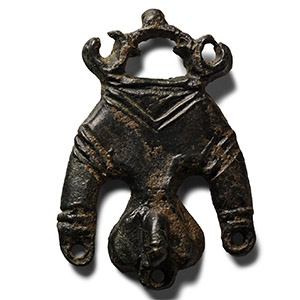
Roman Bronze Elaborate Triple Phallic Horse Harness Pendant
1st-2nd century A.D.Sold for (Inc. bp): £169
Amuletic fascinum formed as a crescent with looped phallus to each side and male genitals to the centre; D-shaped loop above with two smaller side loops. 26.9 grams, 53 mm
Ex German art market, 2000s. Acquired from an EU collector living in London. From the collection of Surrey, UK, gentleman.
