
Loading, please wait...


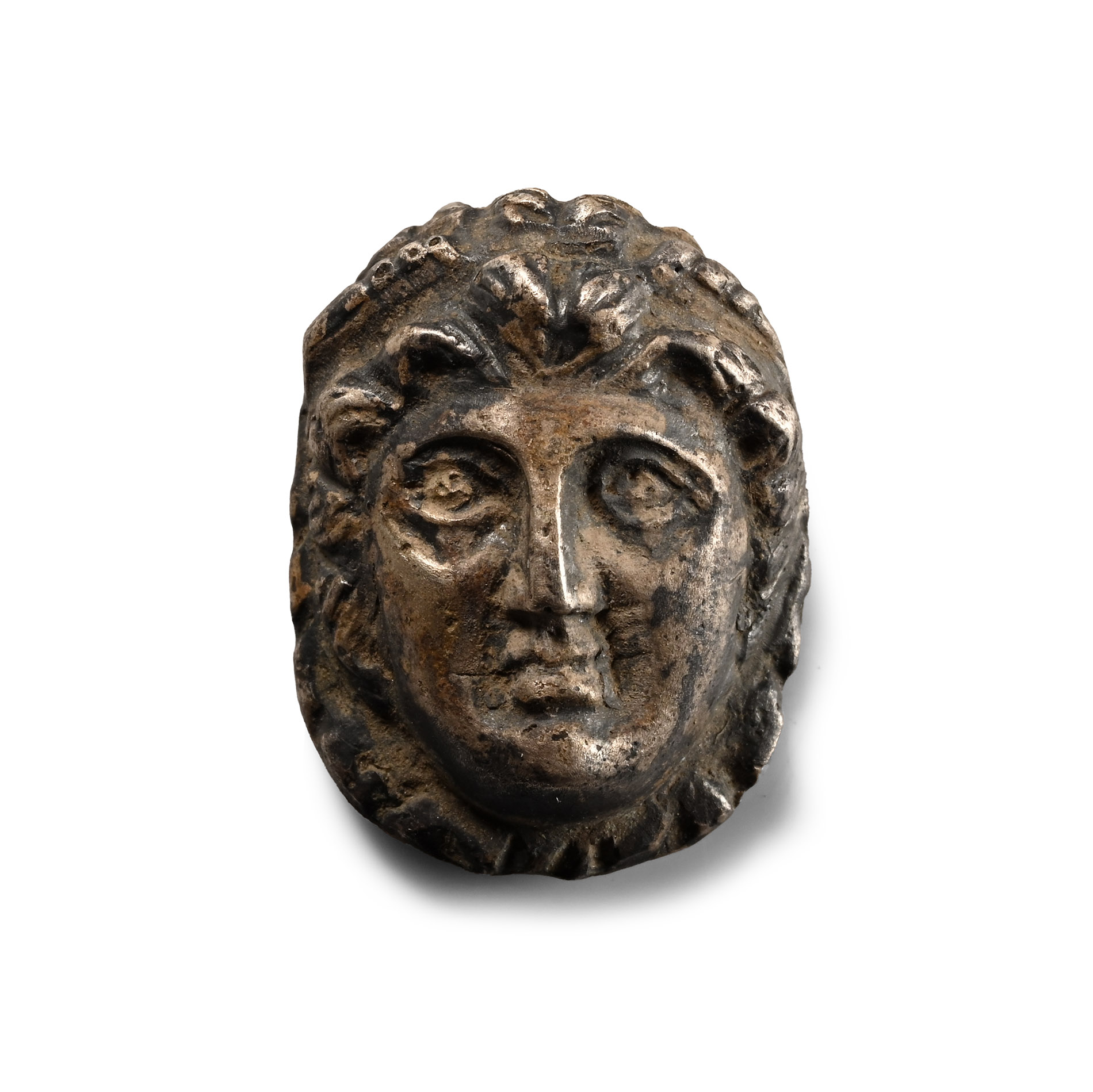
LOT 0613
Roman Silver Applique Mask
2ND-4TH CENTURY A.D.
7/8 in. (3.77 grams, 22 mm).
Appliqué with repoussé detailing, mask of Alexander the Great or Dionysus with diadem to his brow.
ProvenanceAcquired on the London art market in the late 1980s-1990s.
From the family collection of an East London, UK, gentleman.
This lot is accompanied by an illustrated lot declaration signed by the Head of the Antiquities Department, Dr Raffaele D’Amato.
Cf. Rolland, H., Bronzes Antiques de Haute Provence, Paris, 1965, item 331, for similar applique in bronze (Dionysus), of same size.
FootnotesSimilar applications in bronze or silver (sometimes even in gold) decorated the triclinia of rich aristocrats, or the precious furnishings in fine wood of the furniture of the Villas.
CONDITIONTimeLine Auctions follows a vetting process to ensure the authenticity and legality of all items, reinforcing our commitment to integrity and responsible trading. Each antiquity, antique, and coin lot undergoes thorough examination by a vetting committee of at least ten external specialists, professional trade association members, scientists, and archaeologists: Our Vetting Process
AUCTIONS:
TimeLine is a leading auction house specialising in antiquities, ancient art, collectables, natural history, coins, medals, and books. Our auctions offer museums, collectors, historians, and enthusiasts the opportunity to acquire unique and historically significant pieces.
-
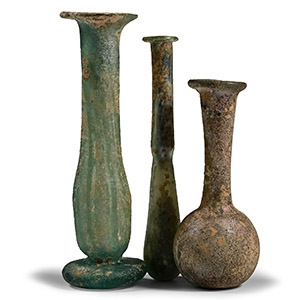
Roman Glass Vessel Group
1st century A.D.Sold for (Inc. bp): £260
Comprising three unguentaria, one with an applied disc foot. 110 grams total, 9.3-12.3 cm
Acquired from Ancient & Oriental, 1980s-1990s. Ian Wilkinson collection, Nottinghamshire, UK, formed since 1985. This lot is accompanied by an illustrated lot declaration signed by the Head of the Antiquities Department, Dr Raffaele D’Amato.
Unguentaria or lacrimatoria (tear-bottles) are among the most common items of Roman blown glass found in the graves. They were cheap and quick to produce, used for perfumes, cosmetics and other gifts offered to the dead. -

Roman Bronze Mirror with Handle
1st century B.C.-1st century A.D.Sold for (Inc. bp): £520
Slightly dished tondo with raised rim, arched handle attached by means of two holes and eyelets; decorated with a series of concentric rings. 128 grams, 12.1 cm
Ex Herbert A. Cahn, Basel, 1990s. Accompanied by a copy of an Art Loss Register certificate no.S00114086,S00034843. This lot is accompanied by an illustrated lot declaration signed by the Head of the Antiquities Department, Dr Raffaele D’Amato.
Mirrors of this type were often composed of two discs hinged together so they could be shut to protect the reflective surfaces on the inside. -
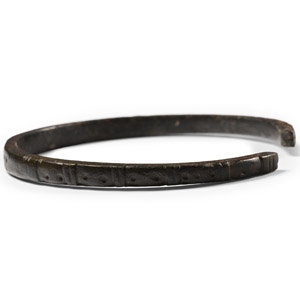
Roman Bronze Decorated Bracelet
1st-4th century A.D.Sold for (Inc. bp): £85
With a rectangular-section body divided into segments with transverse lines, punched pellets in between. 17 grams, 57.7 mm
Ex German art market, 2000s. Acquired from an EU collector living in London. From the collection of Surrey, UK, gentleman. This lot is accompanied by an illustrated lot declaration signed by the Head of the Antiquities Department, Dr Raffaele D’Amato.
