
Loading, please wait...
_900x900.jpg "Roman Severus Alexander Denarius Forger's Coin Die Pair and Crucible")
_200x200.jpg "Roman Severus Alexander Denarius Forger's Coin Die Pair and Crucible")
.jpg "Roman Severus Alexander Denarius Forger's Coin Die Pair and Crucible")
LOT 0130
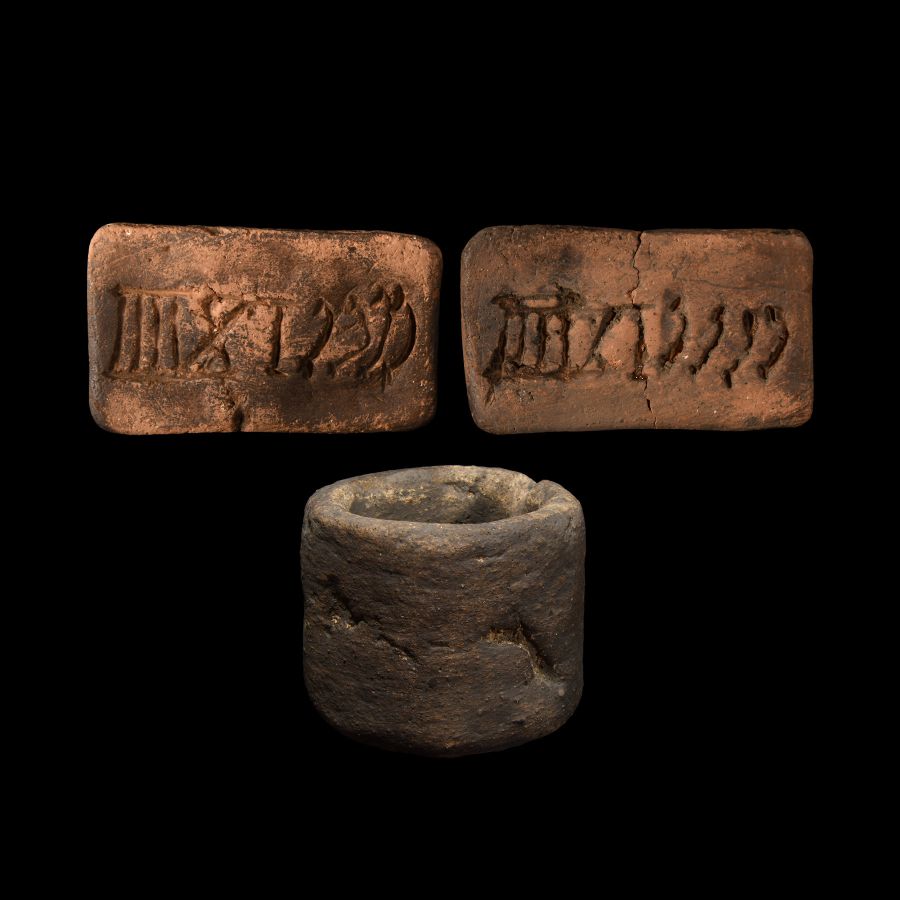
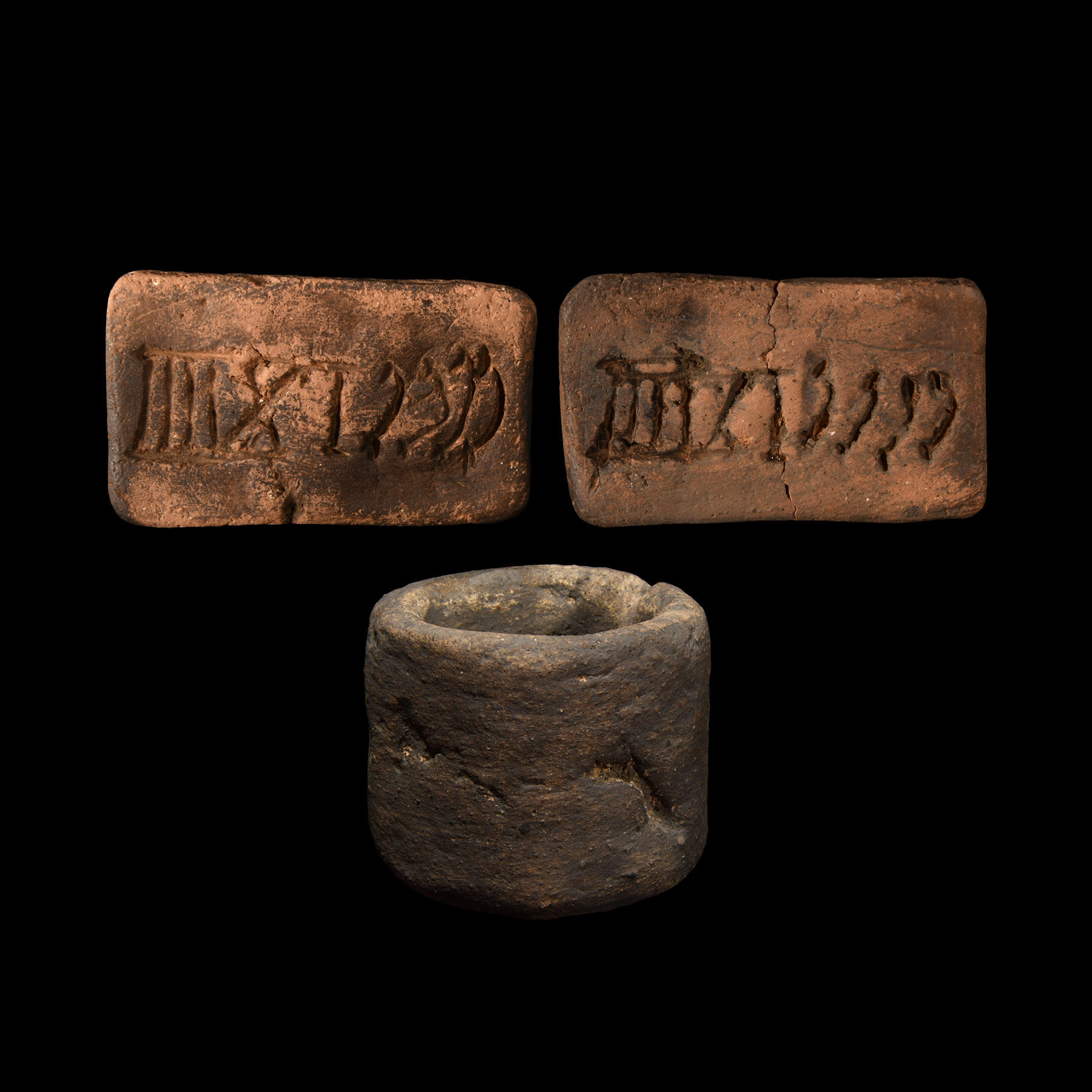
Roman Severus Alexander Denarius Forger's Coin Die Pair and Crucible
CIRCA 222-235 A.D.
1 3/4 - 2 1/4 in. (86.86 grams total, 44-58 mm).
A contemporary pair of clay coin dies used to manufacture coin forgeries, the working faces depicting a gold aureus or silver denarius of Emperor Severus Alexander, with incuse and reversed legends; each counterfeit die with inscribed numbering to verso [(((( LXIIII = 64]; accompanied by a clay crucible excavated at the same time with inked inscription to the underside: 'Arch.-Nr. / 6612-1975', another object that would have been required in the casting process of manufacturing of fake coins. [3]
ProvenanceIn a private collection of Roman objects since 1975.
Accompanied by a copy of a letter and schedule addressed to the Director of the Library Faculty of Kamp-Linfurt, a branch of Stadsparkasse Duisburg regarding the loan of the forger's die and crucible for exhibition, dated 13 December 1993.
Exhibited in 'Monetary History of 2600 Years, Monetary Values Yesterday and Today', Library Faculty of Kamp-Linfurt, Stadsparkasse Duisburg, January 1994.
LiteratureCf. Poey d’Avant F., ‘Roman Coin Moulds’, in The Numismatic Chronicle (1838-1842), June, 1838 – April, 1839, Vol. 1 (June, 1838–April, 1839), pp.147-165, fig.1, p.165, for similar; Hall, J., Goodburn Brown, D., ‘Faking it – the evidence for counterfeiting coins in Roman London’ in The London Archaelogist, summer 2015, pp.123-127, fig.3-4-5.
FootnotesTowards the end of the 2nd century and the early 3rd century A.D. the quality of Roman coinage began to be altered. Probably from the beginning of the reign of Severus Alexander, forgers were tacitly allowed by the Roman government to issue counterfeit coins. There are many ancient coins of this emperor that appear to have been cast in moulds. Most of these moulds would have been employed by forgers, and the dies were normally destroyed quickly after use in an effort to dispose of the evidence.
CONDITIONTimeLine Auctions follows a vetting process to ensure the authenticity and legality of all items, reinforcing our commitment to integrity and responsible trading. Each antiquity, antique, and coin lot undergoes thorough examination by a vetting committee of at least ten external specialists, professional trade association members, scientists, and archaeologists: Our Vetting Process
AUCTIONS:
TimeLine is a leading auction house specialising in antiquities, ancient art, collectables, natural history, coins, medals, and books. Our auctions offer museums, collectors, historians, and enthusiasts the opportunity to acquire unique and historically significant pieces.
LOT 0130
Roman Severus Alexander Denarius Forger's Coin Die Pair and Crucible
Sold for (Inc. bp): £1,300
-
Roman Bronze Lanceolate Nail Cleaner
Circa 2nd-3rd century A.D.Sold for (Inc. bp): £33
Of pendant type with ribbed loop, flat-section neck with chamfered sides, piriform plate extending to split finial; central vertical panel of engraved Late Roman military style zig-zag ornament. 3.23 grams, 49 mm
Acquired late 1980s-early 1990s. Ex private collection, Nottinghamshire, UK. Acquired on the UK art market in 2012. Property of a Kent lady collector. -
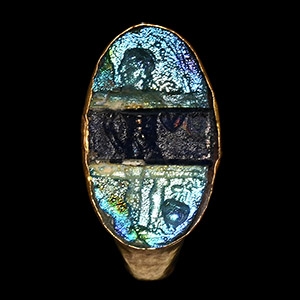
Roman Gold Ring with Banded Glass
1st century B.C.Sold for (Inc. bp): £910
Hollow-formed with ellipsoid bezel, inset panel of banded iridescent glass bearing an image of a nude Greek hero with long hair, the head turned back, carrying branches, an amphora or jug at his feet. 1.18 grams, 18.29 mm overall, 15.66 mm internal diameter (approximate size British G, USA 3 1/4, Europe 4.92, Japan 4)
Acquired early 1990s. Ex private American collection; thence by descent. Private Swiss collection since 1998.
The inset glass bezel is probably archaic Greek or Etruscan and reused in Roman times. The traits of the man point to Archaic Hellenic features, especially the oval eyes and the long hair, and the pointed beard reminiscence of the Achaean heroes. -
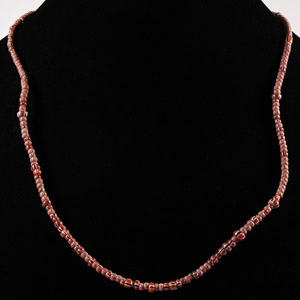
Roman Glass Bead Necklace
1st century A.D. or laterSold for (Inc. bp): £59
Restrung with a modern screw clasp; composed mainly of opaque glass beads of squat, spherical form, displaying a frieze of polychrome vertical stripes. 13.7 grams, 60 cm long
UK gallery, early 2000s.
