
Loading, please wait...
_900x900.jpg "Roman Sard Gemstone with a Maenad Mask")
_200x200.jpg "Roman Sard Gemstone with a Maenad Mask")
.jpg "Roman Sard Gemstone with a Maenad Mask")
LOT 0652
Roman Sard Gemstone with a Maenad Mask
1ST CENTURY B.C.-1ST CENTURY A.D.
3/8 in. (0.49 grams, 11 mm).
With intaglio profile bust of a woman facing left; supplied with a museum-quality impression.
ProvenancePrivate English collection, formed between the late 1970s and early 1990s.
Private collection, London, UK.
TimeLine Auctions follows a vetting process to ensure the authenticity and legality of all items, reinforcing our commitment to integrity and responsible trading. Each antiquity, antique, and coin lot undergoes thorough examination by a vetting committee of at least ten external specialists, professional trade association members, scientists, and archaeologists: Our Vetting Process
AUCTIONS:
TimeLine is a leading auction house specialising in antiquities, ancient art, collectables, natural history, coins, medals, and books. Our auctions offer museums, collectors, historians, and enthusiasts the opportunity to acquire unique and historically significant pieces.
-
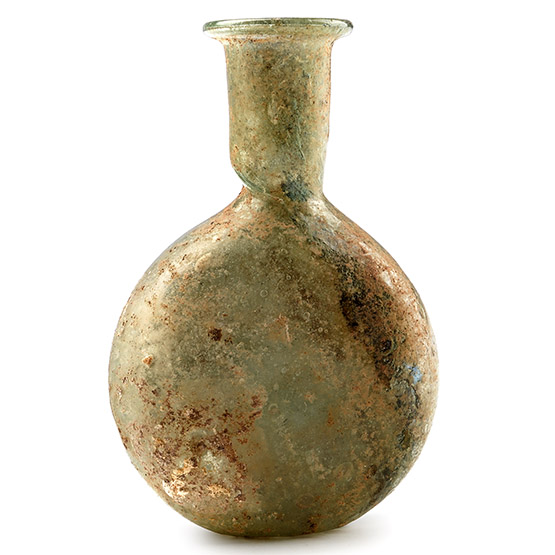
Roman Glass Flat Flask
Circa 1st-4th century A.D.Sold for (Inc. bp): £143
With discoid body, pinched tubular neck with everted rolled rim, iridescent surface. 22.25 grams, 96 mm
From a London, UK, collection of glass, 1970-2000s. -
.jpg)
Late Roman Silver Ring with Nicolo Gemstone with Facing Busts and Chi Rho
4th-6th century A.D. or laterSold for (Inc. bp): £1,690
Broad hoop and shoulder with stepped bezel, inset nicolo with incuse image of two profile busts flanking a frond surmounted by a Christogram; supplied with a museum-quality impression. 12.79 grams, 25.74 mm overall, 17.61 x 14.24 mm internal diameter (approximate size British I 1/2, USA 4 1/2, Europe 8.07, Japan 7)
Private collection, England. -
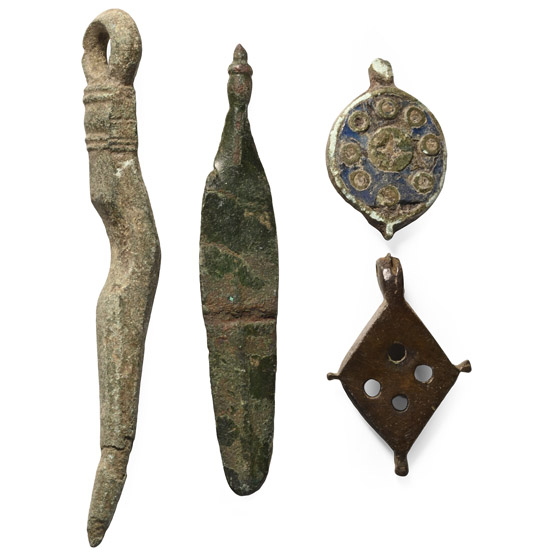
Roman Bronze Artefact Collection
1st-4th century A.D.Sold for (Inc. bp): £59
Including two seal box lids and other items. 30.69 grams total, 27-79 mm
Found Norfolk, UK.
